70k a Year Is How Much an Hour? The Complete Salary-to-Hourly Breakdown
You just received a job offer with a $70,000 annual salary. Or maybe you are negotiating a raise and wondering how your current package translates to an actual hourly rate. Either way, the question is immediate and practical: 70k a year is how much an hour? The answer is simpler than most people expect, and understanding it changes how you evaluate every compensation offer, budget decision, and career move going forward.
This guide gives you the exact hourly, monthly, weekly, and per-paycheck breakdowns for a $70,000 annual salary — and compares it against every major salary range from $45,000 to $140,000 so you have complete context for where $70k actually sits in the compensation landscape.
Table of contents
- What Is 70k a Year in Hourly Pay?
- What Is the Monthly Income for a 70k Salary?
- What Is the Take-Home Pay for 70k Annually?
- How Much Is 70k Salary Per Paycheck?
- 55k a Year Is How Much an Hour vs 70k: The Career Progression Gap
- What Jobs Typically Pay 70k a Year?
- Best Way to Convert Annual Salary to Hourly Pay
- What Calculator Converts Yearly Income to Hourly Pay?
- Conclusion
What Is 70k a Year in Hourly Pay?
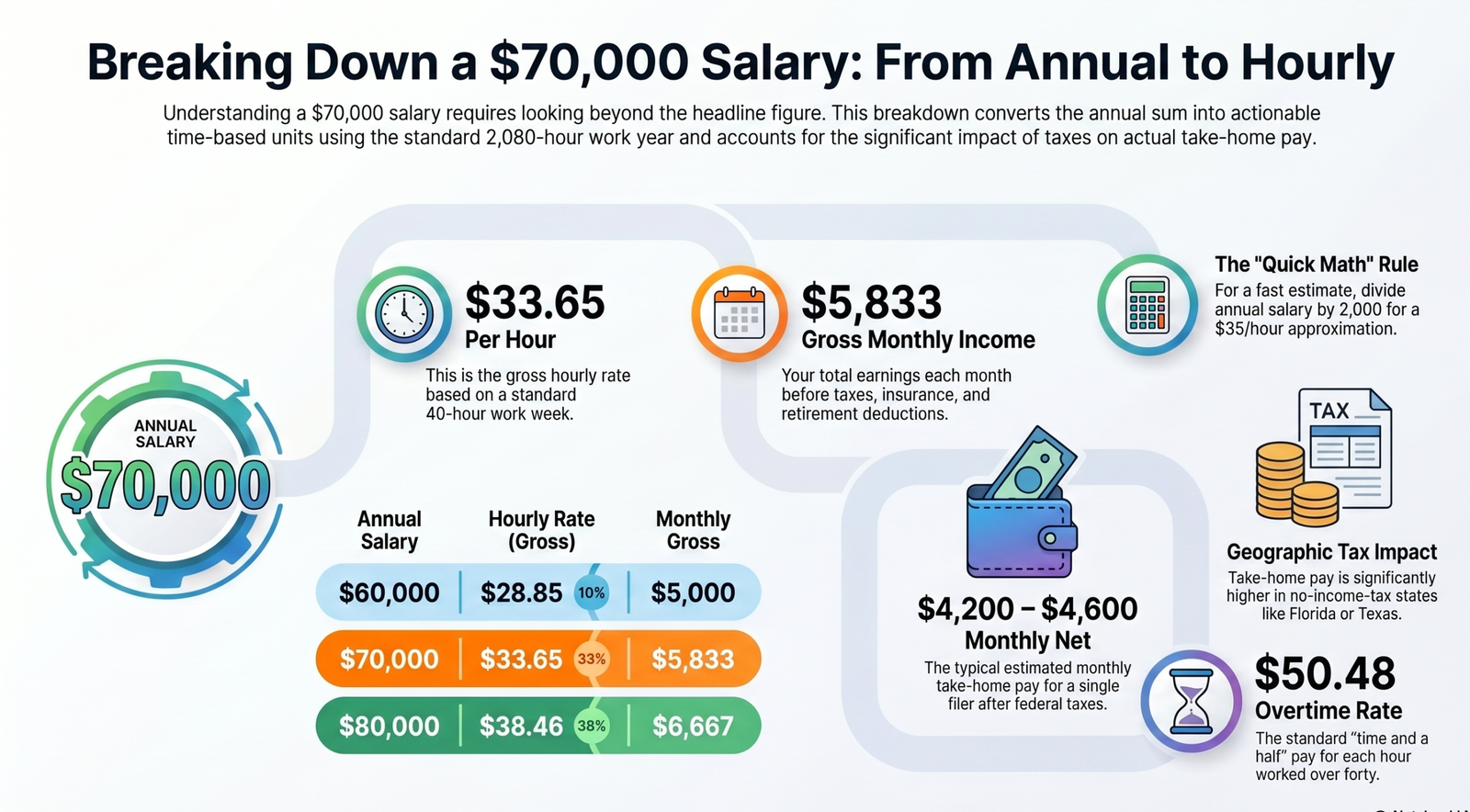
The standard calculation for converting an annual salary to an hourly rate uses 2,080 working hours per year — based on 40 hours per week across 52 weeks. Dividing $70,000 by 2,080 gives you an hourly rate of approximately $33.65. This is the gross hourly rate before any taxes, benefits deductions, or other withholdings are applied.
To put this in practical context: 70k a year is how much an hour in a 40-hour working week means you earn roughly $33.65 for every hour you work. If you ever work overtime, each additional hour at straight time adds $33.65 to your gross earnings. At time and a half — the standard overtime rate in the United States — each overtime hour would pay approximately $50.48. Understanding this baseline rate makes it far easier to evaluate whether a job offer, freelance contract, or side project is financially worth your time.
What Is the Monthly Income for a 70k Salary?
Dividing $70,000 by 12 months gives a gross monthly income of approximately $5,833. This is the pre-tax figure that appears on your monthly pay stub before federal income tax, state income tax (where applicable), Social Security, Medicare, and any voluntary deductions like health insurance or retirement contributions are removed.
After standard federal tax withholding for a single filer, your take-home monthly pay on a $70,000 salary typically falls in the range of $4,200 to $4,600 depending on your specific tax situation, state of residence, and deductions. Understanding this monthly take-home figure is more useful for real budgeting purposes than the gross figure, because it represents the actual money available for rent, food, transportation, savings, and discretionary spending.
What Is the Take-Home Pay for 70k Annually?
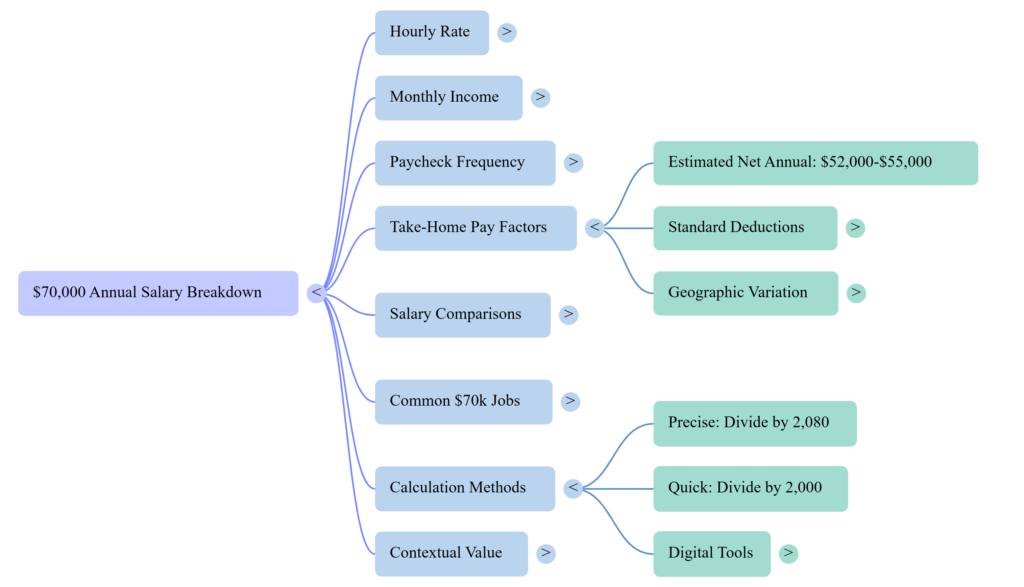
The take-home pay for a $70,000 annual salary varies meaningfully depending on where you live and your filing status, but a reasonable estimate for a single filer in a moderate-tax state puts net annual take-home pay around $52,000 to $55,000. This accounts for federal income tax at the 22% marginal rate that applies to income above $44,725 for single filers in 2024, Social Security tax at 6.2%, and Medicare tax at 1.45%.
State income tax introduces additional variation. In states with no income tax — Texas, Florida, Nevada, Washington, and a handful of others — your take-home pay on a $70,000 salary is meaningfully higher than in high-tax states like California or New York, where combined state and local taxes can add 9% to 13% to your effective tax burden. When evaluating job offers, the location dimension of compensation is as important as the headline salary figure, because 70k a year is how much an hour you actually keep depends significantly on your tax geography.
How Much Is 70k Salary Per Paycheck?
The per-paycheck amount depends on your pay frequency. Most salaried employees in the United States receive pay either biweekly (every two weeks, 26 pay periods per year) or semi-monthly (twice per month, 24 pay periods per year). On a biweekly schedule, a $70,000 annual salary produces a gross paycheck of approximately $2,692 before deductions. On a semi-monthly schedule, each paycheck is approximately $2,917 gross.
Use our Salary to Hourly Calculator to quickly convert annual income into hourly, weekly, and monthly earnings.
After taxes and standard deductions, a biweekly net paycheck on a $70,000 salary typically falls in the range of $1,900 to $2,100 for a single filer in a moderate-tax state. This is the figure that hits your bank account on payday and forms the basis of your actual week-to-week financial planning. Many personal finance professionals recommend building your budget around this net figure rather than the gross annual salary to avoid overestimating available resources.
55k a Year Is How Much an Hour vs 70k: The Career Progression Gap
Understanding 70k a year is how much an hour is most useful when you can compare it directly to adjacent salary levels. The gap between 55k a year is how much an hour and 70k a year is significant: $55,000 converts to $26.44 per hour while $70,000 converts to $33.65. That $7.21 hourly difference equals $14,997 in additional annual gross earnings — or roughly an extra $1,250 per month before taxes. Over a ten-year career span with consistent raises, this compounding difference becomes the primary driver of wealth accumulation variation between workers in similar fields.
Explore our Digital Productivity guides for additional salary breakdowns, paycheck calculators, and income-planning resources.
The jump from $60,000 — where 60k a year is how much an hour translates to $28.85 — to $70,000 represents a 16.7% salary increase. This is the kind of increase typically associated with a job change, a significant promotion, or entering a specialized skill area that commands a market premium. Knowing these reference points makes salary negotiation conversations more precise and more confident.
What Jobs Typically Pay 70k a Year?
A $70,000 annual salary sits comfortably above the US median household income and corresponds to a range of professional roles that require either formal education, specialized skills, or several years of experience. Common job titles in the $65,000 to $75,000 range include registered nurses, software developers in mid-tier markets, financial analysts, marketing managers, human resources managers, mechanical engineers, and licensed clinical social workers.
In high cost-of-living markets like San Francisco, New York, or Seattle, $70,000 represents entry-to-mid-level compensation for many professional roles. In lower cost-of-living markets across the Midwest and South, the same $70,000 salary provides upper-middle-class purchasing power. This geographic dimension of salary evaluation is why understanding 70k a year is how much an hour in after-tax, after-cost-of-living terms matters as much as the gross hourly figure.

Best Way to Convert Annual Salary to Hourly Pay
The fastest manual method for converting any annual salary to an hourly rate is dividing the annual figure by 2,000 rather than the precise 2,080 hours. This gives you a quick approximation that is accurate to within 4% and easy to calculate mentally. For $70,000, dividing by 2,000 gives $35 per hour — close to the precise $33.65 and useful for quick comparisons. For exact calculations, always use 2,080 as the divisor.
If you’re evaluating higher hourly wages, see our $45 an Hour Salary Guide for a detailed income comparison.
Digital salary-to-hourly calculators automate this process and add important layers including tax calculations by state, benefits cost modeling, and comparison tools that show multiple salary scenarios simultaneously. When evaluating a job offer where 70k a year is how much an hour needs to be assessed in the context of the full compensation package — including health insurance value, retirement matching, paid time off, and other benefits — a comprehensive salary calculator provides significantly more useful output than the base rate calculation alone.
What Calculator Converts Yearly Income to Hourly Pay?
Several reliable online tools convert yearly income to hourly pay with varying levels of detail. The Bureau of Labor Statistics wage calculator provides authoritative benchmark data for comparing your hourly rate against occupational averages. SmartAsset and NerdWallet offer comprehensive salary calculators that include state tax calculations and take-home pay estimates. PayScale and Glassdoor provide salary comparison tools that contextualize your hourly rate against market rates for your specific role and location.
You can also compare annual earnings using our How Much Is 36 Dollars an Hour Annually? Complete Salary Breakdown guide.
For ongoing salary tracking and financial planning, integrating your hourly rate calculation into a personal budgeting tool like YNAB or Mint helps connect your compensation understanding to actual spending and savings behavior. Understanding that 70k a year is how much an hour means $33.65 gross is the starting point — connecting that figure to your actual financial life requires the full picture of taxes, benefits, and cost of living that comprehensive tools provide.
Conclusion
Knowing that 70k a year is how much an hour — specifically $33.65 gross — is more than a mathematical exercise. It is a practical lens for evaluating job offers, negotiating raises, pricing your freelance services, and understanding the real value of your working time. Every career decision involves a trade of time for money, and knowing your precise hourly equivalent makes that trade explicit and quantifiable.
Use the salary comparison table in this guide as a reference every time you encounter a compensation figure expressed annually. Whether you are evaluating a $55,000 job offer, negotiating toward $85,000, or planning for a path to $140,000, converting the annual number to its hourly equivalent grounds the conversation in the most intuitive unit of compensation value. Share this guide with anyone navigating a salary decision, explore our salary calculator tool for full after-tax calculations, and subscribe for ongoing personal finance content that helps you earn, keep, and grow more of what your time is worth.
FAQs
Is $70,000 a year a good salary?
Whether $70,000 is a good salary depends significantly on your location, family size, and financial goals. It exceeds the US median household income, which was approximately $74,580 in 2022, and provides comfortable middle-class purchasing power in most US markets. In high cost-of-living cities, $70,000 may feel tight for a family. In lower cost-of-living areas, it can support a very comfortable lifestyle.
How much is 70k a year after taxes?
For a single filer in a moderate-tax state, a $70,000 annual salary typically results in approximately $52,000 to $55,000 in after-tax take-home pay. This accounts for federal income tax, Social Security, and Medicare. State income taxes reduce this figure further in states like California or New York, while residents of no-income-tax states keep more of the gross figure.
How much is 60k a year hourly compared to 70k?
60k a year is how much an hour works out to approximately $28.85 per hour using the standard 2,080-hour calculation. Compared to $33.65 for 70k, the $10,000 annual salary difference represents $4.80 per hour or roughly $400 per month in gross additional earnings before taxes.
What is 75000 a year hourly?
75,000 a year is how much an hour translates to approximately $36.06 per hour based on 2,080 annual working hours. Monthly gross income at this level is $6,250. The jump from $70,000 to $75,000 represents a 7.1% salary increase and adds approximately $2.40 per hour to the gross rate.
How do I convert an 80k salary to hourly?
To convert 80k salary to hourly, divide $80,000 by 2,080 working hours. The result is approximately $38.46 per hour. This is the gross hourly rate. Monthly gross income at $80,000 is approximately $6,667. After taxes for a single filer in a moderate-tax state, monthly take-home pay typically falls around $4,800 to $5,200.