Broadband Router Electricity Cost: How Much Does Your Router Really Use?
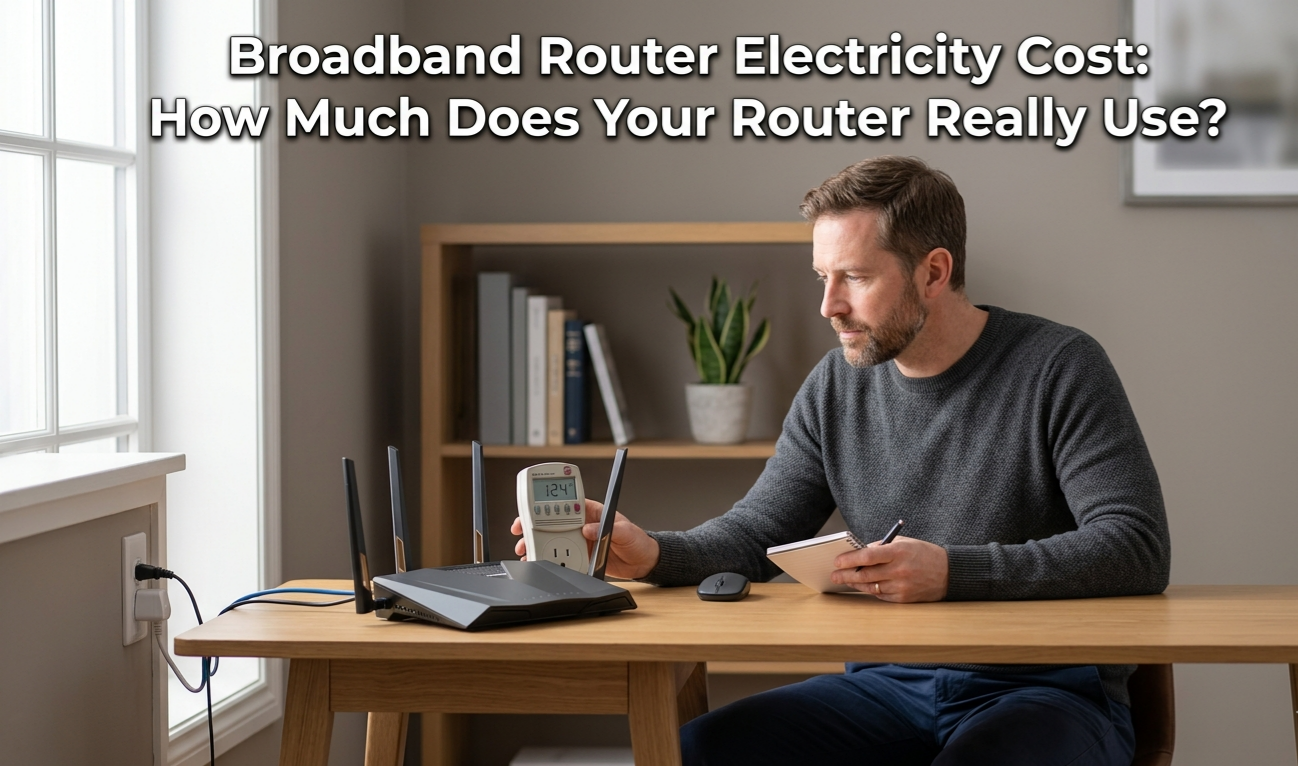
Most people never think twice about leaving their broadband router plugged in around the clock — it is just one of those household devices that silently hums away in the background. But with household energy prices remaining high, even small continuous draws add up. Understanding your broadband router electricity cost is a smart first step toward reducing waste without sacrificing connectivity.
In this guide, you will find the exact wattage figures for common router types, a step-by-step cost calculation, a reference table, and practical tips to cut your broadband router electricity cost without disrupting your internet use.
Table of contents
- What Is Broadband Router Electricity Cost?
- Feature Breakdown: Router Power Consumption — How Many Watts Does a Router Use?
- Does WiFi Consume Electricity at All Times?
- Broadband Router Electricity Cost Per Month and Per Year
- WiFi Berapa Watt? Understanding Router Wattage Across Regions
- Router Power Consumption Reference Table
- Pros & Cons of Leaving Your Router On 24/7
- Which Router Uses the Least Electricity?
- Tips to Reduce Your Broadband Router Electricity Cost
- Conclusion
What Is Broadband Router Electricity Cost?
The broadband router electricity cost is the amount of money spent on electricity to keep your home router running — typically 24 hours a day, 7 days a week. Unlike a television or microwave, a router has no ‘off’ period during normal household use. It draws power continuously, which means even a modest wattage figure accumulates into a real annual cost.
The broadband router electricity cost depends on two variables: the router’s wattage (how much power it draws from the wall) and the electricity tariff you pay per kilowatt-hour (kWh). Both vary — wattage varies by router model and age, while electricity tariffs vary by country, region, and supplier.
Most home users have never checked either figure. This guide changes that, giving you the data to calculate your own broadband router electricity cost in under two minutes.
To estimate the real impact of your router on monthly energy costs, use our Electricity Bill Calculator.
Feature Breakdown: Router Power Consumption — How Many Watts Does a Router Use?
Router power consumption sits in a modest but persistent range. Most home broadband routers draw between 5W and 20W during normal operation. The exact figure depends on the router’s age, technology standard, number of antennas, and whether it is handling heavy traffic or sitting idle.
Unlike appliances with heating elements, routers do not spike dramatically between idle and active use. A router transmitting data to multiple devices might draw 12W, while the same router with no connected devices might draw 9W — a small difference that confirms the device is always consuming power regardless of traffic levels.
WiFi Router Wattage by Router Type
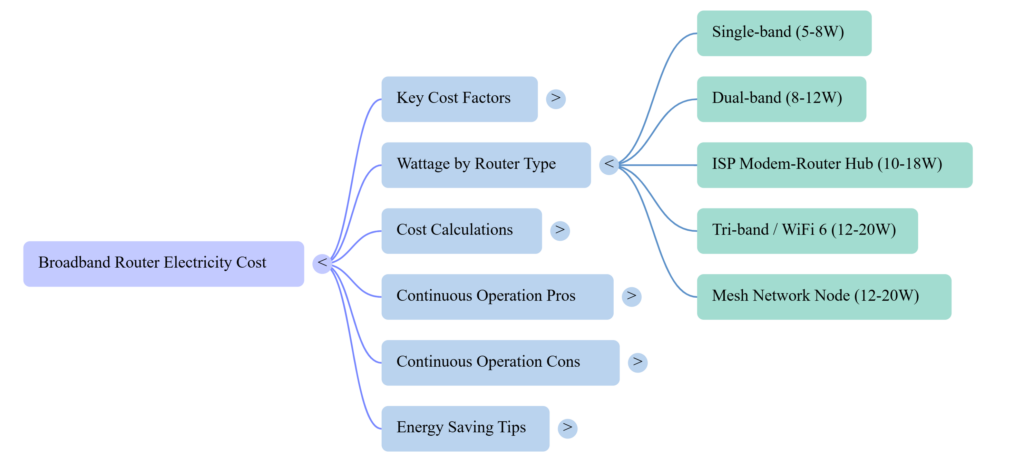
WiFi router wattage varies meaningfully across categories:
Basic single-band router (2.4GHz only): typically 5–8W. These older units are the most energy-efficient in absolute terms but offer the slowest speeds.
Dual-band router (2.4GHz + 5GHz): typically 8–12W. The most common type in homes today. Wifi electricity consumption at this level costs roughly £3–£5 per year at UK rates.
Tri-band or mesh network node: typically 12–20W per unit. Whole-home mesh systems with two or three nodes multiply this figure accordingly.
Combined modem-router unit (ISP hub): typically 10–18W. These all-in-one devices are supplied by most broadband providers and account for the majority of household broadband router electricity cost.
Does WiFi Consume Electricity at All Times?
Yes — a broadband router consumes electricity continuously as long as it remains plugged in and switched on. This answers one of the most common questions: does wifi consume electricity even when you are not actively browsing? Absolutely. The router is always listening for device connections, handling background traffic from smart devices, and maintaining its network broadcast.
A subtler point: does a wifi router consume more electricity when more devices are connected? Marginally, yes — but the increase is small. The router’s power draw is largely determined by its hardware and radio transmitters, not by the number of active users. Turning off WiFi on your smartphone reduces that device’s power consumption, but it does not meaningfully reduce the router’s wattage.
Does the router draw power in standby or sleep mode? Some newer models feature a sleep or eco mode that reduces watt wifi draw by 20–30% during overnight hours — a genuine saving worth enabling if your router supports it.
How Much Electricity Does a WiFi Router Use Per Day?
To calculate how much electricity does a wifi router use each day, apply this formula: (Watts ÷ 1,000) × 24 hours = Daily kWh
Example: A 10W router running 24 hours uses (10 ÷ 1,000) × 24 = 0.24 kWh per day.
At a UK electricity rate of 30p/kWh: 0.24 × £0.30 = £0.072 per day — roughly 7p.
At a US rate of $0.16/kWh: 0.24 × $0.16 = $0.038 per day — under 4 cents.
These figures seem small in isolation, but they compound significantly when calculated over a month and year.
Broadband Router Electricity Cost Per Month and Per Year
Extending the daily calculation, here is what the broadband router electricity cost looks like over time for routers of different wattages at 30p/kWh (UK) and $0.16/kWh (US):
5W router: £1.64/year (UK) | $0.70/year (US)
10W router: £3.29/year (UK) | $1.40/year (US)
15W router: £4.93/year (UK) | $2.10/year (US)
20W router: £6.57/year (UK) | $2.80/year (US)
For router electricity cost per month, simply divide by 12. A 10W router costs approximately 27p/month (UK) or 12 cents/month (US). The broadband router electricity cost per year for a typical dual-band home router is therefore in the £3–£6 range in the UK — modest, but real and worth knowing.
If you have a whole-home mesh system with three nodes at 15W each, multiply accordingly: £14.79/year (UK) — a noticeably higher broadband router electricity cost that justifies considering energy-saving settings.
WiFi Berapa Watt? Understanding Router Wattage Across Regions
The question ‘wifi berapa watt’ (how many watts is WiFi) and ‘berapa watt wifi’ are common searches in Indonesia and other Southeast Asian markets — reflecting the same universal curiosity about router power consumption that drives English-language searches globally.
The hardware answer is the same worldwide: a typical home broadband router draws 5W–20W regardless of country. What changes is the local electricity tariff, which directly affects the broadband router electricity cost in monetary terms.
In Indonesia, where the electricity tariff for residential users is approximately IDR 1,444 per kWh (Rp/kWh), a 10W router running 24/7 costs roughly IDR 125,000–130,000 per year — a meaningful figure for budget-conscious households. Understanding wifi berapa watt helps Indonesian users apply the same kWh calculation as anywhere else: watts ÷ 1,000 × hours × tariff rate = cost.
Router Power Consumption Reference Table
The table below summarises typical router wattage and estimated annual broadband router electricity cost at 30p/kWh (UK). Adjust the tariff for your local rate.
| Router Type | Typical Wattage | Daily kWh (24hr) | Monthly Cost (30p) | Annual Cost (30p) |
| Basic single-band router | 5–8W | 0.12–0.19 kWh | ~3–6p | ~£1.64–£2.63 |
| Standard dual-band router | 8–12W | 0.19–0.29 kWh | ~6–9p | ~£2.63–£3.94 |
| ISP-supplied modem-router hub | 10–18W | 0.24–0.43 kWh | ~7–13p | ~£3.29–£4.72 |
| Tri-band / WiFi 6 router | 12–20W | 0.29–0.48 kWh | ~9–14p | ~£3.94–£5.26 |
| Mesh network (per node) | 12–20W | 0.29–0.48 kWh | ~9–14p | ~£3.94–£5.26 per node |
| Combined modem + router (separate) | 15–28W | 0.36–0.67 kWh | ~11–20p | ~£5.26–£7.30 |
Figures use 30p/kWh. Use the Home Appliance Energy Cost Calculator on this site for a personalised broadband router electricity cost estimate.
You can also compare your router’s power usage with other household devices using our Home Appliance Energy Calculator.
Pros & Cons of Leaving Your Router On 24/7
Pros of Always-On Operation
Uninterrupted connectivity is the obvious advantage — smart home devices, security cameras, and connected appliances all rely on continuous WiFi. Overnight firmware updates and background syncing happen without user involvement. For households with multiple users on different schedules, a router that is always on eliminates the friction of manually switching it on each morning.
The broadband router electricity cost of continuous operation is genuinely low — typically under £6 per year for a standard router. For most households, the convenience-to-cost ratio strongly favours leaving it running.
Cons and Considerations
A continuously powered router generates low-level heat, which contributes to component wear over multi-year periods — though modern routers are engineered for this. There is also a minor but non-zero security consideration: a router that is always on is always theoretically exposed to network-based threats, though keeping firmware updated mitigates this substantially.
For households with mesh systems running three or more nodes, the broadband router electricity cost becomes more meaningful. Three nodes at 15W each cost nearly £15 per year — approaching the cost of other small always-on devices like smart speakers or set-top boxes.
Which Router Uses the Least Electricity?
For the lowest broadband router electricity cost, a basic single-band router (5–8W) is the most energy-efficient choice in absolute terms. However, for most modern households, the performance trade-off is too steep — single-band routers struggle with multiple simultaneous devices and cannot support the speeds delivered by current broadband packages.
The sweet spot for balancing performance and energy efficiency is a modern dual-band WiFi 6 router. Despite supporting faster speeds and more simultaneous connections, WiFi 6 routers are designed with improved power management. They can handle more devices at lower per-device energy cost compared to older WiFi 5 models, making them genuinely more efficient per unit of delivered performance.
For users with a mesh network, enabling the router’s built-in eco or sleep mode — where nodes reduce transmission power during low-traffic hours — can cut the broadband router electricity cost of a multi-node system by 20–30% annually with minimal impact on overnight connectivity.
Tips to Reduce Your Broadband Router Electricity Cost
1. Enable eco or sleep mode. Many modern routers include a scheduled power-reduction mode. Activating it during overnight hours (e.g. 1am–6am) reduces the broadband router electricity cost without affecting daytime performance.
2. Use a smart plug timer. If your router lacks a built-in schedule, a programmable smart plug lets you automatically cut power overnight. A 5-hour nightly shutdown reduces your router’s running time by roughly 20%, trimming the broadband router electricity cost proportionally.
3. Check your router’s power adaptor. The wattage rating is printed on the adaptor. This gives you the maximum draw — real-world use is typically 60–80% of this figure.
4. Consider upgrading an old router. Routers more than 5–6 years old often draw more power than current equivalents while delivering slower speeds. A modern WiFi 6 router may reduce your broadband router electricity cost while improving performance.
5. Disable unused WiFi bands. If your household only uses 5GHz devices, disabling the 2.4GHz radio reduces wifi electricity consumption slightly. Conversely, if all your devices are older 2.4GHz-only units, disable 5GHz.
6. Calculate your exact cost. Use the Home Appliance Energy Cost Calculator on this site — enter your router’s wattage and daily hours of use to get a precise broadband router electricity cost figure per month and per year.
Conclusion
The broadband router electricity cost is one of the smallest but most consistent line items in a household energy budget. A typical home router drawing 10W runs for an annual cost of around £3–£5 in the UK — modest individually, but real money across a multi-year period or when multiplied across several mesh nodes.
Understanding your broadband router electricity cost starts with knowing your router’s wattage (check the power adaptor label), multiplying by 24 hours of daily use, and applying your local electricity tariff. The table in this guide gives you ready-made estimates across the most common router wattages.
Explore our Smart Home guides for energy-saving tips, electricity calculators, and home efficiency resources.
For households looking to reduce their broadband router electricity cost, the highest-impact step is enabling the router’s built-in eco or sleep mode, or using a smart plug timer to cut power during overnight hours. Upgrading an aging, inefficient router to a modern WiFi 6 model also delivers energy savings alongside better performance.
FAQS
Q1: Does WiFi consume electricity when no devices are connected?
Yes. The router draws power continuously regardless of whether any devices are connected. Wifi electricity consumption is driven by the router’s hardware and radios, not by active traffic. The reduction in draw when no devices are connected is minimal — typically 1–3W less than peak load.
Q2: How much does it cost to run a router for a year?
For a typical 10W dual-band router running 24/7 at a UK rate of 30p/kWh, the broadband router electricity cost is approximately £3.29 per year. At US rates ($0.16/kWh), the same router costs around $1.40 per year. A mesh system with three 15W nodes costs roughly £14.79/year (UK).
Q3: Does a WiFi router consume more electricity than a smart TV on standby?
Broadly similar. A smart TV in standby typically draws 0.5–2W, while a home router draws 5–20W continuously. The broadband router electricity cost is generally higher because a router runs at full draw 24/7, whereas a TV spends most hours in low-draw standby.
Q4: What is the watt wifi draw for an ISP-supplied hub?
Most ISP-supplied combined modem-router hubs (such as those supplied with major UK broadband packages) draw 10–18W. Checking the label on your hub’s power adaptor gives the most accurate watt wifi figure for your specific model.
Q5: Should I turn my router off at night to save electricity?
It is a valid option for saving electricity, though the annual saving from a single router is modest (roughly £0.50–£1.50 per year for a standard device). The main trade-offs are: smart home devices lose connectivity, overnight firmware updates are missed, and the router requires a reboot cycle each morning. A better alternative is enabling the router’s built-in eco mode or using a timed smart plug.
Q6: How do I calculate my exact broadband router electricity cost?
Find the wattage on your router’s power adaptor. Then: (Watts ÷ 1,000) × 24 × 365 × your kWh tariff = annual cost. Alternatively, use the Home Appliance Energy Cost Calculator on this site — enter wattage, daily hours, and your tariff for an instant broadband router electricity cost result.