How Many Amps Does a Microwave Use? Complete Electrical Guide

If you have ever wondered how many amps does a microwave use, you are not alone. It is one of the most searched appliance questions online — and for good reason. Whether you are planning a kitchen renovation, troubleshooting a tripped circuit breaker, or simply trying to understand your electricity bill, knowing your microwave’s amp draw gives you the precise information you need to make smart electrical and financial decisions.
This complete guide covers the exact formula, wattage ranges by microwave size, circuit breaker requirements, monthly electricity costs, and a special breakdown for Spanish-speaking households. By the end, you will know exactly how many amps does a microwave use — and what to do with that number.
Table of contents
- What Determines How Many Amps a Microwave Uses?
- How Many Watts Does a Microwave Use?
- Watts to Amps Formula for Microwaves
- Microwave Oven Power Consumption by Size
- How Much Energy Does a Microwave Use Per Month?
- Microwave Electricity Consumption vs. Other Appliances
- How Much Electricity Does a Microwave Use Annually?
- Does a Microwave Need a Dedicated Circuit?
- Cuantos Watts Consume un Microondas
- Tips to Reduce Microwave Power Consumption
- Conclusion
What Determines How Many Amps a Microwave Uses?
Understanding how many amps does a microwave use starts with a foundational electrical concept: the relationship between watts, volts, and amps.
Every electrical appliance draws current (measured in amps) based on its power consumption (watts) and the voltage of the circuit it runs on. In North American homes, standard kitchen outlets operate at 120 volts. Most of the world uses 220–240V, but the formula remains the same.
The governing equation is Ohm’s Law, simplified for practical use:
Amps = Watts ÷ Volts
This means that a higher-wattage microwave draws more amps on the same circuit. A microwave that consumes 1,200 watts at 120V draws 10 amps. Increase the wattage, increase the amp draw — every time.
The microwave’s input wattage (what it draws from the wall) is always higher than its output wattage (the cooking power). Most microwaves operate at 55–65% efficiency, meaning a microwave rated at 1,000W cooking output may draw 1,400–1,600W from the circuit. This distinction is critical when calculating actual amp draw.
How Many Watts Does a Microwave Use?
Before you can determine how many amps does a microwave use, you need the wattage figure. Average microwave wattage varies significantly by size and type:
- Compact/personal microwaves: 600–800W output (700–1,000W input)
- Mid-size countertop microwaves: 900–1,100W output (1,100–1,400W input)
- Full-size countertop microwaves: 1,100–1,250W output (1,400–1,600W input)
- Over-the-range microwaves: 1,000–1,200W output (1,200–1,500W input)
- Commercial-grade microwaves: 1,500–2,200W input
When you see “900-watt microwave” or “1200-watt microwave” on a product label, that figure typically refers to cooking output — not what the appliance actually draws from your home’s electrical system. Always check the input wattage on the appliance nameplate or owner’s manual for accurate amp calculations.
To estimate the energy usage of your microwave and other household appliances, use our Home Appliance Energy Calculator.
Watts to Amps Formula for Microwaves
The microwave watt to amp conversion formula is straightforward:
Amps = Input Watts ÷ Voltage
Here is how that plays out across common microwave sizes at the standard US household voltage of 120V:
- 700W input microwave: 700 ÷ 120 = 5.8 amps
- 1,000W input microwave: 1,000 ÷ 120 = 8.3 amps
- 1,200W input microwave: 1,200 ÷ 120 = 10.0 amps
- 1,500W input microwave: 1,500 ÷ 120 = 12.5 amps
- 1,800W input microwave: 1,800 ÷ 120 = 15.0 amps
For households in countries using 220V (Philippines, UK, most of Europe), the amp draw is roughly half these figures at equivalent wattage. A 1,200W microwave on a 220V circuit draws approximately 5.5 amps — the same power consumption, just lower current at higher voltage.
Understanding the microwave watt to amp conversion protects you from overloading circuits, especially in older homes where kitchen wiring may not be rated for modern appliance loads.
Microwave Oven Power Consumption by Size
This table covers the most common microwave categories, their typical input wattage, calculated amp draw at 120V, and estimated monthly electricity cost at the U.S. average rate of $0.16/kWh (assuming 20 minutes of use per day).
| Microwave Type | Input Wattage | Amps (120V) | Monthly kWh | Monthly Cost (USD) |
|---|---|---|---|---|
| Compact (600W output) | 900W | 7.5A | 9.0 kWh | $1.44 |
| Mid-Size (900W output) | 1,200W | 10.0A | 12.0 kWh | $1.92 |
| Full-Size (1,100W output) | 1,500W | 12.5A | 15.0 kWh | $2.40 |
| Over-the-Range (1,000W output) | 1,300W | 10.8A | 13.0 kWh | $2.08 |
| High-Power (1,250W output) | 1,650W | 13.8A | 16.5 kWh | $2.64 |
Monthly kWh calculated as: Input Watts × (20 min/day × 30 days ÷ 60) ÷ 1,000.
This table answers the core question — how many amps does a microwave use — at a glance, by size. Most households with a standard mid-size microwave are looking at 10–12.5 amps of draw during operation.
You can calculate the monthly operating cost of your microwave using our Electricity Bill Calculator.
Microwave Watts Usage: Low vs. High Power Settings
One aspect of microwave watts usage that most users overlook is that microwaves do not always run at full power. When you set a microwave to power level 5 (50%), it cycles the magnetron on and off rather than reducing the actual wattage of each cycle.
The practical effect: at full power, a 1,200W microwave draws its full 10 amps continuously. At power level 5, it draws those 10 amps for approximately half the total cooking time, and zero amps for the other half. Average current draw over the cooking period is effectively halved — but instantaneous draw during the “on” cycle remains the same.
This matters for circuit breaker sizing: the breaker must handle the full instantaneous draw, not the average. Always size circuits based on full-power input wattage.
How Much Energy Does a Microwave Use Per Month?
To calculate how much energy does a microwave use on a monthly basis, apply the standard power consumption formula:
(Input Watts × Daily Minutes of Use × 30 days) ÷ 60,000 = Monthly kWh
Example — Average household (20 min/day, 1,200W input microwave): 1,200 × 20 × 30 ÷ 60,000 = 12 kWh/month
Example — Heavy user (45 min/day, 1,200W input microwave): 1,200 × 45 × 30 ÷ 60,000 = 27 kWh/month
At the U.S. average electricity rate of $0.16/kWh:
- Light use (10 min/day): ~6 kWh = $0.96/month
- Average use (20 min/day): ~12 kWh = $1.92/month
- Heavy use (45 min/day): ~27 kWh = $4.32/month
For Philippine households on Meralco rates (~₱12.00/kWh), the same average-use microwave costs approximately ₱144/month — a relatively modest addition to the monthly electricity bill compared to air conditioning or water heating.
If you’re comparing appliance power requirements, see our Hair Dryer Wattage guide.
Microwave Electricity Consumption vs. Other Appliances
A critical piece of context for understanding microwave electricity consumption is how it compares to other cooking methods for the same task.
Cooking a single serving of food in a microwave for 5 minutes at 1,200W input uses approximately 0.1 kWh. The same reheating task in a conventional electric oven — which draws 2,400–3,000W and takes 15–20 minutes to preheat and reheat — uses 0.6–1.0 kWh. For single-serving meals and reheating, the microwave uses 80–90% less electricity than a full-size oven.
This makes microwave power consumption deceptively efficient despite the high wattage. The key is cooking duration: microwaves finish tasks in minutes that ovens take 20–40 minutes to complete. When evaluating your home appliance energy consumption, total energy per task (wattage × time) always matters more than peak wattage alone.
How Much Electricity Does a Microwave Use Annually?
Scaling monthly figures to annual consumption reveals the microwave’s true electricity footprint. How much electricity does a microwave use over a full year depends primarily on daily usage:
- Light use (10 min/day): ~72 kWh/year — approximately $11.52 at U.S. rates
- Average use (20 min/day): ~144 kWh/year — approximately $23.04 at U.S. rates
- Heavy use (45 min/day): ~324 kWh/year — approximately $51.84 at U.S. rates
One often-overlooked factor in annual microwave electricity consumption is standby power. Even when not cooking, most microwaves draw 1–3 watts continuously to power the clock display and control panel. Over a full year, that adds 8–26 kWh — small but real.
Unplugging the microwave when not in use eliminates standby draw entirely. For households with very infrequent microwave use, this simple habit can meaningfully reduce annual energy cost.
Does a Microwave Need a Dedicated Circuit?
When calculating how many amps does a microwave use, the answer directly informs circuit planning. And for many households, the answer points toward a dedicated circuit. According to U.S. electrical safety guidelines outlined in the National Electrical Code (NEC), microwaves with a power rating of 1,000 watts or higher should typically operate on their own dedicated 20-amp circuit to ensure safe and reliable performance. Here is why this matters in practice:
A standard kitchen circuit is typically rated at 15 or 20 amps and is shared with multiple outlets. If your 1,500W microwave draws 12.5 amps while a coffee maker (7 amps) runs simultaneously on the same circuit, you are pulling 19.5 amps on a 15-amp circuit — a tripped breaker is guaranteed.
The correct microwave circuit breaker size for most full-size countertop and over-the-range models is a 20-amp breaker on a dedicated 120V circuit. This provides:
- Enough headroom for the microwave’s full amp draw plus NEC’s 80% rule
- Zero interference from other appliances
- Reduced risk of nuisance tripping during high-power cooking cycles
Compact microwaves under 1,000W input can typically share a 20-amp circuit safely, but a dedicated circuit is always the preferred installation standard.
You can also compare microwave usage with our Iron Box Power Consumption guide.
Cuantos Watts Consume un Microondas
Para los usuarios de habla hispana que buscan cuantos watts consume un microondas, la respuesta depende del tamaño y modelo del aparato.
Los rangos más comunes son:
- Microondas compacto: 600–900W de potencia de entrada
- Microondas de tamaño mediano: 1,000–1,300W de potencia de entrada
- Microondas de tamaño completo: 1,400–1,650W de potencia de entrada
Para calcular el consumo mensual, se aplica la misma fórmula:
(Watts × Minutos diarios × 30) ÷ 60,000 = kWh mensuales
Un microondas de 1,200W usado 20 minutos al día consume aproximadamente 12 kWh al mes. En países con tarifas de electricidad de ₱12.00/kWh (como en Filipinas), ese costo mensual sería de aproximadamente ₱144.
The same formula and the same electrical principles apply regardless of language or country — watts, amps, and kilowatt-hours are universal units.
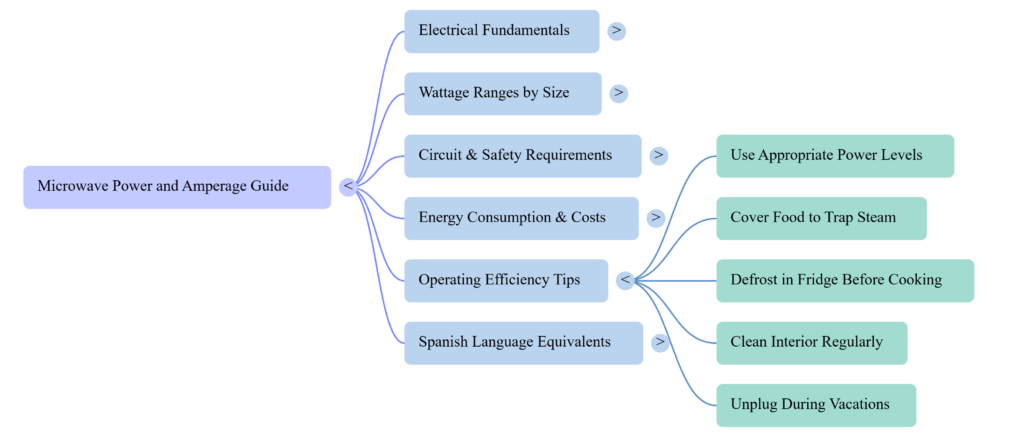
Tips to Reduce Microwave Power Consumption
Even though microwave power consumption is modest compared to most cooking appliances, small adjustments reduce your electricity usage further and extend your appliance’s lifespan:
Use the appropriate power level. Full power is not always necessary. Reheating soups, sauces, and casseroles at 70–80% power produces better results and reduces total energy draw over the heating cycle.
Cover food during heating. A microwave-safe cover traps steam, reduces cooking time by 10–20%, and delivers more even heating — all while lowering total energy consumed per meal.
Defrost before cooking. Starting from frozen dramatically extends microwave run time. Thawing food in the refrigerator overnight and then microwaving from cold (rather than frozen) cuts microwave operating time significantly.
Clean the interior regularly. Food residue absorbs microwave energy that should go into your food. A clean microwave cavity is a more efficient one.
Unplug when away for extended periods. For vacations or extended absences, unplugging the microwave eliminates the 1–3W standby draw entirely. Over a two-week vacation, that saves a small but measurable amount of energy.
Use the microwave instead of the oven when practical. Every time you reheat a single portion in a microwave instead of preheating a full oven, you save 80–90% of the energy that task would otherwise consume. This is the single highest-impact way to reduce cooking-related electricity consumption in a household.
Conclusion
Understanding how many amps does a microwave use gives you practical power over your home’s electrical system and your electricity bill. Most household microwaves draw between 8 and 13 amps during operation, require a 20-amp dedicated circuit for safe installation, and consume a modest 10–15 kWh per month under typical usage conditions.
The formula is always the same: divide input watts by your household voltage to get amps. Apply that number to your circuit planning, your breaker sizing, and your energy cost calculations — and you will never be caught off guard by a tripped breaker or an unexplained spike in your electricity bill.
Explore our Smart Home guides for appliance energy usage, electricity-saving tips, and home efficiency calculators.
Use our home appliance energy cost calculator to calculate your microwave’s exact monthly cost based on your local electricity rate, your specific model’s wattage, and your actual daily usage pattern. Precision beats guesswork every time.
Frequently Asked Questions
Q1: How many amps does a typical household microwave use?
Most mid-size countertop microwaves draw between 8 and 13 amps during operation at 120V. A 1,200W input microwave uses exactly 10 amps (1,200 ÷ 120 = 10A). Full-size models with higher input wattage reach 12.5–15 amps.
Q2: What circuit breaker size does a microwave need?
The NEC recommends a dedicated 20-amp circuit for microwaves rated at 1,000W or more. This provides adequate headroom for the microwave’s full amp draw while complying with the NEC’s 80% continuous load rule (16A usable on a 20A breaker).
Q3: How many watts does an average microwave use?
Average microwave input wattage ranges from 900W to 1,500W. Compact models draw less; full-size countertop and over-the-range units typically draw 1,200–1,500W. Always check the appliance nameplate for exact input wattage — not the cooking output rating.
Q4: How much electricity does a microwave use per month?
A 1,200W microwave used 20 minutes daily consumes approximately 12 kWh per month — costing about $1.92 at the U.S. average rate of $0.16/kWh. Heavy users running the microwave 45 minutes daily pay roughly $4.32/month.
Q5: Cuantos watts consume un microondas de 1000 watts?
Un microondas con potencia de cocción de 1,000W generalmente consume entre 1,200W y 1,400W de la toma eléctrica (potencia de entrada). A 120V, eso equivale a un consumo de entre 10 y 11.7 amperios durante el funcionamiento.
Q6: Does a microwave use electricity when not in use?
Yes — most microwaves draw 1–3 watts continuously in standby mode to power the clock and digital display. Over a full year, this adds 8–26 kWh of passive consumption. Unplugging the microwave when not needed eliminates this standby draw entirely.