Heat Pump Repair Guide to Service Costs & Expert Solutions
A heat pump that stops performing correctly creates immediate discomfort — whether it fails during a winter cold snap or a summer heat wave, the disruption to household comfort is felt within hours. Heat pump repair is one of the most frequently searched HVAC topics because homeowners face a consistent set of questions when something goes wrong: what is causing the problem, can it be fixed without a technician, what will professional heat pump repair cost, and how do they find a reliable heat pump repair service that will not overcharge or misdiagnose the issue. This complete guide answers all of these questions with the depth and specificity that genuine decision-making requires.
Table of contents
- What Is Heat Pump Repair?
- Common Heat Pump Problems — What Goes Wrong and Why
- Heat Pump Repair Cost — What to Expect
- Heat Pump Repair Service — Finding the Right Technician
- Heat Pump Maintenance — Preventing Repairs Before They Happen
- DIY Heat Pump Troubleshooting — What Homeowners Can Safely Check
- Conclusion
What Is Heat Pump Repair?
Heat pump repair encompasses the diagnostic and corrective work performed on heat pump systems when they fail to heat, cool, or operate efficiently. Unlike furnaces and air conditioners that perform one function each, heat pumps handle both heating and cooling through a single system — which means a malfunctioning heat pump affects year-round comfort rather than a single season.
Heat pumps function by moving thermal energy between indoor and outdoor environments instead of creating heat through fuel combustion or electrical resistance. This transfer mechanism involves refrigerant, compressors, reversing valves, coils, and electrical components — and failures in any of these areas require different diagnostic approaches and repair techniques. Homeowners understand the system’s architecture so they can communicate effectively with technicians and evaluate whether a proposed repair actually addresses the identified problem.
Heat pump repairs range from minor issues — a tripped circuit breaker, a clogged filter, or a malfunctioning thermostat — that homeowners can address themselves, to major component failures requiring certified HVAC technicians with specialised equipment and refrigerant handling licences. Knowing which category a specific symptom falls into determines whether the correct first call is to an electrician, a heating and cooling specialist, or a heat pump repair service with manufacturer certification for the specific brand involved.
Common Heat Pump Problems — What Goes Wrong and Why
Understanding the failure patterns that drive most heat pump repair needs helps homeowners diagnose their situation accurately before calling for service.
Heat pump not heating in cold weather is the most common winter complaint. When outdoor temperatures drop below heat pump’s efficient operating range — typically below 35 to 40 degrees Fahrenheit for standard units — the system struggles to extract sufficient heat from the cold air. Some units switch automatically to auxiliary or emergency heat; others simply underperform. This is often a system limitation rather than a defect, though defrost cycle failures, refrigerant undercharge, and dirty coils can all exacerbate the problem in ways that require heat pump repair to resolve.
Heat pump running constantly without reaching setpoint indicates either a sizing problem — the unit is too small for the space — or a performance degradation caused by refrigerant loss, coil fouling, or compressor wear. Constant operation without achieving setpoint places enormous stress on the compressor and dramatically increases electricity consumption, making prompt heat pump repair economically important beyond the comfort dimension.
Heat pump not cooling in summer points toward refrigerant issues, reversing valve failure, or compressor problems. The reversing valve — the component that switches the system between heating and cooling mode — is unique to heat pumps and a relatively common failure point that standard air conditioning technicians may not diagnose correctly if they lack heat pump-specific experience.
Ice buildup on the outdoor unit outside of regular defrost cycles usually points to restricted airflow, low refrigerant levels, or a malfunction in the defrost system. Some ice formation during heating operation is normal and managed automatically by the defrost cycle — but persistent heavy ice accumulation prevents proper heat transfer and requires investigation.
To estimate the monthly operating cost of your heat pump, use our Electricity Bill Calculator.
Heat Pump Repair Cost — What to Expect
Heat pump repair costs span a wide range depending on the problem, the component involved, the system’s age, and local labour rates. Understanding the cost structure before calling a heat pump repair service prevents surprise bills and helps evaluate whether repair or replacement is the economically rational choice.
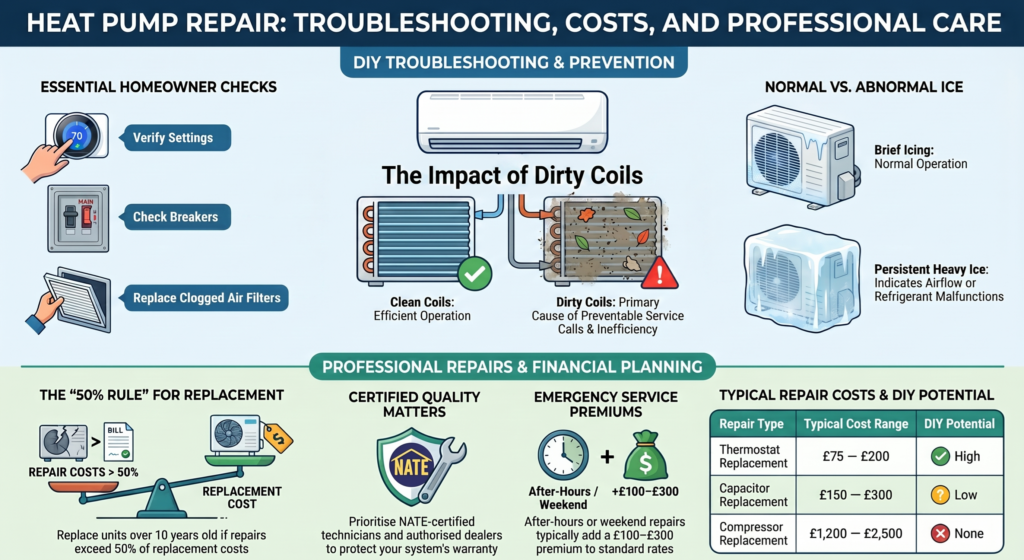
| Repair Type | Typical Cost Range | Notes |
| Thermostat replacement | $75 — $200 | Often DIY-accessible |
| Capacitor replacement | $150 — $300 | Common failure, quick fix |
| Reversing valve replacement | $400 — $800 | Heat pump-specific component |
| Refrigerant recharge | $200 — $600 | Leak detection adds cost |
| Compressor replacement | $1,200 — $2,500 | Major repair — consider system age |
| Circuit board replacement | $300 — $700 | Varies by brand and model |
| Coil cleaning and service | $100 — $300 | Often prevents other failures |
| Emergency heat pump repair | Adds $100 — $300 premium | After-hours and weekend rates |
These figures represent parts and labour combined for a typical residential heat pump repair. Commercial heat pump repair involving larger systems commands higher rates for both components and the specialised technicians required to service them.
You can estimate the power consumption of heat pumps and other household devices using our Home Appliance Energy Calculator.
The most important cost decision homeowners face is whether an expensive repair makes economic sense relative to system replacement. A general rule in HVAC circles applies directly to heat pump repair: if the repair cost exceeds fifty percent of the replacement system cost and the unit is more than ten years old, replacement often delivers better long-term value through improved efficiency, updated technology, and a new warranty period.
Heat Pump Repair Service — Finding the Right Technician
Choosing a heat pump repair service requires more discrimination than most home service decisions because heat pump systems are more technically complex than standard HVAC equipment and because misdiagnosis is common among technicians who lack specific heat pump training.
NATE certification — North American Technician Excellence — is the industry standard credential for HVAC technicians in the United States. Technicians who hold NATE certification have demonstrated competency through independent examination rather than simply completing manufacturer training. When evaluating a heat pump repair service, asking whether their technicians hold NATE certification provides a meaningful quality signal.
Manufacturer authorisation matters when the heat pump is under warranty or when proprietary diagnostic tools are required to access system data. Some heat pump manufacturers — Lennox, Carrier, Trane, and others — require repairs to be performed by authorised dealers to maintain warranty validity. Using an unauthorised heat pump repair service for a warranted component can void coverage for that repair and potentially related components.
Emergency heat pump repair availability should be confirmed before need arises. Heat pumps fail without regard to business hours, and a service provider who cannot respond to emergency calls may leave a household without heating or cooling for days during peak demand periods when appointment availability is compressed.
Multiple quotes for major repairs is standard practice for heat pump repair costs above $500. Different technicians may diagnose the same symptom differently, and the recommended heat pump repairs can vary significantly between providers. A second opinion on a compressor replacement recommendation, for example, occasionally reveals a refrigerant issue or electrical problem that resolves the compressor performance concern at a fraction of the cost.
Heat Pump Maintenance — Preventing Repairs Before They Happen
The most cost-effective heat pump repair strategy is preventing failures through consistent maintenance. Most heat pump technicians offer service agreements that include annual inspection and maintenance — typically costing $100 to $200 per year and consistently extending system life while reducing both the frequency and severity of unexpected heat pump repairs.
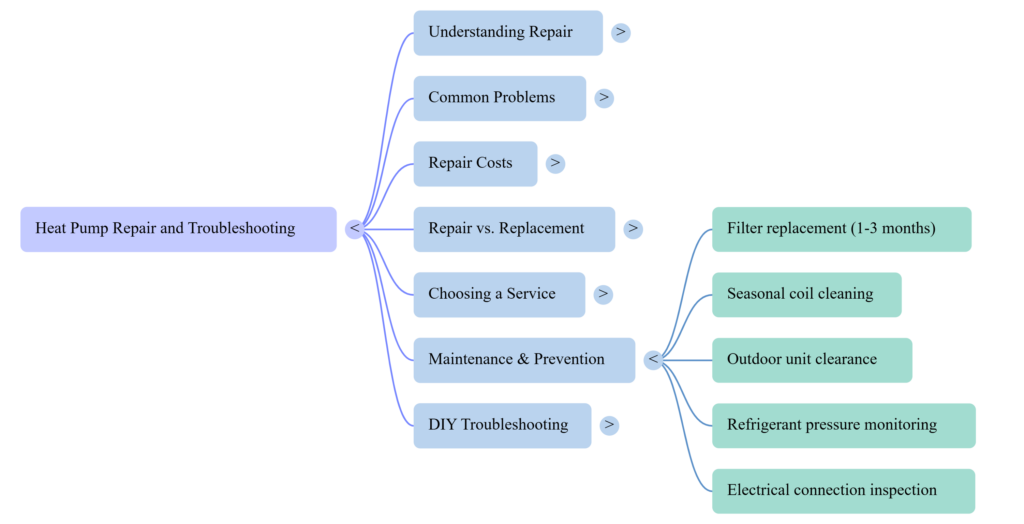
Key maintenance activities that prevent common heat pump repairs include filter replacement every one to three months depending on usage and household conditions, seasonal coil cleaning to maintain heat transfer efficiency, clearance maintenance around the outdoor unit to ensure airflow, refrigerant pressure monitoring to detect slow leaks before they cause compressor damage, and electrical connection inspection to identify failing capacitors and contactors before they cause system shutdowns.
Dirty coils are the single most preventable cause of heat pump repair service calls. Both the indoor evaporator coil and the outdoor condenser coil require periodic cleaning — dirty coils reduce efficiency, increase operating temperatures, and place additional stress on the compressor that shortens its service life. Annual professional cleaning costs significantly less than the compressor replacement that neglected maintenance commonly precipitates.
DIY Heat Pump Troubleshooting — What Homeowners Can Safely Check
Before calling a heat pump repair service, several checks are worth completing that may resolve the issue without professional intervention.
Check that the thermostat settings match the season and set the system mode to heat or cool as needed. Confirm the thermostat is receiving power — a dead battery in a wireless thermostat is a surprisingly common cause of heat pump service calls.
Check circuit breaker panel for tripped breakers affecting the heat pump or air handler. Reset any tripped breakers once and observe whether they hold — a breaker that trips again immediately indicates an electrical problem requiring a licensed electrician rather than a heat pump repair service.
Inspect and replace the air filter if it appears visibly clogged. A severely restricted filter can cause the system to short-cycle, ice over, or underperform in ways that mimic more serious failures.
Clear any debris from around the outdoor unit that might restrict airflow — leaves, grass clippings, and accumulated dirt around the unit base all impede performance. For authoritative guidance on heat pump operation, efficiency standards, and technician certification programmes, the US Department of Energy’s heating and cooling resources provide verified technical information that supports informed decisions about heat pump repair and replacement.
Conclusion
Heat pump repair is a domain where knowledge directly translates into better outcomes — homeowners who understand common failure patterns, realistic repair costs, and how to evaluate heat pump repair service providers consistently make better decisions than those approaching the situation without context. Whether the immediate need is diagnosing a performance problem, finding a qualified technician for heat pump repairs, evaluating whether a quoted repair cost is reasonable, or deciding between repair and replacement, the information in this guide provides the foundation for confident decision-making. Consistent maintenance remains the most powerful tool for reducing heat pump repair frequency — a well-maintained system that receives annual professional attention will outlast a neglected equivalent by years and avoid the most expensive repair scenarios through early detection of developing problems.
Explore our Smart Home guides for energy-saving tips, appliance insights, and home efficiency calculators.
Frequently Asked Questions
How much does heat pump repair cost on average?
Most residential heat pump repair jobs fall between $150 and $800 depending on the component involved. Minor repairs like capacitor replacement or thermostat issues cost $150 to $300, while major work like reversing valve or compressor replacement ranges from $400 to $2,500.
How do I find a reliable heat pump repair service?
Look for technicians with NATE certification, check manufacturer authorisation status if your system is under warranty, read recent Google and Yelp reviews specifically mentioning heat pump work, and request itemised written estimates before authorising any repair.
Can I perform heat pump repairs myself?
Basic troubleshooting — filter replacement, thermostat checks, breaker resets, and coil cleaning — is accessible to homeowners. Refrigerant work requires EPA certification and cannot legally be performed by unlicensed individuals. Electrical and mechanical component replacement should be handled by qualified technicians.
When should I replace instead of repair my heat pump?
If the system is over ten years old and the heat pump repair cost exceeds half the replacement price, replacement is typically the better financial decision. New systems also offer substantially improved efficiency ratings that reduce ongoing operating costs.
What causes a heat pump to stop heating effectively?
Common causes include refrigerant undercharge, dirty coils reducing heat transfer, reversing valve failure preventing mode switching, defrost cycle malfunction causing ice accumulation, or outdoor temperatures below the system’s efficient operating range.
Is emergency heat pump repair significantly more expensive?
Yes — after-hours, weekend, and holiday service calls typically add $100 to $300 or more to standard repair costs. Establishing a relationship with a heat pump repair service before an emergency arises often provides priority scheduling and potentially reduced emergency rates for existing maintenance contract customers.