HP to Amps: Horsepower to Amps Conversion Guide with Formulas
Understanding how to convert hp to amps is a fundamental skill for anyone working with electric motors, sizing circuit breakers, selecting wire gauge, or planning a battery backup system for motor-driven equipment. Horsepower is the unit describes a motor’s mechanical output, while amps determine electrical current used to size conductors, protection devices. Without an accurate hp to amps conversion, you cannot safely specify the electrical infrastructure around any motor load.
This guide covers every dimension of the horsepower to amps conversion: the physics behind the relationship, the correct hp to amps formula for single-phase and three-phase systems, a complete motor hp to amps chart covering 0.5 HP through 100 HP across four common voltage configurations, worked examples, and practical guidance on how to use these figures for breaker sizing, wire selection, and battery backup planning.
Table of contents
- What Does HP to Amps Mean?
- HP to Amps Formula: How to Convert Horsepower to Amps
- Motor HP to Amps Chart: NEC Full Load Current Reference Table
- 10 HP 3 Phase Motor Amps: A Detailed Worked Example
- How to Use an HP to Amps Calculator
- Pros and Cons of Calculating HP to Amps Manually vs. Using a Chart
- Which HP to Amps Conversion Method Is Best for Your Application?
- Conclusion
What Does HP to Amps Mean?
Horsepower (HP) is a measure of mechanical power — the rate at which a motor does work. One horsepower equals 746 watts of electrical power. Amperes (amps) measure electrical current — the rate at which charge flows through a conductor. Converting hp to amps requires bridging these two units using voltage, for AC motors, motor’s power factor and efficiency rating.
The reason this conversion matters practically is that circuit protection, conductor sizing, and power supply capacity are all specified in amps, not horsepower. A nameplate that says ’10 HP motor’ tells you the mechanical output rating, but the electrician wiring that motor needs to know how many amps it draws at full load — referred to as Full Load Amps (FLA) or Full Load Current (FLC) — to select the right wire, breaker, and disconnect switch.
The relationship between horsepower, voltage, and amperage also changes depending on whether the motor operates on single-phase AC power, three-phase AC power, or DC power. Each configuration requires a different formula, and using the wrong formula produces a significant error that can result in undersized wiring or improperly sized overcurrent protection. A reliable hp to amps calculator or conversion chart — cross-referenced against the NEC Table 430.248 and 430.250 Full Load Current values — is the most accurate and code-compliant approach to this conversion.
HP to Amps Formula: How to Convert Horsepower to Amps
Single-Phase HP to Amps Formula
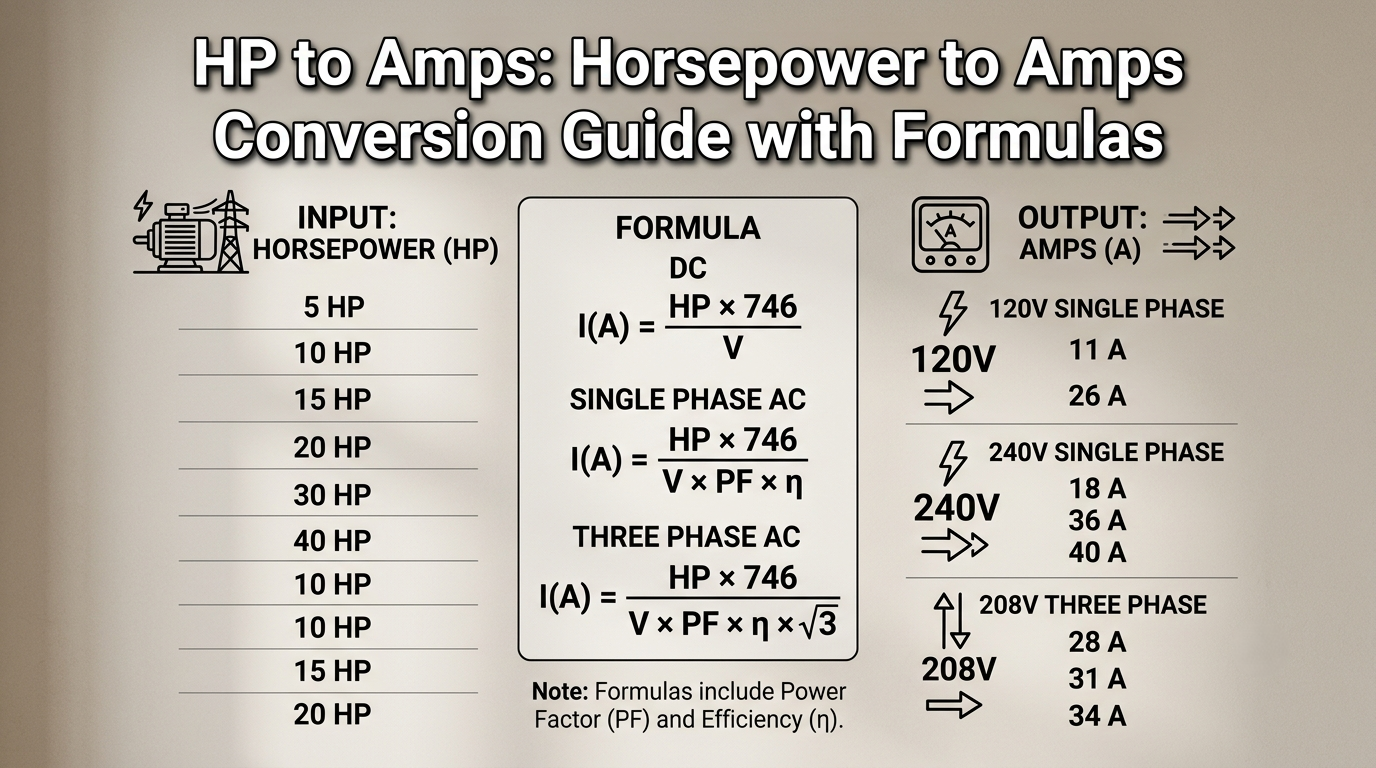
For single-phase AC motors, the hp to amps formula accounts for voltage, motor efficiency, and power factor:
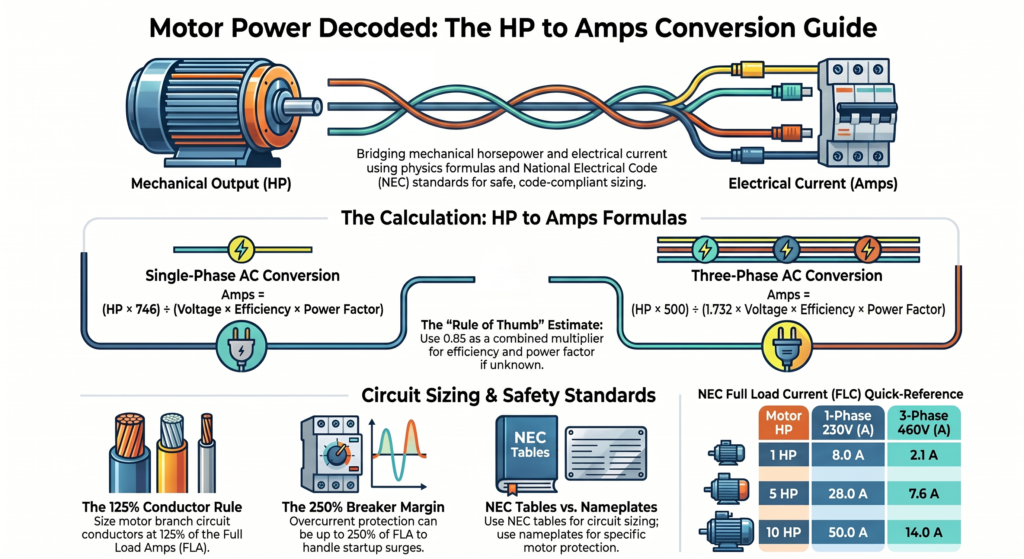
Amps = (HP × 746) ÷ (Voltage × Efficiency × Power Factor)
In practical applications where motor efficiency and power factor are not specified on nameplate, a simplified version is commonly used:
Amps = (HP × 746) ÷ (Voltage × 0.85)
The 0.85 factor represents a combined approximate efficiency and power factor for typical single-phase motors. For a 1 HP motor on a 115-volt single-phase circuit: Amps = (1 × 746) ÷ (115 × 0.85) = 746 ÷ 97.75 = 7.63 amps — which NEC Table 430.248 rounds to approximately 8.0 FLA at 115 V. At 230 volts, the same 1 HP motor draws approximately 4.0 amps full load.
After converting horsepower to electrical load, use our Home Appliance Energy Calculator to estimate energy consumption.
Three-Phase HP to Amps Formula
For three-phase AC motors, the hp to amps formula includes the square root of 3 (approximately 1.732) because three-phase power distributes across three conductors:
Amps = (HP × 746) ÷ (√3 × Voltage × Efficiency × Power Factor)
Using the same simplified efficiency/power factor approximation for practical calculations:
Amps = (HP × 746) ÷ (1.732 × Voltage × 0.85)
For a 10 HP three-phase motor on a 460-volt supply: Amps = (10 × 746) ÷ (1.732 × 460 × 0.85) = 7,460 ÷ 677.6 = 11.01 amps — which aligns closely with the NEC Table 430.250 value of approximately 14 FLA at 460 V (the NEC values include conservative safety margins). This is why always cross-referencing calculated results against NEC tables matters for code-compliant installations.
DC Motor HP to Amps Formula
For DC motors, the hp to amps conversion is simpler because there is no phase factor to account for:
Amps = (HP × 746) ÷ (Voltage × Efficiency)
For a 5 HP DC motor operating at 240 V with 90% efficiency: Amps = (5 × 746) ÷ (240 × 0.90) = 3,730 ÷ 216 = 17.27 amps. DC motor applications are common in battery backup systems and battery-operated equipment, where accurate hp to amps conversion is essential for sizing the battery bank, inverter, and cabling correctly.
Once you know the power consumption of your motor or appliance, use our Electricity Bill Calculator to estimate monthly operating costs.
Motor HP to Amps Chart: NEC Full Load Current Reference Table
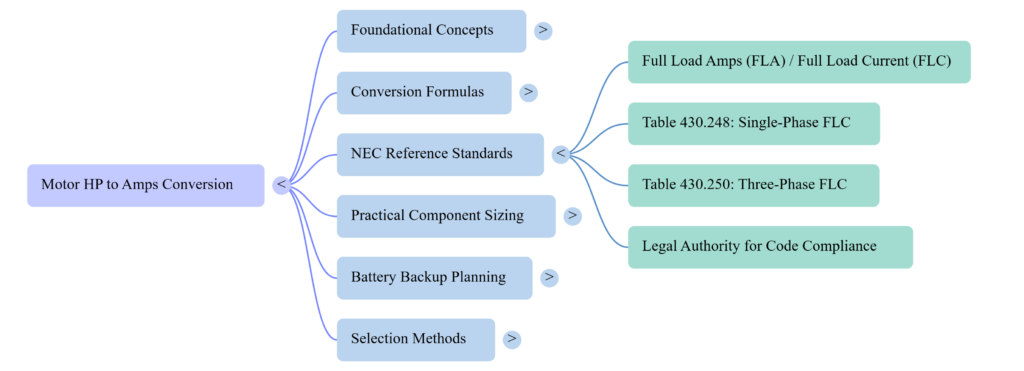
The following motor hp to amps chart is based on NEC Table 430.248 (single-phase) and NEC Table 430.250 (three-phase) Full Load Current values — the authoritative reference for motor circuit sizing in the United States. These figures already incorporate standard motor efficiency and power factor assumptions and are the values licensed electricians use to size motor circuits:
| Motor HP | Single-Phase 115 V (A) | Single-Phase 230 V (A) | 3-Phase 230 V (A) | 3-Phase 460 V (A) |
| 0.5 HP | 9.8 | 4.9 | 2.2 | 1.1 |
| 0.75 HP | 13.8 | 6.9 | 3.2 | 1.6 |
| 1 HP | 16.0 | 8.0 | 4.2 | 2.1 |
| 1.5 HP | 20.0 | 10.0 | 6.0 | 3.0 |
| 2 HP | 24.0 | 12.0 | 6.8 | 3.4 |
| 3 HP | 34.0 | 17.0 | 9.6 | 4.8 |
| 5 HP | 56.0 | 28.0 | 15.2 | 7.6 |
| 7.5 HP | 80.0 | 40.0 | 22.0 | 11.0 |
| 10 HP | 100 | 50.0 | 28.0 | 14.0 |
| 15 HP | — | — | 42.0 | 21.0 |
| 20 HP | — | — | 54.0 | 27.0 |
| 25 HP | — | — | 68.0 | 34.0 |
| 30 HP | — | — | 80.0 | 40.0 |
| 50 HP | — | — | 130 | 65.0 |
| 75 HP | — | — | 192 | 96.0 |
| 100 HP | — | — | 248 | 124 |
Note: ‘—’ indicates that NEC does not list single-phase FLA values for motors above 10 HP, as these large motors are almost exclusively operated on three-phase power systems. Always verify the actual FLA for the operating voltage on the motor nameplate.
You can also use our Amps to kW Calculator guide for additional electrical conversion formulas.
10 HP 3 Phase Motor Amps: A Detailed Worked Example
The 10 HP 3 phase motor is one of the most commonly sized motors in light industrial and commercial applications, making it an excellent case study for applying the hp to amps formula and chart together.
From the motor hp to amps chart above, a 10 HP three-phase motor draws 28 amps FLA at 230 V and 14 amps FLA at 460 V. These are the NEC-defined Full Load Current values used for all circuit sizing decisions.
Sizing the Circuit for a 10 HP 3 Phase Motor
NEC Article 430 requires that motor branch circuit conductors be sized at a minimum of 125% of the motor’s Full Load Current (not 80% as with general circuits — motor circuits use a different multiplier for the conductors). For a 10 HP motor at 460 V: 14 A × 1.25 = 17.5 amps minimum conductor ampacity → use 12 AWG copper wire rated for 20 amps or larger.
For the branch circuit overcurrent protection (breaker), NEC 430.52 permits sizing up to 250% of the FLA for inverse-time circuit breakers to accommodate motor starting surge current: 14 A × 2.5 = 35 amps → use a 35-amp or 40-amp breaker (next standard size up). This is why motor circuits use larger breakers relative to conductor size than standard circuits — the startup surge would trip a smaller breaker that is otherwise correctly sized for running current.
How to Use an HP to Amps Calculator
An online hp to amps calculator automates the formula above by accepting three inputs — horsepower rating, supply voltage, and motor phase (single-phase, three-phase, or DC) — and returning the calculated Full Load Current in amps. The best hp to amps calculators also allow you to input power factor and efficiency directly from the motor nameplate for maximum accuracy.
When using an hp to amps calculator for battery backup system planning, keep in mind that motors draw significantly higher current during startup than during normal running. Startup (locked rotor) current can be five to eight times the FLA. Rate the battery backup inverter for the motor’s startup surge, not just its running load. Always note both the FLA (from the chart or formula) and the locked rotor amps (from the motor nameplate) when specifying battery backup capacity for motor-driven equipment.
HP to Amps Conversion for Battery Backup Planning
When using hp to amps results to plan a battery backup system, the key figure is the running current (FLA) for sustained battery capacity, and the peak or startup current for inverter sizing. For a pump or compressor motor on a 10 HP three-phase 460 V circuit drawing 14 FLA and perhaps 98 locked rotor amps at startup, your battery backup inverter must be rated for at least 98 amps peak output at 460 V — or equivalently, a larger inverter configured to deliver that peak. The battery bank capacity is then calculated based on the FLA and the desired runtime: 14 A × 460 V × runtime in hours = watt-hours of battery capacity needed.
Pros and Cons of Calculating HP to Amps Manually vs. Using a Chart
Why Electricians Prefer Using the NEC Motor HP to Amps Chart
- NEC table values already incorporate conservative efficiency and power factor assumptions that protect against under-sizing in real-world conditions
- Licensed electricians use NEC FLA values as the legally required reference when sizing motor circuits under the National Electrical Code.
- Chart lookup is faster and less error-prone than manual formula application for standard AC motor sizes
- NEC table values account for range of real motor nameplate variations at each HP rating rather than single idealized calculation
- Cross-referencing the chart against the motor nameplate FLA catches discrepancies caused by non-standard motor designs or unusual efficiency ratings
When Manual HP to Amps Formula Calculation Is Necessary
- DC motor circuits — NEC FLA tables cover AC motors only; DC motor sizing requires manual formula with motor nameplate efficiency
- Non-standard voltages outside the 115 V / 230 V / 460 V / 575 V values covered in NEC tables require formula calculation
- Battery backup inverter sizing requires wattage-based calculation that starts from the hp to amps formula rather than NEC table alone
- International motor specifications using different voltage standards (e.g., 400 V three-phase common in Europe) require manual formula application
- Engineering calculations requiring exact efficiency and power factor values from a specific motor nameplate rather than NEC approximations
Correct amp calculations are essential for selecting circuit protection. Read our Breaker Size Calculator guide for more information.
Which HP to Amps Conversion Method Is Best for Your Application?
Best for Standard Residential and Commercial Motor Wiring
Use the NEC motor hp to amps chart as your primary reference and verify against the motor nameplate FLA value. For any standard AC motor on 115 V, 230 V, 460 V, or 575 V single-phase or three-phase circuits, the NEC table gives you the code-compliant Full Load Current in seconds. This is the method every licensed electrician uses for standard motor circuit sizing, and it is the most reliable approach for conductor and breaker selection.
Best for Industrial Motor and Drive Applications
For variable frequency drives (VFDs), soft starters, or motors with non-standard efficiency ratings, always start with the motor nameplate FLA and the drive manufacturer’s specifications. The nameplate full load current is the most accurate single value for sizing the motor branch circuit — more reliable than either the NEC table or a formula calculation for any specific motor in isolation. Cross-reference the nameplate against the NEC table to confirm the value is within a reasonable range, then size conductors at 125% of nameplate FLA per NEC 430.22.
Best for Battery Backup and Generator Sizing with Motor Loads
For battery backup system planning, use the hp to amps conversion to calculate both running wattage (HP × 746 ÷ efficiency) and peak startup demand (locked rotor amps from the nameplate × voltage). Size the inverter for peak startup current and battery bank for running wattage multiplied by your required runtime in hours. An hp to amps calculator that handles DC power calculations is particularly useful here, as battery-fed inverter systems operate in DC on the battery side and require careful power translation between the DC battery voltage and the AC motor supply voltage.
Conclusion
Converting hp to amps is a foundational calculation in electrical engineering, motor circuit design, and power system planning. The relationship between horsepower, voltage, efficiency, and current is clearly defined by physics and codified by the NEC — giving engineers, electricians, and system designers a reliable framework for making every sizing decision correctly the first time.
For standard AC motors, the NEC motor hp to amps chart provides the most code-aligned Full Load Current values and should be your first reference for any single-phase or three-phase motor circuit. For DC motors, battery backup systems, or non-standard voltage configurations, the manual hp to amps formula — modified for the appropriate phase, efficiency, and power factor — gives you the flexibility to calculate accurately for any condition.
Explore our Smart Home guides for electrical calculations, appliance energy usage, and home efficiency tips.
Whether you are sizing a 10 HP 3 phase motor circuit, planning the electrical system for a new industrial installation, or determining the battery capacity needed to run a pump motor during a power outage, understanding and applying the correct hp to amps conversion is the first step toward a safe, compliant, and reliable electrical system.
Frequently Asked Questions
1. What is the hp to amps formula for a single-phase motor?
The precise single-phase hp to amps formula is: Amps = (HP × 746) ÷ (Voltage × Efficiency × Power Factor). For practical calculations where nameplate efficiency and power factor are not available, the simplified version Amps = (HP × 746) ÷ (Voltage × 0.85) provides a reliable estimate. For code-compliant motor circuit sizing, always cross-reference the result against NEC Table 430.248 Full Load Current values.
2. What is the hp to amps 3 phase formula?
The three-phase hp to amps formula is: Amps = (HP × 746) ÷ (√3 × Voltage × Efficiency × Power Factor). Using the simplified combined efficiency/power factor approximation: Amps = (HP × 746) ÷ (1.732 × Voltage × 0.85). For a 10 HP motor at 460 V three-phase, this gives approximately 11 amps calculated — compared to the NEC Table 430.250 value of 14 amps FLA, which includes conservative safety margins and should be used for actual circuit sizing.
3. How many amps does a 10 HP 3 phase motor draw?
According to NEC Table 430.250, a 10 HP three-phase motor draws 28 amps FLA at 230 V and 14 amps FLA at 460 V. At 575 V three-phase, the same motor draws approximately 11 amps FLA. Always verify against the motor nameplate, as actual FLA can vary slightly depending on motor manufacturer and design efficiency class.
4. Can I use an online hp to amps calculator instead of NEC tables?
Yes — a quality hp to amps calculator that incorporates power factor, efficiency, and phase selection will produce results consistent with NEC tables for standard motor sizes and voltages. However, for any permitted electrical installation, the NEC Full Load Current tables (430.248 for single-phase and 430.250 for three-phase) are the authoritative reference. Use an hp to amps calculator to check your work and for quick reference, then confirm against the applicable NEC table before finalizing any conductor or overcurrent protection selection.
5. Why is the motor nameplate FLA more important than the calculated hp to amps value?
The motor nameplate Full Load Amps (FLA) reflects the actual current draw of that specific motor at full mechanical load under real operating conditions, including its actual efficiency, power factor, and design class. The hp to amps formula and NEC tables use standardized assumptions that may not perfectly match every motor. NEC 430.6(A) specifies that the nameplate FLA should be used over the NEC table values when the two differ by more than a small margin. For the most accurate circuit sizing, always verify the calculated or tabulated value against the motor nameplate.
6. How do I use hp to amps conversion for battery backup planning?
For battery backup systems supporting motor loads, use the hp to amps conversion to determine two figures: the running current (FLA from the chart or formula) for battery capacity sizing, and the locked rotor current (from the motor nameplate) for inverter peak output sizing. Calculate battery capacity as: Running Watts × Runtime Hours = Watt-Hours needed. Running watts = FLA × Supply Voltage. Then add a 20–25% safety margin for battery inefficiency and depth of discharge limits.