LED Lights Price, Power Consumption & Monthly Costs Explained
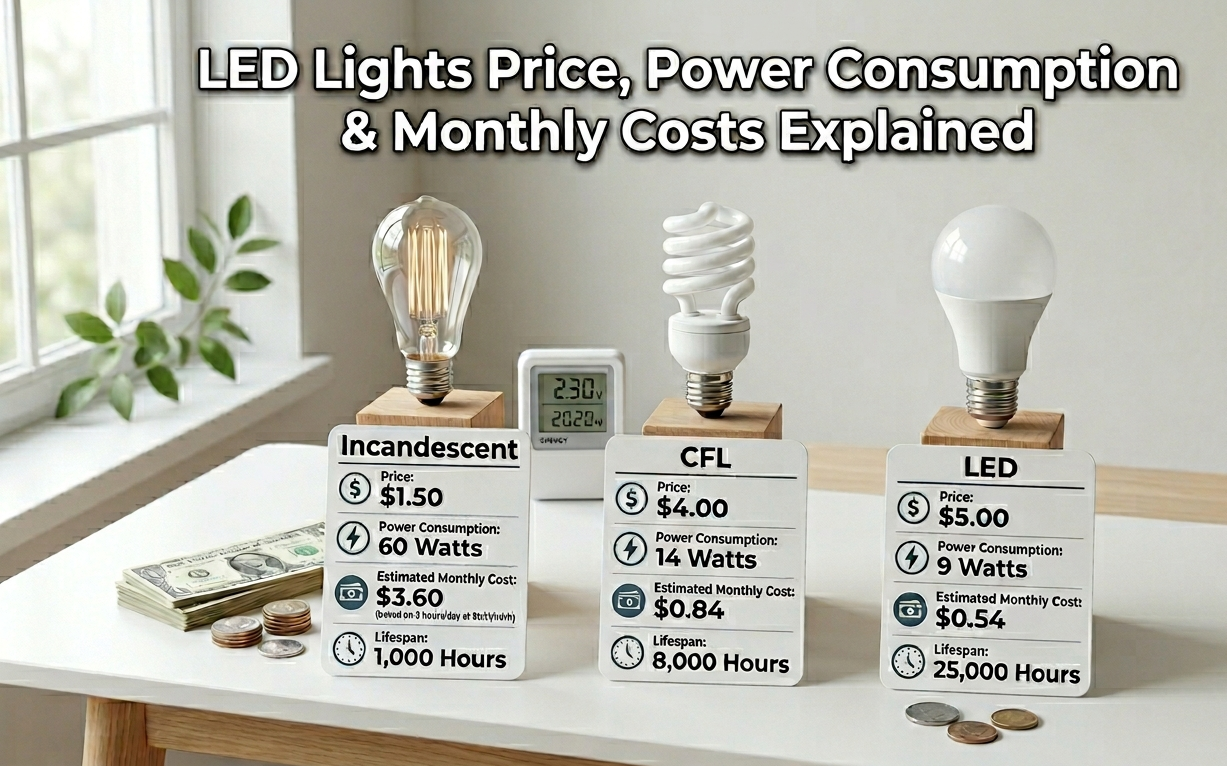
Understanding LED lights price is no longer just about what you pay at the shop — it is equally about what you pay on your electricity bill every month. The real value of LED lighting lies in the combination of affordable purchase prices and dramatically lower running costs compared to every other bulb technology available today.
Whether you are calculating the 9 watt LED bulb power consumption per hour for your home energy audit, comparing LED lights price options before a bulk purchase, or simply trying to understand why switching to LED reduces your electricity bill so significantly, this complete guide delivers every number you need — with worked examples, a full reference table, and practical advice tailored to both Indian and global electricity markets.
Table of contents
- What Are LED Lights and Why Do They Cost Less to Run?
- How Many Watts Does a Lamp Use? LED vs Other Bulb Types
- LED Bulb Power Consumption Reference Table
- 9 Watt LED Bulb Power Consumption Per Month
- How Much Do LED Lights Cost to Run?
- LED Lights Price Guide: What You Pay to Buy
- Tips to Maximise LED Lighting Energy Savings
- Conclusion
What Are LED Lights and Why Do They Cost Less to Run?
LED (Light Emitting Diode) bulbs produce light through a semiconductor process that converts electricity directly into photons. Unlike incandescent bulbs, which produce light as a byproduct of heating a metal filament to extreme temperatures, LEDs generate almost no wasted heat. This fundamental difference is why LED lights price in electricity terms is 80–90% lower than incandescent lighting for identical brightness levels.
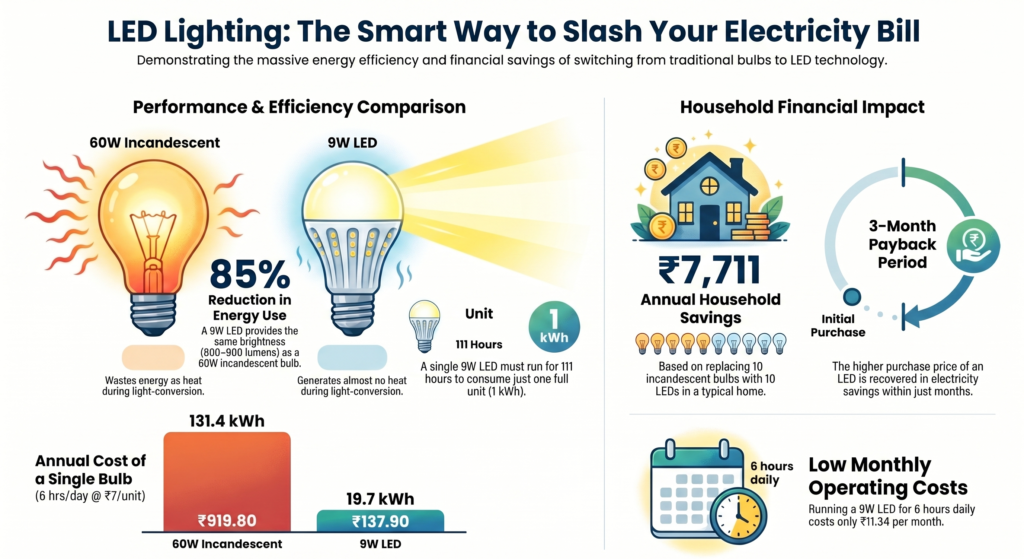
A standard 9W LED bulb produces approximately 800–900 lumens — the same brightness as a 60W incandescent. The incandescent uses 60 watts; the LED uses 9. Running that single bulb for 6 hours a day over a full year, the incandescent consumes 131.4 kWh while the LED consumes just 19.7 kWh. At ₹7/unit, the incandescent costs ₹919.80 annually versus ₹137.90 for the LED — a saving of ₹781.90 per bulb per year.
Multiply that across every light in a typical home of 10–15 bulbs and the annual electricity saving from switching to LED runs into thousands of rupees. That is why understanding both the purchase LED lights price and the running cost matters equally for household financial planning.
How Many Watts Does a Lamp Use? LED vs Other Bulb Types
A common question before replacing bulbs is: how many watts does a lamp use when running different bulb types?
The answer depends entirely on the bulb installed, not the lamp fixture itself. The same table lamp accepts different bulbs with vastly different wattage:
- Incandescent bulb in that lamp: 40W–60W
- CFL (compact fluorescent) bulb: 11W–15W for equivalent brightness
- LED bulb for the same brightness: 5W–9W
For ceiling light fixtures that previously used 100W incandescent bulbs, a 14W–15W LED produces equivalent or greater brightness. For a bathroom vanity with four fixture points that each held 60W bulbs (240W total), replacing with 9W LEDs drops total fixture consumption to 36W — an 85% reduction from a single fixture.
Standard floor lamps with a single bulb socket typically draw 7W–15W with a modern LED, compared to 60W–100W with the incandescent they replaced. For track lighting and recessed downlights, individual LED spots draw 5W–8W versus 35W–50W for halogen equivalents.
To estimate the monthly operating cost of LED lights in your home, use our Electricity Bill Calculator.
The lamp fixture itself draws zero electricity — the wattage is entirely determined by the bulb installed.
LED Bulb Power Consumption Reference Table
This table covers the most common LED bulb wattages with their incandescent equivalents, lumen output, and monthly electricity consumption at 6 hours daily use.
| LED Wattage | Incandescent Equiv. | Lumens | kWh/Hour | Units/Month (6hrs/day) | Monthly Cost (₹7/unit) |
|---|---|---|---|---|---|
| 5W LED | 40W | 400–450 lm | 0.005 kWh | 0.9 units | ₹6.30 |
| 7W LED | 50W | 600–650 lm | 0.007 kWh | 1.26 units | ₹8.82 |
| 9W LED | 60W | 800–900 lm | 0.009 kWh | 1.62 units | ₹11.34 |
| 10W LED | 75W | 900–1000 lm | 0.010 kWh | 1.8 units | ₹12.60 |
| 12W LED | 100W | 1100–1200 lm | 0.012 kWh | 2.16 units | ₹15.12 |
| 15W LED | 120W | 1400–1500 lm | 0.015 kWh | 2.7 units | ₹18.90 |
| 20W LED | 150W | 1800–2000 lm | 0.020 kWh | 3.6 units | ₹25.20 |
Monthly units calculated as: Watts × 6 hrs × 30 days ÷ 1,000. This table makes the LED lights price in electricity terms immediately visible and comparable across wattages.
9 Watt LED Bulb Power Consumption Per Hour
The 9 watt LED bulb power consumption per hour is among the most searched electricity calculations in South Asia — and the answer is simple:
9W ÷ 1,000 = 0.009 kWh per hour
At a tariff of ₹7 per unit: 0.009 × ₹7 = ₹0.063 per hour (less than 7 paise per hour).
Over a full day at 6 hours: 0.009 × 6 = 0.054 kWh/day = approximately ₹0.38 per day.
This means running a single 9W LED for an entire month costs just over ₹11 at average Indian electricity tariffs — making LED the most economical lighting solution available at any price point.
You can estimate the power consumption of LED lighting and other household devices using our Home Appliance Energy Calculator.
9 Watt LED Bulb Consumption Per Hour: Units Explained
For Indian electricity bills, the relevant unit is kWh (kilowatt-hour), commonly called a “unit.” Understanding 9 watt LED bulb consumption per hour in units:
- 1 unit = 1,000 watt-hours = 1 kWh
- A 9W LED uses 0.009 units per hour
- To consume 1 full unit, a single 9W LED must run for 111 hours
This is the reason LED lighting has such a negligible impact on electricity bills — the 9 watt LED bulb unit consumption per hour is so small that even 10 such bulbs running simultaneously for 6 hours consume only 0.54 units per day, or roughly 16 units per month for the entire lighting circuit.
10 Watt LED Bulb Power Consumption Per Hour
The 10 watt LED bulb power consumption per hour follows the same formula:
10W ÷ 1,000 = 0.010 kWh per hour
A 10W LED costs ₹0.07 per hour at ₹7/unit — barely more than the 9W version but delivering noticeably more brightness (900–1,000 lumens versus 800–900 lumens). For living rooms and kitchen work areas where brightness matters, the 10W–12W range delivers the best balance of lumen output and electricity cost.
Monthly consumption at 6 hours/day: 0.010 × 6 × 30 = 1.8 units/month = ₹12.60 at ₹7/unit.
If you’re planning to upgrade your lighting system, read our Panel Light Guide to LED Ceiling Panel Lights for more insights.
20 Watt LED Bulb Unit Consumption Per Hour
20 watt LED bulb unit consumption per hour:
20W ÷ 1,000 = 0.020 kWh (units) per hour
The 20W LED is the high-brightness option — replacing 150W incandescent bulbs and delivering 1,800–2,000 lumens suitable for large rooms, outdoor areas, garages, and commercial display lighting. Despite the higher wattage, its monthly cost remains very manageable:
Monthly at 6 hours/day: 0.020 × 6 × 30 = 3.6 units/month = ₹25.20 at ₹7/unit.
Compare this to the 150W incandescent it replaces: 0.15 × 6 × 30 = 27 units/month = ₹189/month. The 20W LED lights price in electricity is 87% lower than its incandescent equivalent — ₹25 versus ₹189 every single month.
9 Watt LED Bulb Power Consumption Per Month
For users tracking monthly electricity usage, here is the 9 watt LED bulb power consumption per month across different daily usage patterns:
- 4 hours/day: 9W × 4 × 30 ÷ 1,000 = 1.08 units/month = ₹7.56
- 6 hours/day: 9W × 6 × 30 ÷ 1,000 = 1.62 units/month = ₹11.34
- 8 hours/day: 9W × 8 × 30 ÷ 1,000 = 2.16 units/month = ₹15.12
- 10 hours/day: 9W × 10 × 30 ÷ 1,000 = 2.70 units/month = ₹18.90
- 12 hours/day (continuous overnight): 9W × 12 × 30 ÷ 1,000 = 3.24 units/month = ₹22.68
Even at 12 continuous hours per day, a single 9W LED bulb costs less than ₹23 per month. For households that leave corridor or security lights on overnight, the 9 watt LED bulb power consumption per month remains among the most affordable lighting options available.
For Philippine users on Meralco rates (~₱12/kWh): 1.62 units × ₱12 = ₱19.44/month at 6 hours daily — equally affordable.
You can estimate the power consumption of LED lighting and other devices using our Home Appliance Energy Calculator.
How Much Do LED Lights Cost to Run?
When calculating how much do LED lights cost to run at the whole-home level, the numbers become genuinely compelling.
Scenario — 10 LED bulbs averaging 9W each, 6 hours/day: Total draw: 10 × 9W = 90W Monthly kWh: 90W × 6 × 30 ÷ 1,000 = 16.2 units/month Monthly cost at ₹7/unit: ₹113.40
Same scenario with 60W incandescent bulbs (pre-LED): Total draw: 10 × 60W = 600W Monthly kWh: 600W × 6 × 30 ÷ 1,000 = 108 units/month Monthly cost at ₹7/unit: ₹756
Monthly saving by switching to LED: ₹642.60 Annual saving: ₹7,711.20
This is why understanding LED lights price in running cost terms matters as much as purchase price. A household still running incandescent or even CFL lighting pays an electricity penalty of ₹500–₹800 per month compared to full LED conversion — a recurring cost that continues indefinitely.
LED Lights Price Guide: What You Pay to Buy
Understanding LED lights price at the point of purchase helps households plan upgrades efficiently. Here are typical price ranges in the Indian market for different LED product categories:
Standard LED bulbs (B22/E27 base, 7W–15W): Entry-level: ₹30–₹80 per bulb Mid-range branded (Syska, Philips, Havells): ₹80–₹200 per bulb Premium with warranty: ₹150–₹300 per bulb
LED tube lights (2-foot and 4-foot T8): Entry-level: ₹150–₹250 Branded 4-foot 20W: ₹250–₹450 Batten-style integrated: ₹300–₹600
LED panel lights (recessed ceiling): 6W round downlight: ₹120–₹300 18W square panel: ₹400–₹900 36W large panel: ₹800–₹2,000
Smart LED bulbs (Wi-Fi/Bluetooth, color-changing): Entry smart bulb: ₹400–₹700 Premium color-changing: ₹700–₹2,000
LED strip lights: Basic warm white per meter: ₹80–₹150 RGB smart strips per meter: ₹200–₹500
The LED lights price premium over incandescent is real but recovers within months through electricity savings. A ₹150 branded 9W LED replacing a ₹20 incandescent 60W bulb pays back the price difference in approximately 3–4 months at typical Indian usage patterns — then delivers free savings for the remaining 4–8 years of its rated lifespan.
If you’re planning a lighting upgrade, read our Panel Light Guide to LED Ceiling Panel Lights for more insights.
Tips to Maximise LED Lighting Energy Savings
Once you have switched to LED, these strategies push electricity savings even further:
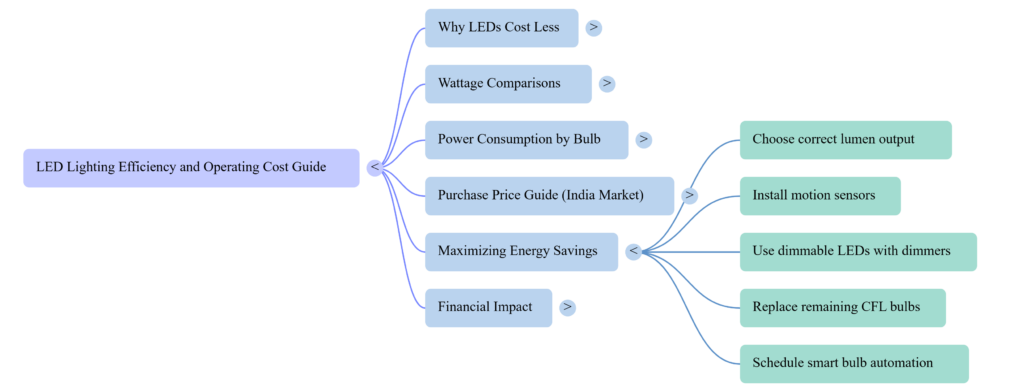
Choose the right lumen output, not just wattage. A 7W LED (600 lumens) is sufficient for bedrooms and hallways. A 12W–15W LED suits living rooms and kitchens. Using a 15W where a 7W would suffice doubles your lighting electricity cost for no additional benefit.
Install motion sensors in low-traffic areas. Corridors, storerooms, bathrooms, and garages are ideal locations. A motion sensor turns the light off within 30–90 seconds of the room emptying — eliminating hours of unnecessary daily operation.
Use dimmers with dimmable LEDs. Running a dimmable LED at 70% brightness reduces its power consumption proportionally. Evening ambient lighting at half brightness cuts electricity use in half compared to full output.
Replace remaining CFL bulbs. Many households switched from incandescent to CFL years ago but never completed the LED upgrade. A 9W LED and an 11W CFL produce similar brightness — but the LED costs 18% less to run and lasts 2–3 times longer without the mercury disposal concern.
Schedule smart bulbs with automation. Smart LED bulbs with scheduling features eliminate forgotten lights entirely. Setting a bedtime shutoff schedule for children’s rooms and a dawn-on/dusk-off schedule for exterior lights can save 1–3 units per day with zero behavioral change required.
Want to reduce your overall electricity bill? Check out our Broadband Router Electricity Cost guide to understand how everyday devices consume energy.
Conclusion
The true value of LED lights price only becomes clear when you calculate both sides of the equation: what you pay at purchase, and what you pay to run the light every month for the next 5–10 years.
A ₹150 branded 9W LED bulb costs ₹11/month to run at typical Indian usage. A ₹20 incandescent costs ₹63/month for the same brightness. Over a single year, the LED saves ₹624 per bulb — and pays back its purchase cost in under three months.
With 9 watt LED bulb power consumption per hour at just 0.009 kWh, and monthly costs well under ₹20 per bulb for most usage patterns, LED lighting has made household electricity savings accessible at a scale that was impossible with any previous lighting technology.
Use the reference table and formulas in this guide to calculate exactly what your current lighting setup costs per month — then use the LED lights price data in the buying guide to plan the most financially efficient upgrade path for your home.
Explore our Smart Home guides for lighting solutions, energy-saving tips, and home efficiency calculators.
Frequently Asked Questions
Q1: How much does a 9W LED bulb cost to run per month?
A 9W LED bulb used for 6 hours daily consumes 1.62 units per month. At ₹7/unit, that is approximately ₹11.34 per month — less than ₹1 per day. Even at 10 hours/day, monthly cost stays below ₹19.
Q2: How many units does a 10W LED bulb consume per hour?
A 10W LED bulb consumes exactly 0.010 kWh (units) per hour. It takes 100 hours of continuous operation to consume 1 full unit of electricity — making it one of the most economical lighting options available for any room.
Q3: Are LED lights cheaper to run than CFL bulbs?
Yes — meaningfully so. A 9W LED replaces a 60W incandescent but also replaces an 11W CFL. The LED uses 18% less electricity than the CFL equivalent, lasts 2–3 times longer, and contains no mercury. Over a 3-year period, the LED saves both electricity and replacement costs compared to CFL.
Q4: What is the monthly cost of running 10 LED bulbs in a home?
Ten 9W LED bulbs running 6 hours/day consume approximately 16.2 units per month — costing ₹113 at ₹7/unit. The same 10 slots with 60W incandescent bulbs would cost ₹756/month. LED lighting cuts whole-home lighting costs by approximately 85%.
Q5: What is a good LED lights price for quality bulbs in India?
For reliable everyday use, branded LED bulbs in the ₹80–₹200 range (Syska, Philips, Crompton, Havells) offer the best balance of quality, warranty, and LED lights price value. Ultra-cheap bulbs under ₹40 often have inferior drivers that cause flickering, shorter lifespan, and less consistent light output.
Q6: How much electricity does a 20W LED use per month?
A 20W LED bulb at 6 hours/day consumes 3.6 units per month = ₹25.20 at ₹7/unit. The 150W incandescent it replaces would consume 27 units/month = ₹189 — making the 20W LED’s monthly LED lights price in electricity 87% cheaper.