AC Power Consumption Calculator: Calculate Your Air Conditioner’s Electricity Bill
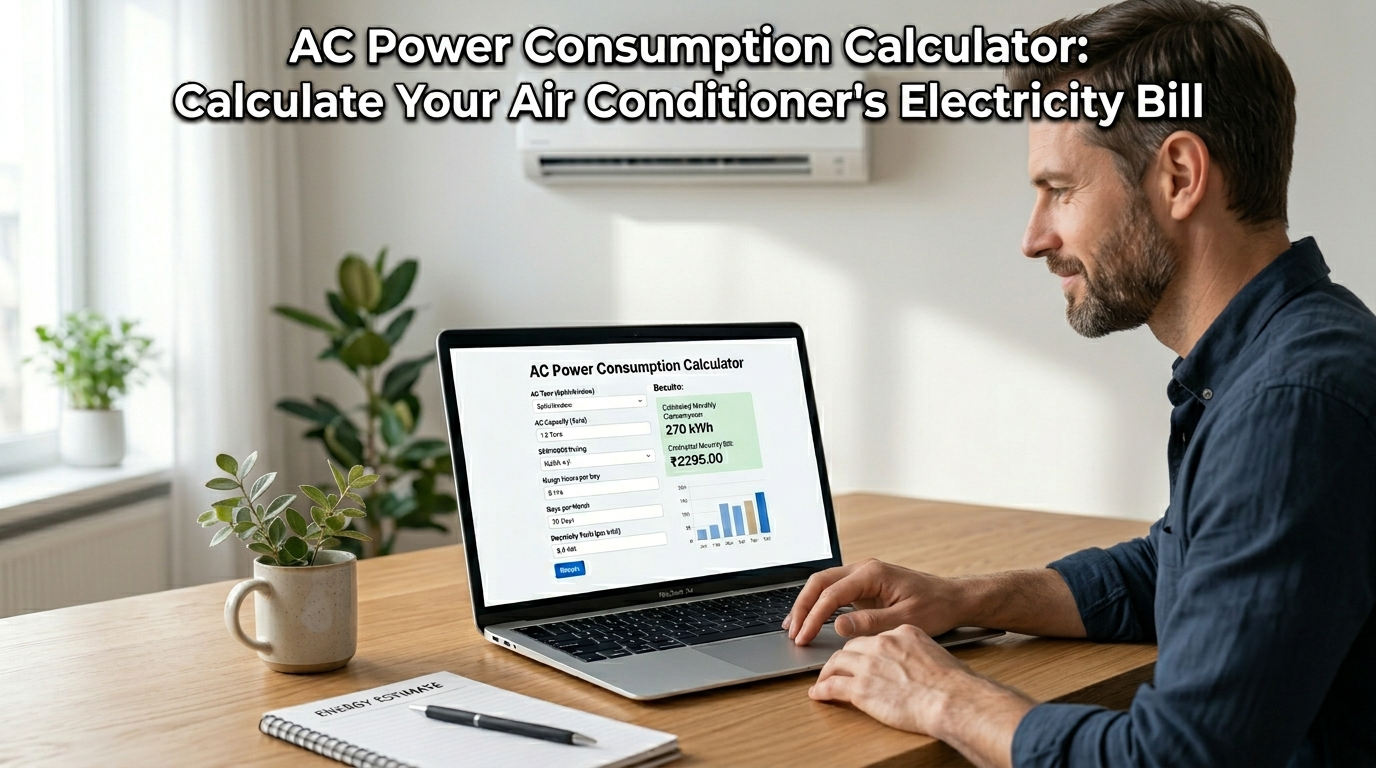
For millions of households across India, Pakistan, the Philippines, and Southeast Asia, the air conditioner is the single largest contributor to the monthly electricity bill — often accounting for 40–60% of total consumption during summer months. Yet most people pay that bill without ever knowing exactly what their specific AC unit costs to run each day.
An AC power consumption calculator changes that. It takes your air conditioner’s wattage or tonnage, your daily running hours, and your local electricity rate — and gives you a precise rupee, peso, or dollar figure for exactly what your AC costs per day, per month, and per season. This complete guide covers the formula, a full reference table, inverter versus non-inverter comparisons, and actionable tips to bring that number down without sacrificing comfort.
Table of contents
- What Is an AC Power Consumption Calculator?
- AC Watts: How Much Power Does an Air Conditioner Use?
- AC Power Consumption Formula Explained
- AC Power Consumption Reference Table
- 1 Ton AC Watt Calculator: Full Breakdown
- AC Electricity Consumption by Tonnage
- How Much Electricity Does an AC Use? Inverter vs Non-Inverter
- AC Electricity Bill Calculator: Monthly Cost Estimates
- How to Reduce AC Power Consumption?
- Energy Efficient AC: Star Ratings and What They Mean
- Conclusion
What Is an AC Power Consumption Calculator?
An AC power consumption calculator is a tool that estimates how many electricity units (kWh) your air conditioner consumes and what that consumption costs based on your local tariff. It works by combining three inputs: the AC unit’s input wattage (or tonnage), the number of hours it runs daily, and the number of days in the billing period.
The output — kilowatt-hours consumed — is the same unit your electricity meter measures. Multiply it by your per-unit rate and you have your AC’s exact contribution to your monthly bill.
Unlike your total electricity statement, which bundles all appliances together, an AC power consumption calculator isolates the air conditioner’s cost. This lets you make informed decisions: whether to adjust thermostat settings, upgrade to an inverter model, add insulation to reduce cooling load, or simply understand why your summer bill is triple your winter bill.
Every household that runs an AC regularly benefits from running this calculation at least once — the results are often surprising.
AC Watts: How Much Power Does an Air Conditioner Use?
Understanding AC watts is the essential first step in any consumption calculation. The wattage of an air conditioner refers to its input power — how much electricity it draws from your home’s supply — not its cooling output.
To estimate your monthly air conditioner expenses, use our Electricity Bill Calculator.
Typical AC watt ranges by tonnage:
- 0.75 ton AC: 700W–950W input
- 1 ton AC: 900W–1,400W input
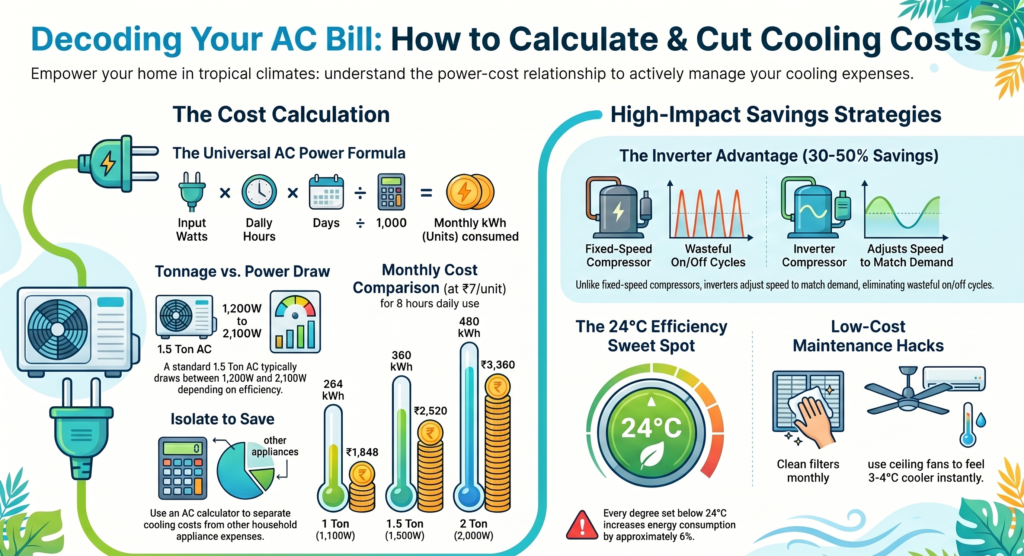
- 1.5 ton AC: 1,200W–2,100W input
- 2 ton AC: 1,800W–2,800W input
The wide ranges reflect two critical variables: whether the unit is inverter or non-inverter, and its star efficiency rating. A 5-star inverter 1.5 ton AC may draw as little as 1,100W at moderate load, while a 2-star non-inverter 1.5 ton unit draws a constant 1,800W whenever the compressor runs.
AC watt figures are always printed on the unit’s nameplate or specification sheet. For the most accurate AC power consumption calculation, use the input wattage from the product documentation — not the cooling capacity (BTU) or tonnage alone.
AC Power Consumption Formula Explained
The AC power consumption formula is identical to any other appliance energy calculation:
(Input Watts × Daily Hours × Days) ÷ 1,000 = kWh (Units)
Once you have your kWh figure, multiply by your electricity rate to get the cost:
kWh × Tariff Rate = Cost
Worked example — 1.5 ton non-inverter AC at 1,600W, 8 hours/day, 30 days: 1,600W × 8 hrs × 30 days ÷ 1,000 = 384 kWh (units) per month
At ₹7/unit (Indian average): 384 × ₹7 = ₹2,688 per month At ₱12/kWh (Philippines Meralco average): 384 × ₱12 = ₱4,608 per month
This single calculation explains why AC dominates electricity bills in tropical climates. No other common household appliance approaches this consumption level at typical usage hours.
How Many Units of Electricity Does an AC Consume Per Day?
For daily unit tracking — useful for households monitoring smart meter readings — the calculation simplifies to:
Input Watts × Daily Hours ÷ 1,000 = Units per Day
Daily consumption by running hours (1.5 ton AC at 1,500W):
- 6 hours/day: 1,500 × 6 ÷ 1,000 = 9 units/day
- 8 hours/day: 1,500 × 8 ÷ 1,000 = 12 units/day
- 10 hours/day: 1,500 × 10 ÷ 1,000 = 15 units/day
- 12 hours/day: 1,500 × 12 ÷ 1,000 = 18 units/day
These figures explain how much unit of electricity is consumed by AC per day at the most common usage level. A household running a 1.5 ton AC for 10 hours daily consumes approximately 450 units from that single appliance per month — a figure that pushes many Indian households into higher tariff slabs.
You can estimate the power consumption of your air conditioner and other appliances using our Home Appliance Energy Calculator.
AC Power Consumption Reference Table
This table provides a complete reference for AC watts consumption, daily units, and estimated monthly costs across common AC capacities. All figures assume 8 hours of daily operation and non-inverter performance at rated load.
| AC Capacity | Input Watts | Units/Day (8 hrs) | Units/Month | Monthly Cost (₹7/unit) | Monthly Cost (₱12/kWh) |
|---|---|---|---|---|---|
| 0.75 Ton | 800W | 6.4 units | 192 units | ₹1,344 | ₱2,304 |
| 1 Ton | 1,100W | 8.8 units | 264 units | ₹1,848 | ₱3,168 |
| 1.5 Ton | 1,500W | 12 units | 360 units | ₹2,520 | ₱4,320 |
| 2 Ton | 2,000W | 16 units | 480 units | ₹3,360 | ₱5,760 |
| 2.5 Ton | 2,500W | 20 units | 600 units | ₹4,200 | ₱7,200 |
These figures represent non-inverter consumption under moderate ambient conditions. Actual consumption varies based on room insulation, thermostat setting, outdoor temperature, and AC star rating. Inverter models typically consume 30–50% fewer units for the same cooling output.
1 Ton AC Watt Calculator: Full Breakdown
The 1 ton AC watt calculator is the most searched variant of this topic — and for good reason. One-ton ACs are the most common household size in South Asia, suitable for rooms of 100–150 square feet.
Non-inverter 1 ton AC:
- Rated input power: 900W–1,200W
- Compressor behavior: cycles on at full power, off when thermostat satisfied
- Average effective consumption: approximately 1,000W accounting for on/off cycles
- Units per day (8 hrs): ~8 units
- Monthly cost at ₹7/unit: ₹1,680
Inverter 1 ton AC:
- Rated input power range: 300W–1,100W (variable by load)
- Compressor behavior: continuously adjusts speed to match cooling demand
- Average effective consumption at moderate load: approximately 600–700W
- Units per day (8 hrs at moderate load): ~4.8–5.6 units
- Monthly cost at ₹7/unit: ₹1,008–₹1,176
The monthly savings from choosing an inverter 1 ton AC over a non-inverter equivalent: ₹500–₹700/month — approximately ₹6,000–₹8,400 per year. At that savings rate, the premium cost of an inverter model typically pays back within 2–3 cooling seasons.
Keeping HVAC systems in good condition can improve efficiency. Read our Heat Pump Repair Guide for expert maintenance tips.
AC Electricity Consumption by Tonnage
Understanding AC electricity consumption across tonnage sizes helps both buyers choosing a new unit and existing owners planning their monthly budget.
0.75 ton AC is appropriate for rooms up to 100 sq ft. Its lower wattage (700–950W) makes it the most economical choice for small bedrooms, but undersizing for larger rooms causes continuous compressor operation — ironically consuming more electricity than a correctly sized larger unit.
1 ton AC suits rooms of 100–150 sq ft. It is the most common residential choice in South Asia and represents the best balance of cooling capacity and electricity consumption for standard bedroom sizes.
1.5 ton AC is designed for 150–200 sq ft rooms and is the standard for master bedrooms and medium living rooms. It draws significantly more watts but correctly cools a larger space — while a smaller unit running continuously in the same room would consume comparable or greater energy under peak conditions.
2 ton AC is appropriate for large living rooms, open-plan areas, or commercial spaces of 200–250 sq ft. Its higher AC watts are justified by the cooling demand — but in a smaller room, a 2 ton unit would short-cycle inefficiently and increase both wear and electricity cost.
Matching AC tonnage to room size is one of the most impactful decisions for managing AC electricity consumption — more so than most people realize.
How Much Electricity Does an AC Use? Inverter vs Non-Inverter
For anyone asking how much electricity does an AC use, the answer depends heavily on whether the unit is an inverter or non-inverter model — a distinction that can mean a 30–50% difference in monthly consumption.
Non-inverter (fixed-speed) AC: The compressor operates at a single speed: fully on or fully off. When the room reaches the set temperature, the compressor shuts down completely. When temperature rises again, it restarts at full power. This constant cycling is mechanically inefficient and electrically wasteful, especially when ambient conditions are moderate and partial cooling would suffice.
Inverter AC: The compressor runs continuously but adjusts its speed based on real-time cooling demand. In moderate conditions, it operates at 30–60% of maximum capacity — drawing proportionally less electricity. Only in extreme heat does it ramp to near-maximum. This variable operation eliminates wasteful on/off cycling and maintains more stable room temperature with lower overall consumption.
Real-world comparison — 1.5 ton AC, 8 hours/day, 30 days:
- Non-inverter at 1,600W constant: 384 units/month → ₹2,688
- Inverter at effective 1,000W average: 240 units/month → ₹1,680
- Monthly savings: ₹1,008 | Annual savings: ₹12,096
At an annual saving of over ₹12,000, the inverter premium of ₹8,000–₹15,000 over a non-inverter model pays back within one to two cooling seasons for households running AC 6+ hours daily.
AC Electricity Bill Calculator: Monthly Cost Estimates
Using an AC electricity bill calculator approach, here are realistic monthly cost scenarios across different usage levels and regional tariff rates for a standard 1.5 ton inverter AC (effective 1,000W average consumption):
India — varying tariff slabs:
- ₹5/unit: 240 units × ₹5 = ₹1,200/month
- ₹7/unit: 240 units × ₹7 = ₹1,680/month
- ₹9/unit: 240 units × ₹9 = ₹2,160/month
Philippines (Meralco ~₱12/kWh):
- 240 kWh × ₱12 = ₱2,880/month
Pakistan (~PKR 50/unit average):
- 240 units × PKR 50 = PKR 12,000/month
Bangladesh (~BDT 8/unit):
- 240 units × BDT 8 = BDT 1,920/month
The AC bill calculator result changes significantly based on local tariff rates — which is why applying your actual per-unit charge from your electricity bill always produces a more accurate estimate than using national averages. Many Indian states have tiered tariffs where higher consumption shifts you into costlier slabs, making the AC power consumption calculator result even more financially significant.
How to Reduce AC Power Consumption?
Once you know your AC’s monthly cost from the AC power consumption calculator, these strategies deliver the most significant real-world reductions:
Set the thermostat at 24°C, not 18°C. Every degree below 24°C increases AC energy consumption by approximately 6%. Setting the thermostat to 18°C versus 24°C increases monthly consumption by roughly 36% with no proportional comfort benefit — the room simply reaches the lower temperature and the compressor works harder to maintain it.
Clean or replace air filters monthly. Clogged filters restrict airflow, forcing the compressor to work harder and longer to deliver the same cooling effect. A clean filter maintains rated efficiency; a dirty filter can increase AC watts draw by 10–15% for the same cooling output.
Use ceiling fans simultaneously. A ceiling fan costs approximately 30–75W to run but makes a room feel 3–4°C cooler through wind-chill effect. Running the AC at 26°C with a ceiling fan feels as comfortable as 22°C without one — saving significant compressor energy.
Seal room gaps and insulate. Cool air escaping under doors and through unsealed windows forces the AC to run longer to compensate. A simple door draft stopper and sealed window frames can reduce cooling load by 15–20%.
Use the AC’s timer or smart scheduling. Program the AC to switch off 30–45 minutes before you leave the room or wake up. Residual cooling maintains comfort while the compressor rests — a simple habit that trims 30–60 minutes of daily runtime.
Service the outdoor unit annually. A buildup of dirt on the outdoor condenser coils restricts heat transfer, forcing the compressor to work harder and consume more electricity to maintain the same level of cooling. Annual professional servicing keeps the unit operating at its rated efficiency.
You can further lower household energy costs by switching to efficient lighting. See our LED Lights Price, Power Consumption & Monthly Costs Explained guide.
Energy Efficient AC: Star Ratings and What They Mean
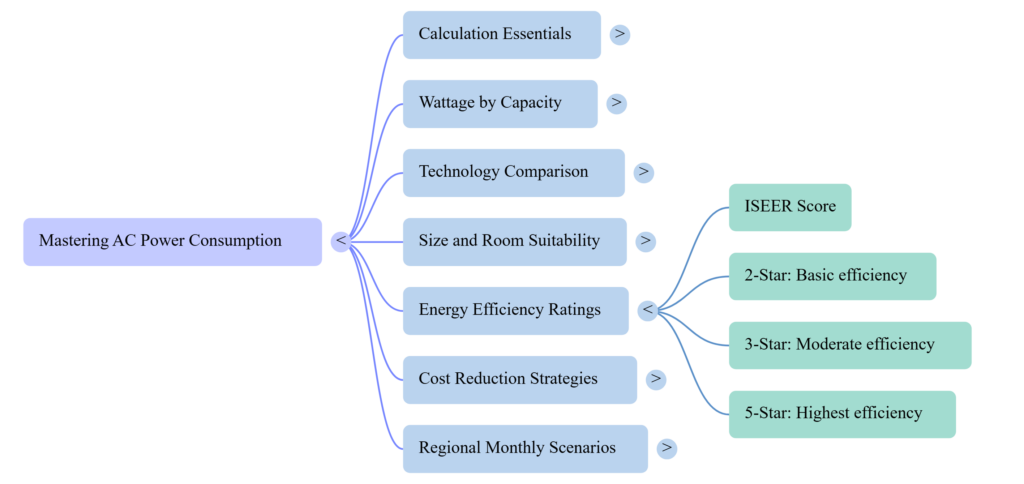
India’s Bureau of Energy Efficiency (BEE) evaluates air conditioners using the Indian Seasonal Energy Efficiency Ratio (ISEER) and assigns star ratings accordingly. The ISEER score reflects how effectively an AC delivers cooling throughout a typical Indian cooling season while using electricity efficiently under varying climate conditions.
Higher ISEER = less electricity consumed for the same cooling:
- 2-star AC: ISEER 3.50–3.99 — basic efficiency, lowest purchase price
- 3-star AC: ISEER 4.00–4.49 — moderate efficiency, mid-range
- 4-star AC: ISEER 4.50–4.99 — good efficiency, better long-term value
- 5-star AC: ISEER 5.00+ — highest efficiency, highest purchase cost, lowest running cost
Annual savings: 3-star vs 5-star 1.5 ton AC (8 hrs/day, 6 months):
- 3-star unit at 1,500W average: 2,160 units/season → ₹15,120 at ₹7/unit
- 5-star unit at 1,050W average: 1,512 units/season → ₹10,584 at ₹7/unit
- Annual saving: ₹4,536 on a seasonal operation basis
The premium cost of a 5-star AC over a 3-star equivalent is typically ₹5,000–₹10,000. At ₹4,536 saved per cooling season, the payback period is 1–2 years for households in hot climates running the AC for 5–6 months annually.
Conclusion
The AC power consumption calculator is the most valuable tool a household can use to understand and manage electricity expenses in hot climates. Your air conditioner’s monthly cost is not a mystery — it is a simple formula applied to your AC’s wattage, your usage hours, and your local electricity rate.
For Indian households running a 1.5 ton non-inverter AC at ₹7/unit, the monthly bill contribution often exceeds ₹2,500. Switching to a 5-star inverter model and adjusting the thermostat to 24°C can reduce that figure by 40–50% — delivering annual savings that comfortably offset the upgrade investment.
Use the reference table, apply the formula to your specific AC and usage pattern, and calculate exactly what your air conditioner costs you every month. Then use the tips in this guide to bring that number down — without sacrificing a single degree of comfort.
Explore our Smart Home guides for energy-saving tips, appliance insights, and home efficiency calculators.
Frequently Asked Questions
Q1: How do I use an AC power consumption calculator?
Enter your AC’s input wattage (found on the nameplate or manual), your estimated daily running hours, and your electricity tariff per unit. Apply the formula: Watts × Hours × Days ÷ 1,000 = kWh. Multiply by your tariff to get the monthly cost. For inverter ACs, use 60–70% of rated input wattage to account for variable-speed operation.
Q2: How many units does a 1 ton AC consume per day?
A non-inverter 1 ton AC consuming approximately 1,000W–1,100W for 8 hours uses 8–8.8 units per day. An inverter 1 ton AC at moderate load (effective 600–700W) uses approximately 4.8–5.6 units per day. Actual consumption depends on ambient temperature and thermostat setting.
Q3: What is the monthly electricity bill for a 1.5 ton AC in India?
A non-inverter 1.5 ton AC running 8 hours daily for 30 days consumes approximately 360 units per month. At ₹7/unit, that is ₹2,520/month. A 5-star inverter equivalent reduces this to approximately 180–240 units, costing ₹1,260–₹1,680/month — a saving of ₹840–₹1,260 monthly.
Q4: Is inverter AC significantly better for electricity consumption?
Yes — meaningfully so for regular users. Inverter ACs save 30–50% on electricity compared to non-inverter models under typical conditions. The saving increases in moderate weather where the inverter compressor throttles back to low power, while a non-inverter unit would still cycle at full capacity.
Q5: How much electricity does an AC use per hour?
Divide the input wattage by 1,000 to get kWh per hour. A 1,500W AC uses 1.5 kWh (units) per hour. At ₹7/unit, that is ₹10.50 per hour of continuous operation. An inverter unit at 60% load draws 0.9 kWh/hour, costing ₹6.30 per hour — noticeably less for the same cooling output.
Q6: What thermostat setting uses the least electricity?
The most energy-efficient thermostat setting for comfort is 24°C. This is the internationally recommended setting for balancing comfort and efficiency. Each degree below 24°C adds approximately 6% to energy consumption. Setting at 26°C with a ceiling fan achieves equivalent comfort to 22°C without a fan — typically cutting AC electricity consumption by 12–15%.