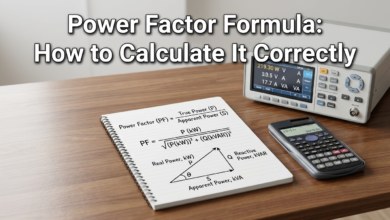
How to Find Watts: The Complete Formula & Conversion Guide
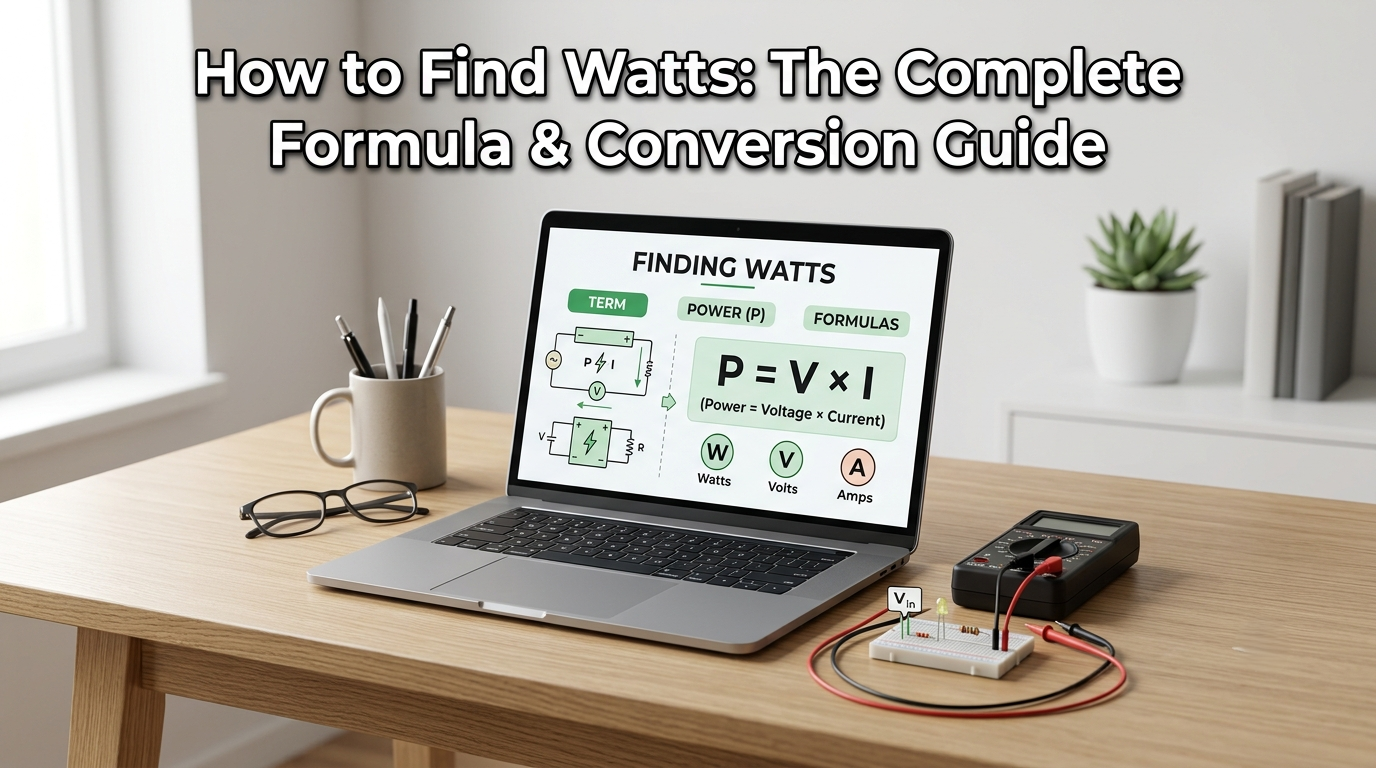
Knowing how to find watts is one of the most useful skills in everyday electrical understanding. Whether you are checking whether an appliance is safe for a circuit, calculating your energy bill, or simply trying to make sense of the numbers on a power label, watts are the unit that ties voltage and current together. This guide explains everything you need — from the core watt formula to worked conversion examples for every common voltage — so you can confidently calculate power in any situation.
By the end of this page, you will know how to find watts from volts and amps, how to reverse the calculation, and how to use that knowledge to estimate your home appliance running costs with the Home Appliance Energy Cost Calculator.
Table of contents
- What Does ‘Finding Watts’ Mean?
- Feature Breakdown: The Watt Formula Explained
- Volts to Watts: Common Voltage Conversions
- Watts to Volts and Watts to Amps: Reverse Calculations
- How Many Watts in a Volt? Clarifying a Common Confusion
- Appliance Wattage Reference Table
- Pros & Cons of Different Calculation Methods
- Which Method Is Best for Finding Watts?
- Tips for Calculating Your Home Energy Use
- Conclusion
What Does ‘Finding Watts’ Mean?
A watt (W) is the standard unit of electrical power. It measures the rate at which energy is consumed or produced. When people ask how to find watts, they are typically asking how to calculate the amount of power an electrical device draws from the supply.
Watts sit at the intersection of two other fundamental electrical quantities: voltage (measured in volts) and current (measured in amps or amperes). You cannot determine wattage from voltage alone — you always need current as well. This is why the phrase ‘how many watts in a volt’ does not have a fixed answer: it depends entirely on how many amps are flowing.
Understanding how to find watts is essential for safe home wiring decisions, accurate energy cost estimates, and choosing the right fuses or circuit breakers for your appliances.
Feature Breakdown: The Watt Formula Explained
The foundation of how to find watts is a single, simple formula derived from the physics of electrical power:
W = V × A
Where: W = Power in watts | V = Voltage in volts | A = Current in amperes (amps)
This formula tells you that power equals voltage multiplied by current. It is accurate for direct current (DC) circuits and for resistive AC loads. For reactive AC loads (motors, inductive appliances), a power factor correction applies — but for most household appliance calculations, W = V × A gives a reliable result.
How to Calculate Watts from Volts and Amps
Step 1: Find the voltage of your supply. In the UK and most of Europe, standard household voltage is 230V. In the US, it is typically 120V for standard outlets and 240V for heavy appliances.
Step 2: Find the current rating of the appliance. This is usually printed on the device label in amps (A) or milliamps (mA).
Step 3: Multiply voltage by current: W = V × A.
Example 1: A US kettle rated at 120V drawing 8.33A uses 120 × 8.33 = 999.6W — approximately 1,000W or 1kW.
Example 2: A UK washing machine at 230V drawing 10A uses 230 × 10 = 2,300W.
Once you understand how to find watts using this method, you can apply it to any electrical device in seconds.
To estimate the wattage and energy usage of household devices, use our Home Appliance Energy Calculator.
How to Calculate Current from Watts and Volts
The watt formula can be rearranged to find current when you know power and voltage:
A = W ÷ V
Example: A 2,000W electric heater on a 120V US supply draws 2,000 ÷ 120 = 16.67 amps. This tells you the heater needs a 20-amp circuit breaker for safe operation. This rearrangement is especially useful when planning home circuits or checking whether an extension lead is rated to handle a specific appliance.
Volts to Watts: Common Voltage Conversions
The key to converting volts to watts is always the same: you must know the current. The table below (see the Appliance Wattage Reference section) provides real-world examples. In the meantime, here are the worked conversions for the most common voltages.
220 Volts to Watts
220 volts to watts conversions at common amperage ratings:
220V × 1A = 220W | 220V × 5A = 1,100W | 220V × 10A = 2,200W | 220V × 13A = 2,860W
A 220V supply is common in many parts of Asia, Africa, and some European countries. Large appliances like washing machines and electric ovens typically draw 220V at 8–13A, giving wattages in the 1,760W–2,860W range.
240 Volts to Watts — Including 236V, 237V, 238V, 239V
In the UK and Australia, the nominal supply voltage is 230V but can vary between 216V and 253V. For practical calculations, 240 volts to watts conversions are widely used:
240V × 1A = 240W | 240V × 5A = 1,200W | 240V × 10A = 2,400W | 240V × 13A = 3,120W
For voltages of 236, 237, 238, and 239 volts to watts: apply the same formula. At 10A, these give 2,360W, 2,370W, 2,380W, and 2,390W respectively — barely different from the 240V result and within normal supply tolerance.
Once you know the wattage, you can estimate operating costs with our Electricity Bill Calculator.
115 Volts and 120 Volts to Watts
How many watts is 120 volts? Again — it depends on amps. At 10A: 120V × 10A = 1,200W. At 15A (a common US circuit): 120V × 15A = 1,800W.
115 volts to watts at 10A = 1,150W. The 5V difference between 115V and 120V supply is within normal North American voltage tolerance and has minimal real-world impact on appliance wattage.
Watts to Volts and Watts to Amps: Reverse Calculations
Knowing how to find watts is only half the picture. Reverse calculations are equally important for circuit planning and appliance assessment.
Watts to Volts: V = W ÷ A
Example using a 10 watts to volts calculation: if a 10W LED bulb draws 0.083A, the supply voltage is 10 ÷ 0.083 ≈ 120V. Use a dedicated 10 watts to volts calculator on this site for instant results.
Watts to Amps: A = W ÷ V
Example: A 500W appliance on a 240V UK supply draws 500 ÷ 240 = 2.08A.
1 Amp to Watt: Quick Reference by Voltage
One of the most frequently searched conversions is 1 amp to watt. The answer depends entirely on voltage:
1 amp at 120V = 120 watts | 1 amp at 220V = 220 watts | 1 amp at 230V = 230 watts | 1 amp at 240V = 240 watts
This quick amp to watt reference is useful for checking low-power devices like LED lighting, small USB chargers, or battery-operated equipment.
For a practical example, see our AC Power Consumption Calculator guide to understand air conditioner energy usage.
Amps to Volts and Using an Amp Calculator
To go from amps to volts, you need to know watts first: V = W ÷ A. A good amp calculator — such as the one built into this site’s Home Appliance Energy Cost Calculator — handles all these rearrangements automatically. Enter any two known values and it outputs the third. The watts to amps calculator function is especially useful when assessing whether a multi-socket extension lead can safely handle several appliances simultaneously.
How Many Watts in a Volt? Clarifying a Common Confusion
This is one of the most misunderstood questions in basic electrical science. The answer is: there are no watts ‘in’ a volt. Volts and watts measure different things. Voltage (volts) measures electrical pressure — the force pushing current through a circuit. Watts measure the rate of energy transfer.
You cannot convert volts directly to watts without knowing the current. The relationship is always: Watts = Volts × Amps. Similarly, when people ask ‘how many watts in a volt’, the honest answer is: it depends on the amps. At 1A, 1 volt equals 1 watt. At 10A, 1 volt equals 10 watts.
Think of it like water flow: voltage is water pressure, current is flow rate, and watts is the power delivered. Pressure alone tells you nothing about power — you need both.
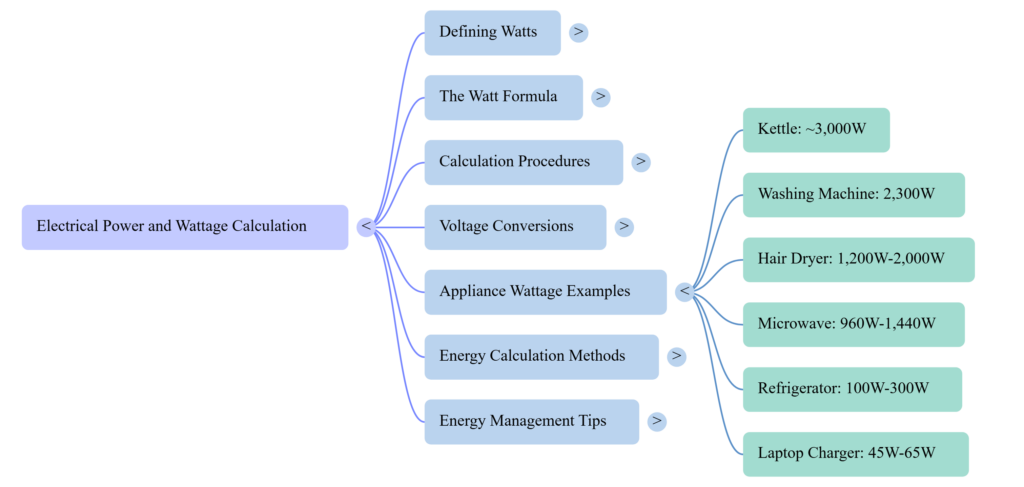
Appliance Wattage Reference Table
The table below shows typical wattage for common household appliances to help you understand how to find watts for devices in your own home. Use these figures as a starting point for energy cost calculations.
| Appliance | Typical Voltage | Typical Amps | Typical Watts | Notes |
| Kettle (UK) | 230V | 13A | 2,990W (~3kW) | Boiling cycle only |
| Microwave (US) | 120V | 8–12A | 960W–1,440W | Varies by power level |
| Washing Machine | 230V | 10A | 2,300W | Heating cycle peak |
| Refrigerator | 120V / 230V | 1–3A | 100–300W | Compressor cycles on/off |
| LED TV (50″) | 120V / 230V | 0.5–1A | 60–120W | Standby ~0.5W |
| Gaming Console (PS5) | 120V / 230V | ~1.7A / ~0.87A | ~200W | Heavy gaming |
| Laptop Charger | 120V / 230V | 1.5–2A | 45–65W | Charging at full speed |
| Smart Speaker | 120V | 0.5A | ~15W | Active use |
| Hair Dryer | 120V / 230V | 10–15A | 1,200–2,000W | High heat setting |
| Phone Charger | 5V (USB) | 2–3A | 10–18W | USB-C fast charge |
Use the Home Appliance Energy Cost Calculator on this site to convert any wattage into a per-hour, monthly, or annual electricity cost.
Pros & Cons of Different Calculation Methods
Manual Calculation (W = V × A)
Pros: Works anywhere, no tool required. Deepens understanding of electrical principles. Accurate for simple resistive loads. Directly teaches you how to find watts from first principles.
Cons: Requires knowing both voltage and current. Can be inaccurate for reactive loads (inductive motors, transformers) without applying a power factor. Manual errors possible with large numbers.
Online Watt Calculator / App
Pros: Instant results. Handles all formula rearrangements (watts to amps, amps to volts, volts to watts). Reduces human error. Ideal for quick appliance assessments and energy bill estimates.
Cons: Requires internet or app access. Some calculators do not account for power factor. Results are only as accurate as the input values.
Which Method Is Best for Finding Watts?
For everyday appliance checks — understanding how much power a device draws, whether a socket is adequate, or estimating electricity costs — the manual formula W = V × A is all you need. Learning how to find watts this way takes minutes and stays with you for life.
For more complex scenarios (comparing multiple appliances, calculating monthly energy bills, or handling reactive loads), an online watts to amps calculator or energy cost calculator is the smarter choice. It saves time, eliminates arithmetic errors, and often provides additional outputs like kWh and cost per month.
The best approach combines both: understand the watt formula well enough to sanity-check calculator outputs, and use a dedicated tool for detailed energy cost planning.
You can also read our PC Watt Calculator guide to calculate desktop computer energy usage
Tips for Calculating Your Home Energy Use
1. Check the appliance label first. Most devices have a wattage (W) or kilowatt (kW) rating printed directly on them — saving you the calculation entirely.
2. Use amps when wattage is absent. If only voltage and amperage are listed, multiply them: you now know how to find watts without any additional tools.
3. Account for duty cycles. A fridge’s rated wattage is its peak draw — it only runs the compressor around 30–40% of the time. Real energy use is lower than peak watts suggest.
4. Convert watts to kWh for bill estimates. Divide wattage by 1,000 and multiply by hours used: (W ÷ 1,000) × Hours = kWh. Multiply by your electricity rate for the cost.
5. Use a smart energy monitor. Plug-in power meters display real-time wattage — the most accurate way to find watts for any appliance without needing to know its voltage or amp rating separately.
6. Link to the calculator. The Home Appliance Energy Cost Calculator on this site handles all of the above automatically — input any appliance’s wattage and it outputs daily, monthly, and annual running costs.
Conclusion
Learning how to find watts is a straightforward but genuinely valuable skill. The core watt formula — W = V × A — gives you everything you need to calculate power consumption for any electrical device, convert between volts, amps, and watts in any direction, and understand how to find watts from the numbers printed on appliance labels.
Whether you are working out how to find watts for a PS5, a kettle, or a circuit breaker decision, the same formula applies every time. The only variables are the voltage of your supply and the current your device draws. Multiply them, and you have your answer.
From 220 volts to watts calculations for heavy appliances to the quick 1 amp to watt reference for small devices, this guide covers every conversion you are likely to need. For a fully automated experience, use the Home Appliance Energy Cost Calculator on this site to convert any wattage directly into an electricity cost — per hour, per month, or per year.
Explore our Smart Home guides for electricity calculations, appliance power usage, and energy-saving tips.
FAQs
Q1: How do you find watts if you only know volts and amps?
Multiply them: W = V × A. This is the fundamental watt formula. For example, 230V × 5A = 1,150W. No other information is needed for standard resistive appliances.
Q2: How many watts is 120 volts?
There is no fixed answer — 120 volts alone does not determine wattage. At 1A, 120V = 120W. At 10A, 120V = 1,200W. 15A (a fully loaded US circuit), 120V = 1,800W. You always need both voltage and current to find watts.
Q3: How many watts does 1 amp equal?
1 amp to watt depends on voltage. At 120V (US standard): 1 amp = 120W. At 230V (UK standard): 1 amp = 230W. 240V: 1 amp = 240W.
Q4: How do I convert 220 volts to watts?
Use the watt formula: multiply 220V by the current in amps. At 5A, 220 volts to watts = 1,100W. At 10A it is 2,200W. Check the appliance’s amp rating on its label.
Q5: What is the difference between watts and volts?
Volts measure electrical pressure (the force driving current). Watts measure electrical power (the rate of energy use). You need both voltage and current (amps) to calculate watts.
Q6: Is there a faster way to find watts for household appliances?
Yes — check the appliance label or nameplate. Most devices list their rated wattage directly. If only amps and volts are shown, multiply them. For instant conversions across all configurations, use the amps to watts calculator or watts to amps calculator built into this site.