Iron Box Power Consumption: Units and Monthly Electricity Cost
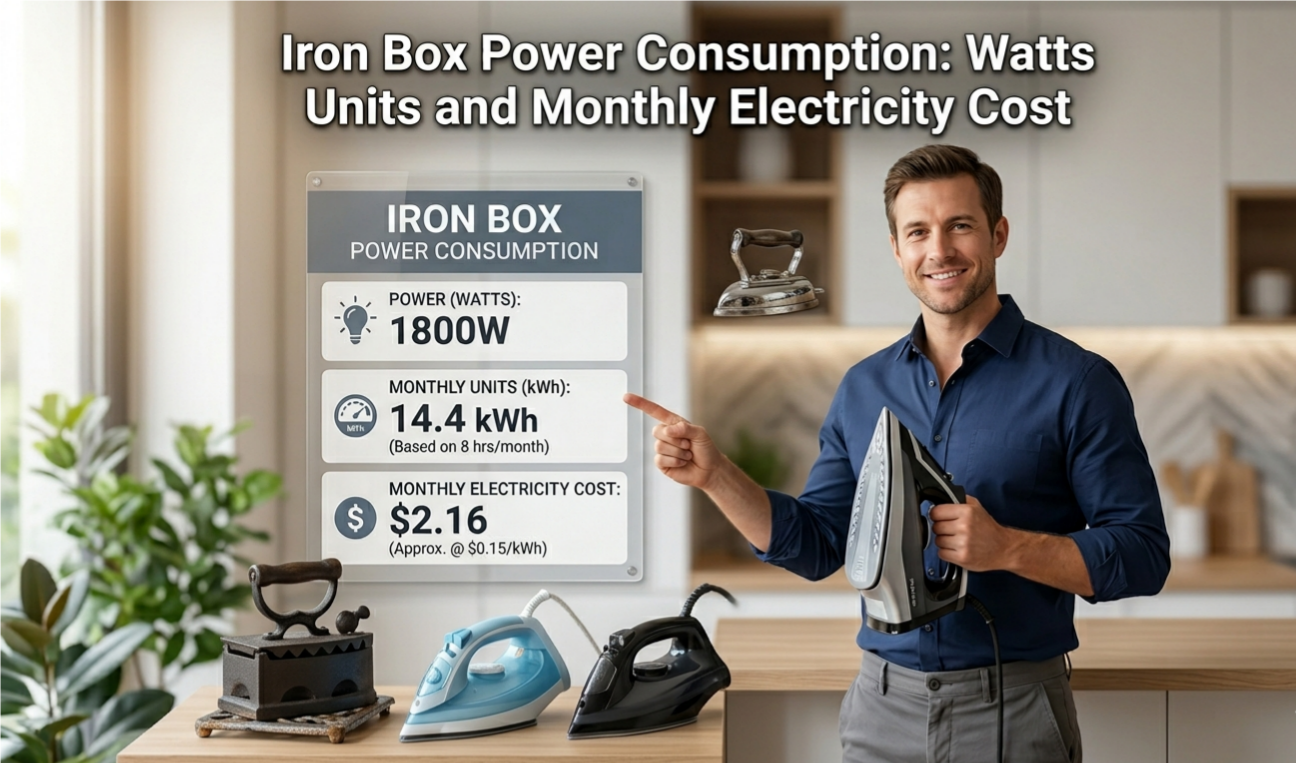
The electric iron — known as the “iron box” across India, Sri Lanka, and much of South Asia — is one of the most frequently used household appliances, yet one of the least understood in terms of electricity consumption. With wattage ranging from 300W for compact travel models to 3,000W for professional steam stations, understanding iron box power consumption helps you calculate your actual electricity bill contribution and make smarter decisions about when and how you iron.
This guide covers everything: typical iron watts by type, the formula for calculating units per hour and per month, a complete reference table, steam versus dry iron comparisons, and practical tips to reduce electricity costs without spending less time ironing.
Table of contents
- What Is Iron Box Power Consumption and Why Does It Matter?
- Iron Watts: How Much Power Does an Iron Use?
- Iron Wattage by Type: Dry, Steam and Travel Irons
- Iron Box Power Consumption Reference Table
- Steam Iron Power Consumption vs Dry Iron
- Iron Box Power Consumption Per Month: Full Calculation
- Iron Wattage and Electricity Bill: What It Really Costs
- Tips to Reduce Iron Box Power Consumption
- Conclusion
What Is Iron Box Power Consumption and Why Does It Matter?
Iron box power consumption refers to the total electricity an electric iron draws from your household supply during operation — measured in watts during active use and kilowatt-hours (units) over time.
Understanding your iron’s power consumption matters for three practical reasons. First, irons are high-wattage appliances — a 2,000W steam iron draws more instantaneous power than most other household devices except air conditioners and water heaters. Second, frequent daily use adds up — households that iron for 45–60 minutes daily accumulate meaningful monthly electricity costs that rarely appear as a separate line item but contribute directly to rising bills. Third, knowing your iron box power consumption helps you compare models intelligently: a higher-wattage iron is not necessarily more expensive to run if it completes ironing faster due to better heat delivery.
The term “iron box” is standard across South Asian markets. Whether you call it an iron box, electric iron, clothes iron, or steam iron, the electricity calculation is identical — watts × hours ÷ 1,000 = kWh (units).
To estimate the exact monthly cost of running your iron, use our Electricity Bill Calculator.
Iron Watts: How Much Power Does an Iron Use?
The direct answer to how many watts does an iron use: most household electric irons draw between 1,000 watts and 2,400 watts during active heating cycles.
Iron watts vary significantly by type and purpose:
- Dry iron (basic/budget): 750W–1,200W
- Standard steam iron: 1,200W–1,800W
- High-performance steam iron: 1,800W–2,400W
- Professional steam station: 2,000W–3,000W
- Travel/compact iron: 300W–1,000W (often dual voltage)
One important nuance: an iron does not draw its rated iron watt figure continuously. Built-in thermostats regulate temperature by cycling the heating element on and off. When the soleplate reaches the set temperature, the heating element cuts out and draws zero watts until the temperature drops below threshold. This cycling behavior means actual iron box power consumption over a 45-minute session is 40–60% of the rated wattage — a critical distinction for accurate electricity cost calculation.
Iron Wattage by Type: Dry, Steam and Travel Irons
Understanding iron wattage across the main categories helps you estimate consumption before checking your specific model’s label.
Dry irons are the simplest and most common type in budget households. They use a heated soleplate without steam generation, drawing 750W–1,200W. Their lower wattage makes them cheaper to run but slower on thick fabrics like denim and cotton shirts, as they lack steam to relax fibers.
Standard steam irons are the most popular category for regular household ironing. They combine a heated soleplate with a water reservoir that generates steam on demand. Steam iron power consumption ranges from 1,200W to 1,800W — higher than dry irons due to the energy required to heat water into steam. However, steam irons typically complete the same ironing load faster, partially offsetting the higher wattage.
High-performance steam irons target users who iron frequently or deal with heavily creased fabrics. Their iron wattage of 1,800W–2,400W delivers more powerful steam output and faster recovery time between bursts, but draws meaningfully more electricity per session.
Travel irons prioritize compactness and dual-voltage compatibility (100V–240V) for international use. Their iron watts of 300W–1,000W make them the most economical to run but unsuitable as a daily household iron due to smaller soleplates and limited steam capacity.
Compare your iron’s energy consumption with other appliances using our Home Appliance Energy Calculator.
Iron Box Power Consumption Reference Table
This table covers iron box power consumption by type, with calculated units per hour, per ironing session (45 minutes), and estimated monthly cost based on daily 45-minute use.
| Iron Type | Wattage | kWh Per Hour | Units Per Session (45 min) | Monthly kWh (daily use) | Monthly Cost (₹7/unit) |
|---|---|---|---|---|---|
| Travel Iron | 500W | 0.5 kWh | 0.375 units | 11.25 kWh | ₹78.75 |
| Dry Iron (basic) | 1,000W | 1.0 kWh | 0.75 units | 22.5 kWh | ₹157.50 |
| Standard Steam Iron | 1,500W | 1.5 kWh | 1.125 units | 33.75 kWh | ₹236.25 |
| High-Power Steam Iron | 2,000W | 2.0 kWh | 1.5 units | 45 kWh | ₹315 |
| Professional Steam Station | 2,500W | 2.5 kWh | 1.875 units | 56.25 kWh | ₹393.75 |
Note: These figures assume continuous rated-wattage operation. With thermostat cycling (approximately 50% active time in practice), actual consumption is typically 40–60% of the values shown — meaning real monthly costs are often closer to half these estimates for normal household ironing.
How Many Watts Does an Iron Use Per Session?
To understand how many watts does an iron use over a realistic ironing session, consider both the rated wattage and the thermostat cycling factor.
A 1,500W steam iron running for 45 minutes at full continuous draw would consume:
1,500W × 0.75 hrs ÷ 1,000 = 1.125 kWh per session
However, with thermostat cycling at approximately 50% active time:
1.125 × 0.50 = ~0.56 kWh effective per session
At ₹7/unit: 0.56 × ₹7 = ₹3.92 per ironing session — less than ₹4 for a full clothing ironing session with a standard 1,500W steam iron. This is why iron electricity costs are lower than many households expect, despite the high instantaneous wattage.
Iron Power Consumption Per Hour: Units Breakdown
For Indian electricity billing purposes, understanding iron power consumption per hour in units is the most practical calculation:
Wattage ÷ 1,000 = kWh (units) per hour of continuous use
- 750W dry iron: 0.75 units per hour
- 1,000W dry iron: 1.0 units per hour
- 1,500W steam iron: 1.5 units per hour
- 2,000W steam iron: 2.0 units per hour
- 2,500W professional iron: 2.5 units per hour
With thermostat cycling reducing effective consumption by 40–50%, a 1,500W iron actually consumes approximately 0.75–0.90 units per hour of ironing time in real use — making the iron a manageable contributor to the monthly electricity bill even with daily use.
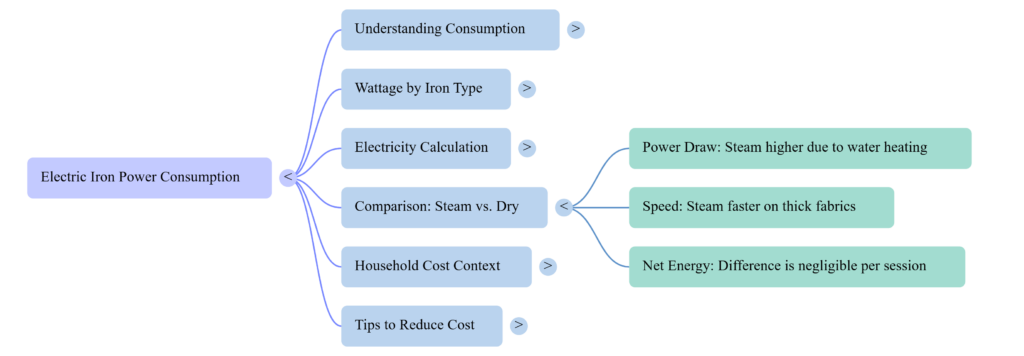
Steam Iron Power Consumption vs Dry Iron
When evaluating steam iron power consumption against a dry iron’s electricity use, the comparison requires looking beyond wattage alone.
A 1,500W steam iron draws 500W more than a 1,000W dry iron during active heating cycles. Over a 45-minute session at rated power, that difference is 0.375 kWh — approximately ₹2.63 more per session.
However, steam irons typically complete the same volume of ironing faster. Steam relaxes fabric fibers more effectively, requiring fewer passes to remove creases, especially from cotton shirts, linen trousers, and thick denim. A load of 8–10 garments that takes 45 minutes with a dry iron may take only 30–35 minutes with a quality steam iron.
Net energy per garment comparison:
- Dry iron: 1,000W × 0.75 hrs × 50% cycling ÷ 1,000 = 0.375 kWh for 10 garments
- Steam iron: 1,500W × 0.55 hrs × 50% cycling ÷ 1,000 = 0.413 kWh for 10 garments
The difference per ironing load is approximately 0.04 kWh — less than 30 paise per session. For the modest additional electricity cost, steam irons deliver faster, better results on most fabric types. The decision between steam and dry iron should rest primarily on fabric needs and ironing volume rather than electricity cost differences.
Iron Box Power Consumption Per Month: Full Calculation
To calculate your iron box power consumption per month, apply this formula using your iron’s rated wattage, daily ironing time, and local electricity tariff:
(Wattage × Daily Hours × 30) ÷ 1,000 = Monthly kWh
For a 1,500W steam iron with thermostat cycling (using 60% effective consumption):
- 30 min/day: 1,500 × 0.5 × 30 × 0.60 ÷ 1,000 = 13.5 kWh/month
- 45 min/day: 1,500 × 0.75 × 30 × 0.60 ÷ 1,000 = 20.25 kWh/month
- 1 hour/day: 1,500 × 1.0 × 30 × 0.60 ÷ 1,000 = 27 kWh/month
Monthly cost at Indian tariff rates:
- ₹5/unit: 20.25 × ₹5 = ₹101.25/month
- ₹7/unit: 20.25 × ₹7 = ₹141.75/month
- ₹9/unit: 20.25 × ₹9 = ₹182.25/month
For Philippines Meralco users (~₱12/kWh): 20.25 kWh × ₱12 = ₱243/month for daily 45-minute ironing with a 1,500W steam iron.
These figures show that even daily ironing contributes a manageable and predictable amount to the monthly electricity bill — far less than air conditioning, water heating, or refrigeration in most households.
Iron Wattage and Electricity Bill: What It Really Costs
Putting iron wattage costs in household bill context is important for financial planning. Many people assume their iron significantly inflates their electricity bill — the actual numbers tell a more moderate story.
Monthly electricity cost comparison for a typical household:
- 1.5 ton AC (8 hrs/day, non-inverter): ~₹2,520/month
- Electric water heater/geyser (30 min/day): ~₹315/month
- Refrigerator (continuous): ~₹500/month
- Iron box (45 min/day, 1,500W): ~₹142/month
- Washing machine (1 hr/day): ~₹175/month
The iron, despite its high instantaneous wattage, costs significantly less monthly than the appliances that run for hours or continuously. This context matters: households worried about their electricity bill will find far greater savings by optimizing AC use, refrigerator efficiency, or geyser habits than by reducing ironing time.
That said, iron box power consumption does add real rupees to your bill — and the tips below reduce it further without compromising your clothing care routine.
Want to see how other devices affect your electricity bill? Check out our Broadband Router Electricity Cost guide.
Tips to Reduce Iron Box Power Consumption
Practical habits that meaningfully reduce iron box power consumption over a month:
Iron in batches, not individual garments. Heating an iron from cold to operating temperature consumes electricity equivalent to several minutes of ironing. Ironing all your weekly clothing in one session instead of daily single-garment sessions reduces the total number of heat-up cycles — cutting energy wasted on reheating.
Set the correct temperature for each fabric type. Using the cotton/linen setting (maximum heat) for synthetic fabrics that require low heat wastes electricity maintaining unnecessary temperature. Start with delicate fabrics at lower settings, then progress to cotton — using the iron’s residual heat on the lowest-temperature items last.
Use the steam function strategically, not continuously. Activating steam continuously draws more power than using intermittent steam bursts on stubborn creases. Most garments only need occasional steam on collar bands, cuffs, and heavily creased areas — not throughout the ironing process.
Unplug immediately after finishing. Some households leave irons plugged in between garments “to stay warm.” Modern irons reheat from operating temperature within seconds — there is no benefit to leaving them plugged in, and the practice adds unnecessary electricity draw (and safety risk).
Hang clothes immediately after washing. Proper hanging while damp reduces crease formation significantly, shortening the ironing time needed per garment. Fewer minutes ironing directly translates to fewer units consumed per session.
Consider a good-quality steam iron if you use a low-watt dry iron on heavy fabrics. The paradox of iron power consumption: a 1,000W dry iron that requires 20 minutes on a thick cotton shirt may consume more electricity than a 1,800W steam iron that finishes the same shirt in 8 minutes — because electricity cost is total kWh, not peak wattage.
Conclusion
Understanding iron box power consumption removes the mystery from one of the most frequently used but least analyzed household appliances. A standard 1,500W steam iron running 45 minutes daily costs approximately ₹100–₹145 per month at typical Indian electricity tariffs — meaningful but manageable, and far smaller than the AC or water heater’s contribution to the monthly bill.
The key insight from this guide: iron wattage is high, but ironing sessions are short, and thermostat cycling reduces effective consumption significantly. The iron ranks as a moderate electricity consumer — predictable and controllable through simple behavioral habits.
Explore our Smart Home guides for appliance energy usage, electricity-saving tips, and home efficiency calculators.
Use the reference table and formula in this guide to calculate your specific iron box power consumption based on your model’s wattage and actual daily ironing time. Then apply the tips to bring that number down further — spending less on electricity without changing how well your clothes are cared for.
Frequently Asked Questions
Q1: What is the power consumption of an iron box?
Most household iron boxes consume between 1,000W and 2,400W rated power. With thermostat cycling reducing effective consumption to approximately 50–60% of rated draw during actual ironing, a 1,500W steam iron effectively consumes 750W–900W on average during use. Monthly consumption for 45-minute daily ironing is approximately 13–20 kWh.
Q2: How many units does a 1000 watt iron use per hour?
A 1,000W iron uses exactly 1 unit (kWh) per hour of continuous operation. With thermostat cycling, effective consumption drops to approximately 0.5–0.6 units per hour. At ₹7/unit, that is ₹3.50–₹4.20 per hour of ironing — about ₹2.63 for a standard 45-minute ironing session.
Q3: Is steam iron power consumption higher than a dry iron?
Yes — steam irons draw 1,200W–2,400W versus 750W–1,200W for dry irons. However, steam irons complete the same ironing load faster due to more effective crease removal. The net electricity cost per ironing session is often only marginally higher for steam versus dry — typically less than ₹3 difference per session.
Q4: What is the monthly iron box power consumption for daily use?
For a standard 1,500W steam iron used 45 minutes daily for 30 days, accounting for thermostat cycling: approximately 13–20 kWh per month. At ₹7/unit, monthly cost ranges from ₹91 to ₹140 — a manageable household electricity expense.
Q5: How much does an iron box cost to run per ironing session?
A 1,500W steam iron running 45 minutes with 50% thermostat cycling uses approximately 0.56 kWh per session. At ₹7/unit: ₹3.92 per session. At ₱12/kWh: ₱6.75 per session. Even daily ironing adds up to only ₹117–₹140 per month at Indian tariff rates.
Q6: How can I reduce my iron box power consumption?
The most impactful methods are: ironing in weekly batches instead of daily individual items (reduces heat-up cycles), setting the correct temperature for each fabric (avoids unnecessary high heat), and hanging clothes properly after washing to reduce creasing (shortens ironing time per garment). These three habits can reduce monthly ironing electricity costs by 20–35%.