How Many Watts Does a Crock Pot Use? Complete Energy Cost Guide
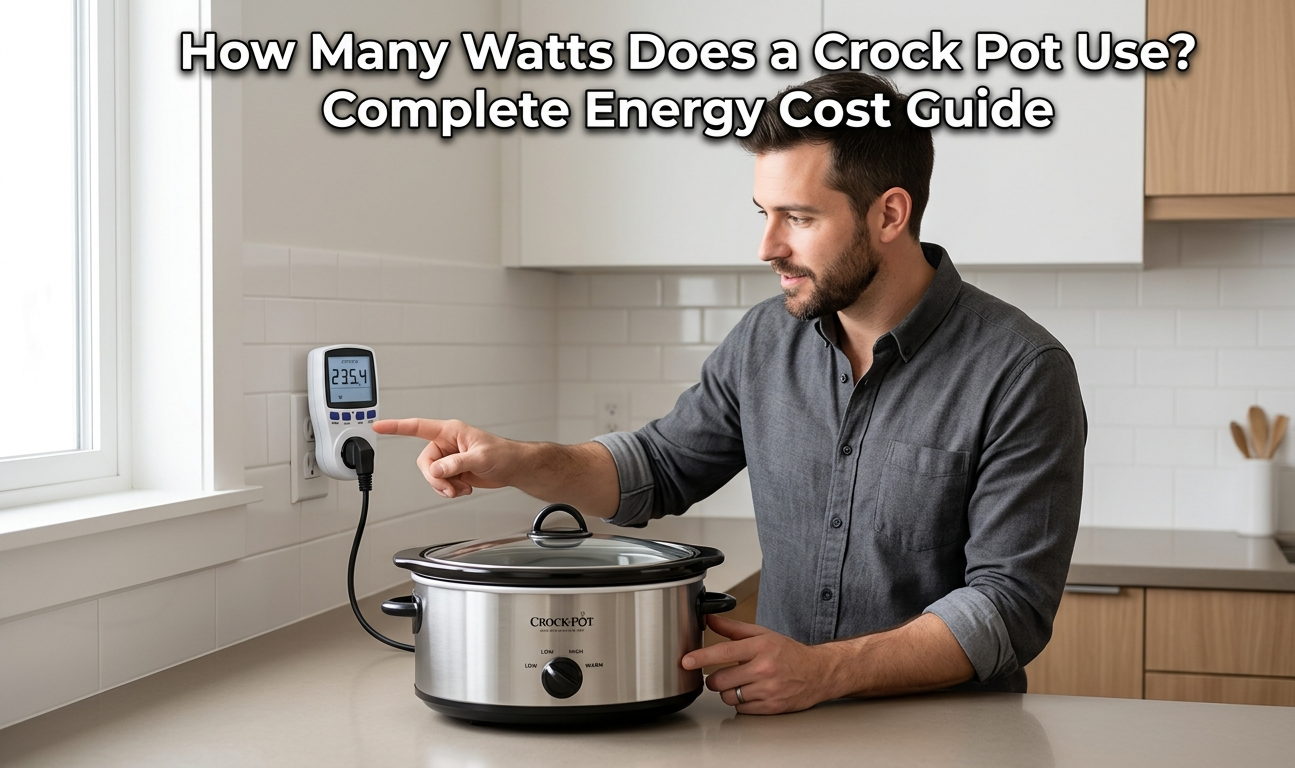
Slow cookers are one of the most beloved time-saving appliances in the modern kitchen — you load them in the morning and come home to a ready meal. But with a crock pot running for 6–10 hours at a stretch, many people understandably wonder: how many watts does a crock pot use, and what does that translate to on the electricity bill? The answer is more reassuring than most expect.
This guide answers the question of how many watts does a crock pot use across every size and setting, walks through a full electricity cost calculation, and explains whether a slow cooker is genuinely energy efficient compared to other cooking methods. You will also find a reference table, worked examples for UK and US tariffs, and tips to keep your slow cooker running cost as low as possible.
Table of contents
- What Is Crock Pot Power Consumption?
- Feature Breakdown: How Many Watts Is a Slow Cooker by Size and Setting?
- How Much Electricity Does a Slow Cooker Use Per Hour?
- How Much Power Does a Crockpot Use in a Month?
- Slow Cooker Power Consumption Reference Table
- Does a Crock Pot Use a Lot of Electricity?
- Pros & Cons of Slow Cooker Energy Use
- Slow Cooker vs Oven: Which Uses Less Electricity?
- Tips to Reduce Your Crock Pot Electricity Cost
- Conclusion
What Is Crock Pot Power Consumption?
Crock pot power consumption refers to the amount of electrical power — measured in watts — that a slow cooker draws from the mains during operation. What makes the crock pot unique among kitchen appliances is its combination of low wattage and long running time. Where a kettle draws 2,500–3,000W but runs for just 3 minutes, a slow cooker draws 100–320W but runs for 6–10 hours. The total energy per cooking session ends up comparable — but the slow cooker delivers a full meal rather than a single cup of tea.
Knowing how many watts does a crock pot use in different settings allows you to calculate the electricity cost per meal accurately, compare it against oven or hob cooking, and decide whether your slow cooker is genuinely saving you money — on both energy and food bills.
Feature Breakdown: How Many Watts Is a Slow Cooker by Size and Setting?
Slow cooker wattage is not fixed — it varies by the physical size of the appliance, the setting selected, and the age and brand of the model. How many watts is a slow cooker across the most common categories? Here is the breakdown:
Small slow cooker (1–2L capacity): 70–130W on high, 45–80W on low. Suitable for soups, dips, and single-portion meals.
Medium slow cooker (3–4.5L capacity): 150–210W on high, 90–140W on low. The most common household size — ideal for family stews and casseroles.
Large slow cooker (5–8L capacity): 220–320W on high, 130–200W on low. Used for batch cooking, whole chickens, and large family meals.
Most branded slow cookers in the medium category — the type found in the majority of UK and US kitchens — draw approximately 180–200W on high and 90–120W on low. This is the ‘typical’ crock pot wattage figure used in most electricity cost calculations.
To estimate the electricity consumption of your Crock Pot and other household appliances, use our Home Appliance Energy Calculator.
Slow Cooker Wattage on Low vs High Setting
A common misconception is that the ‘high’ setting cooks food faster simply by drawing more power continuously. In reality, slow cookers use a cycling thermostat on both settings. The appliance draws full wattage to heat up, then cycles on and off to maintain temperature. On the low setting, the cycle ratio is lower — meaning the element is active for a smaller proportion of each cycle, drawing less average power.
As a practical rule: the low setting draws approximately 60–70% of the wattage of the high setting. A 200W slow cooker on high is equivalent to roughly 130W on low — though the total cooking time on low is typically twice as long, partially offsetting the wattage saving.
How Much Electricity Does a Slow Cooker Use Per Hour?
To answer how much electricity does a slow cooker use per hour, apply the standard formula: Watts ÷ 1,000 = kWh per hour.
For a typical 200W slow cooker on high: 200 ÷ 1,000 = 0.2 kWh per hour. At a UK electricity rate of 30p/kWh: 0.2 × £0.30 = 6p per hour.
For the same cooker on low at 120W: 120 ÷ 1,000 = 0.12 kWh per hour. Cost: 0.12 × £0.30 = 3.6p per hour.
At a US rate of $0.16/kWh: the 200W setting costs $0.032 per hour (about 3 cents) and the low setting costs roughly 2 cents per hour.
These per-hour figures are deliberately modest — slow cooker electricity usage is designed to be low-impact. The real number that matters for budgeting is the cost per full cooking session.
Slow Cooker Power Consumption Over a Full Cook
Extending the per-hour figure across realistic cooking durations gives a clear picture of total kWh usage per meal:
6-hour beef stew (200W on high): 0.2 × 6 = 1.2 kWh → £0.36 (UK) / $0.19 (US)
8-hour pulled pork (180W on low): 0.108 × 8 = 0.864 kWh → £0.26 (UK) / $0.14 (US)
10-hour bone broth (120W on low): 0.12 × 10 = 1.2 kWh → £0.36 (UK) / $0.19 (US)
The kWh usage slow cooker produces per meal — typically 0.8–1.5 kWh — is strikingly low for a complete family-sized dish. Even accounting for the longer cooking duration, this places the slow cooker among the most energy-efficient cooking methods available for suitable dishes.
How Much Power Does a Crockpot Use in a Month?
To understand how much power does a crockpot use across a typical month, consider a household that uses it three times per week for an average of 7 hours per session at 200W:
Weekly kWh: 0.2 × 7 × 3 = 4.2 kWh/week
Monthly kWh: 4.2 × 4.33 = ~18.2 kWh/month
Monthly crock pot electricity cost: 18.2 × £0.30 = £5.46 (UK) | 18.2 × $0.16 = $2.91 (US)
For households using a smaller 100W slow cooker less frequently (twice per week, 6 hours): monthly consumption drops to approximately 5.2 kWh — around £1.56/month (UK) or $0.83/month (US).
How much power does a crockpot use annually for a regular user? At the higher end (three uses per week, 200W model): approximately 218 kWh per year — an annual crock pot electricity cost of roughly £65 (UK) or $35 (US). This is higher than casual users might expect but remains modest in the context of total household cooking energy.
You can calculate the monthly operating cost of your slow cooker using our Electricity Bill Calculator.
Slow Cooker Power Consumption Reference Table
The table below shows how many watts does a crock pot use by size and setting, along with estimated electricity costs per hour at 30p/kWh (UK):
| Slow Cooker Size | High Setting (W) | Low Setting (W) | Cost/Hr (High, 30p) | Cost/Hr (Low, 30p) | Typical Cook Duration |
| Small (1–2L) | 70–130W | 45–80W | 2.1–3.9p | 1.4–2.4p | 4–6 hours |
| Medium (3–4.5L) | 150–210W | 90–140W | 4.5–6.3p | 2.7–4.2p | 6–8 hours |
| Large (5–6L) | 220–280W | 130–175W | 6.6–8.4p | 3.9–5.3p | 6–10 hours |
| Extra Large (7–8L) | 280–320W | 170–200W | 8.4–9.6p | 5.1–6.0p | 8–12 hours |
Figures are estimates based on typical crock pot wattage ranges. Check your appliance’s label for the exact rated wattage.
Does a Crock Pot Use a Lot of Electricity?
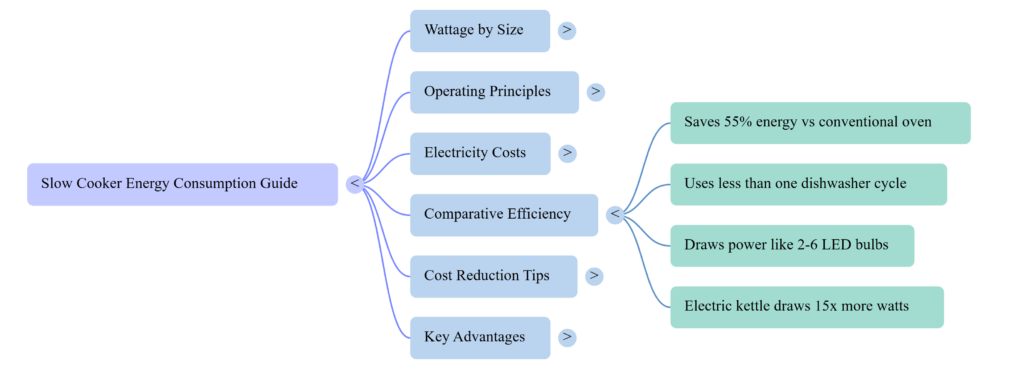
No — in absolute terms, a crock pot does not use a lot of electricity. With peak wattage between 70W and 320W, a slow cooker draws roughly the same power as two to six LED light bulbs. To put how many watts does a crock pot use in perspective: a standard electric kettle draws 2,500–3,000W — up to 15 times more than a slow cooker.
The mild confusion arises from the extended running time. A crock pot running for 8 hours does consume more total energy than a kettle used once for 3 minutes. But compared to other cooking methods — especially a conventional oven — the crock pot’s total kWh per meal is remarkably low.
The honest answer to ‘does a crock pot use a lot of electricity’ is: relative to its cooking output and session length, no. The total crock pot energy consumption per meal sits between 0.8 and 1.5 kWh for most family-sized dishes — less than a single cycle of a dishwasher.
If you’re comparing household appliance power requirements, see our Hair Dryer Wattage guide.
Pros & Cons of Slow Cooker Energy Use
Advantages of Slow Cooker Power Consumption
The primary energy advantage of a crock pot is its sustained low-power operation. Unlike an oven that must maintain 180–220°C and frequently cycles its heating element at full wattage, a slow cooker reaches 80–90°C and maintains it efficiently. For dishes that suit slow cooking — stews, braises, pulled meats, soups — the energy cost per meal is genuinely lower than oven-based alternatives.
A secondary benefit is batch cooking efficiency. Cooking a double or triple portion in a large slow cooker does not proportionally increase the electricity cost — the appliance draws the same watts whether half full or completely full, making it one of the most cost-effective cooking methods for meal preppers.
Limitations and Considerations
Not all dishes suit slow cooking. High-heat cooking methods like searing, stir-frying, or baking require temperatures that a slow cooker cannot reach, meaning it is not a full oven replacement for most households. The extended cooking time also means forward planning is required — the low crock pot electricity cost only applies when you actually use it rather than reaching for a faster but less efficient alternative.
For households that use the slow cooker infrequently, the annual energy saving over oven cooking is modest. The real financial benefit combines lower electricity consumption with the ability to use cheaper, tougher cuts of meat that benefit from long, slow heat.
Slow Cooker vs Oven: Which Uses Less Electricity?
For qualifying dishes, a slow cooker uses significantly less electricity than a conventional oven. Here is the direct comparison for a beef casserole:
Conventional oven at 1,800W for 2 hours: 1.8 × 2 = 3.6 kWh → £1.08 (UK) / $0.58 (US)
Slow cooker at 200W for 8 hours: 0.2 × 8 = 1.6 kWh → £0.48 (UK) / $0.26 (US)
The slow cooker uses approximately 55% less electricity for the same dish. Over a year of three weekly slow cooker meals that would otherwise go in the oven, the saving amounts to roughly 280 kWh — approximately £84 (UK) or $45 (US) per year in cooking energy alone.
However, for quick meals that require 30 minutes of oven time, the equation reverses: 1,800W × 0.5 hours = 0.9 kWh (oven) vs 200W × 6 hours = 1.2 kWh (slow cooker). The slow cooker’s energy advantage is strongest for dishes requiring 4+ hours of oven time.
You can also compare slow cooker energy usage with our How Many Amps Does a Microwave Use guide.
Tips to Reduce Your Crock Pot Electricity Cost
1. Fill the slow cooker appropriately. A slow cooker operates most efficiently when filled to between half and three-quarters of its capacity. Under-filling wastes energy heating empty space; over-filling reduces circulation and may extend cooking time.
2. Use the low setting when time allows. Cooking on low rather than high reduces slow cooker electricity usage by 30–40% per hour. For most dishes, the outcome is identical — you simply need to plan ahead.
3. Avoid lifting the lid during cooking. Each time the lid is removed, the slow cooker loses accumulated heat and must draw full power to recover temperature. This can add 15–20 minutes to cooking time and measurably increases crock pot energy consumption per session.
4. Defrost ingredients before adding. Adding frozen ingredients forces the slow cooker to work harder to raise the internal temperature, increasing energy use and potentially creating food safety concerns.
5. Choose the right size for the dish. A large 8L slow cooker cooking a single portion of soup draws 280W regardless of fill level. Matching the appliance size to the meal reduces how many watts does a crock pot use per session needlessly.
6. Calculate your exact running cost. Use the Home Appliance Energy Cost Calculator on this site — enter your crock pot’s wattage (from the label or table above), cooking hours, and electricity tariff for an instant per-meal and monthly cost breakdown.
Conclusion
Knowing how many watts a crock pot uses helps you understand why it is considered one of the most energy-efficient ways to cook meals. With a typical medium slow cooker drawing 150–210W on high and 90–140W on low, the answer to how many watts does a crock pot use is considerably lower than most household cooking appliances — and far lower than a conventional oven running at 1,500–2,500W.
The modest wattage combined with a multi-hour cooking cycle produces a per-meal electricity cost of roughly 30–50p (UK) or 15–26 cents (US) — making the slow cooker one of the cheapest ways to cook a family-sized meal. For households cooking three or more slow cooker meals per week, the annual saving over oven-based cooking can reach £80–£100 (UK).
Explore our Smart Home guides for appliance energy usage, electricity-saving tips, and home efficiency calculators.
Whether you are asking how many watts does a crock pot use to manage your energy budget, compare it against an oven, or simply understand your household electricity consumption better, the reference table and calculations in this guide give you everything you need. Use the Home Appliance Energy Cost Calculator on this site to generate a personalised crock pot electricity cost estimate based on your exact model and cooking frequency.
FAQs
Q1: How many watts does a crock pot use on low vs high?
On the low setting, a typical medium slow cooker draws approximately 90–140W. On high, the same appliance draws 150–210W. The low setting uses roughly 60–70% of the wattage of high, but cooking sessions on low are typically twice as long — partially offsetting the per-hour saving.
Q2: How much electricity does a slow cooker use in 8 hours?
A 200W slow cooker running on high for 8 hours uses 200 × 8 ÷ 1,000 = 1.6 kWh. At 30p/kWh (UK), that is 48p. At $0.16/kWh (US), it is approximately 26 cents. The same cooker on low at 120W for 8 hours uses 0.96 kWh — around 29p (UK) or 15 cents (US).
Q3: Is a slow cooker cheaper to run than an oven?
Yes, for suitable long-cooking dishes. A slow cooker typically uses 55–65% less electricity per meal than a conventional oven for stews, casseroles, and braises that would otherwise require 90+ minutes of oven time. For short oven-time dishes, the comparison is less clear-cut.
Q4: Does a crock pot use a lot of electricity?
No — a crock pot is a low-wattage appliance (70–320W depending on size and setting). Despite long running times, total crock pot energy consumption per meal is typically 0.8–1.5 kWh — less than a single dishwasher cycle and considerably less than oven-based cooking for equivalent dishes.
Q5: How much does it cost to run a slow cooker all day (12 hours)?
A medium 200W slow cooker running for 12 hours uses 0.2 × 12 = 2.4 kWh. At 30p/kWh (UK): £0.72. At $0.16/kWh (US): $0.38. For the low setting at 120W: 1.44 kWh → £0.43 (UK) / $0.23 (US). A full-day run is inexpensive in absolute terms.
Q6: How do I calculate my crock pot electricity cost per meal?
Use the formula: (Watts ÷ 1,000) × Hours × Your kWh Rate = Cost Per Meal. Alternatively, use the Home Appliance Energy Cost Calculator on this site — enter your slow cooker’s wattage, cooking duration, and electricity tariff for an instant result covering cost per session, per month, and per year.