Fresh Air Fan: How It Works and Why Your Home Needs One

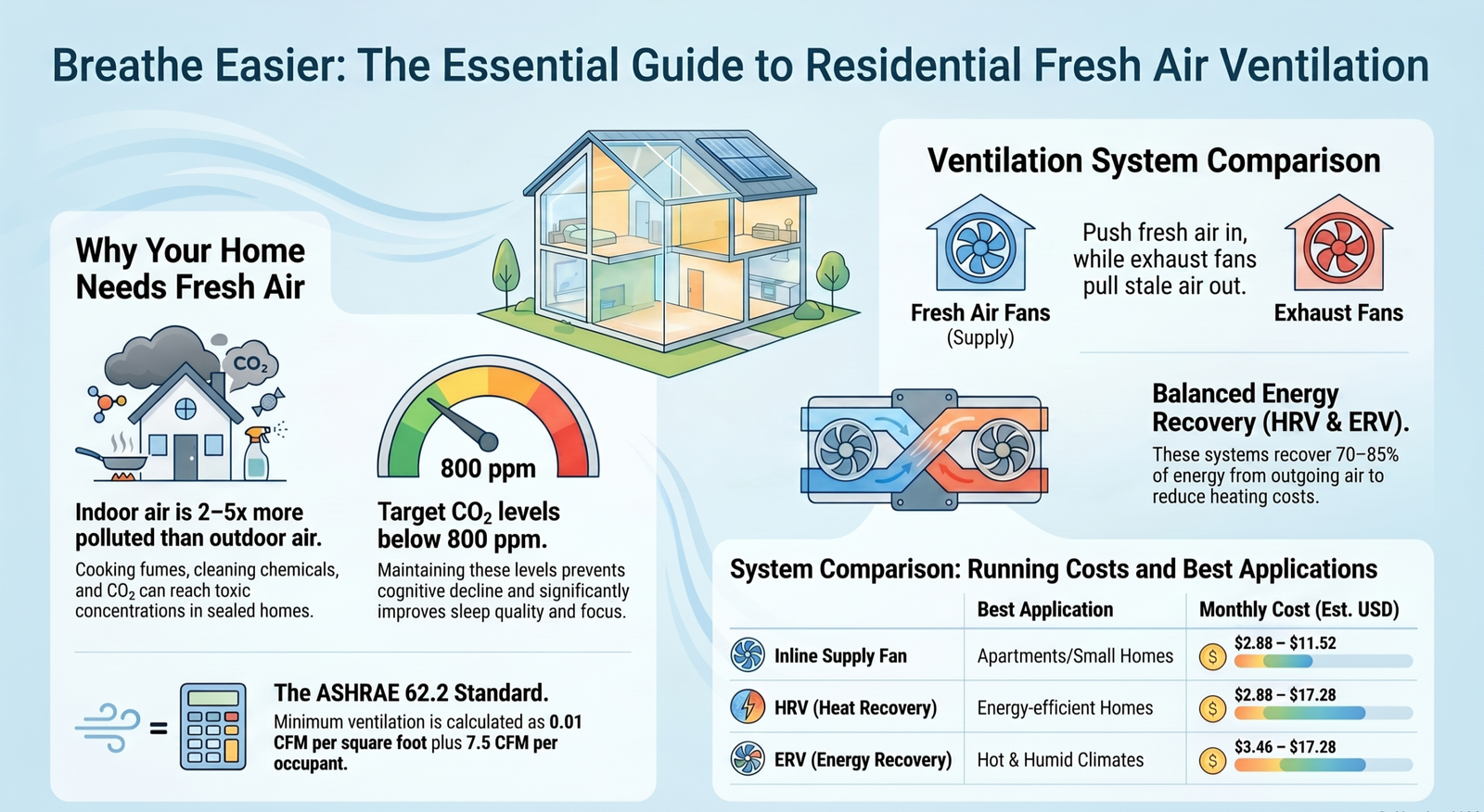
Most homes trap far more pollution indoors than people realize. Cooking fumes, cleaning product chemicals, CO₂ from breathing, moisture from showers, and off-gassing from furniture all accumulate in enclosed spaces — sometimes reaching concentrations two to five times higher than outdoor air. A fresh air fan is the mechanical solution to this invisible problem, actively cycling outdoor air into your home to displace the stale, pollutant-laden air that builds up over hours of habitation.
Whether you are researching a fresh air fan for a new build, an apartment, or a renovation project, this complete guide covers everything you need: how different systems work, the distinction between a fresh air fan and an exhaust fan, which ventilation fan type suits different home sizes and climates, realistic installation costs, and how much electricity these systems use monthly.
Table of contents
- What Is a Fresh Air Fan and How Does It Work?
- Fresh Air Fan vs Exhaust Fan: Key Differences
- Types of Ventilation Fan for Home Use
- Fresh Air Fan Reference Table by System Type
- Benefits of Installing a Fresh Air Fan in Your Home
- Drawbacks and Limitations to Consider
- Which Fresh Air Fan Is Best for Your Home?
- Fresh Air Fan Electricity Cost and Running Expenses
- Fresh Air Fan Installation: What to Know
- Conclusion
What Is a Fresh Air Fan and How Does It Work?
A fresh air fan is any mechanical fan system designed to introduce outdoor air into an interior space in a controlled, continuous manner. Unlike opening a window — which relies on wind and pressure differences — a fresh air ventilation fan actively moves air at a predictable rate, ensuring consistent air changes regardless of weather conditions outside.
The fundamental principle is straightforward: fresh outdoor air replaces stale indoor air that has accumulated CO₂, moisture, odors, volatile organic compounds (VOCs), and other pollutants. The rate of air exchange is measured in air changes per hour (ACH) or cubic feet per minute (CFM) — the volume of air the system moves through the space each hour or minute.
ASHRAE Standard 62.2 — the North American benchmark for residential ventilation — recommends a minimum whole-home ventilation rate calculated as 0.01 CFM per square foot of floor area plus 7.5 CFM per occupant. For a 1,200 sq ft home with four occupants, this means approximately 42 CFM of continuous fresh air supply.
A fresh air fan for home use can fulfill this requirement through several different system types, each with different installation requirements, energy implications, and performance characteristics.
Fresh Air Fan vs Exhaust Fan: Key Differences
The most common point of confusion in home ventilation is the relationship between a fresh air fan and an exhaust fan. They perform opposite but complementary functions:
A fresh air fan operates in supply mode — it pushes outdoor air INTO the building, creating slight positive pressure inside. This ensures fresh air reaches living spaces directly and displaces stale air toward exits.
An exhaust fan operates in extraction mode — it pulls stale air OUT of the building, creating slight negative pressure that draws fresh air in passively through gaps, vents, and leakage points in the building envelope.
Neither system alone achieves optimal results in modern airtight homes. A supply-only fresh air fan without exhaust can cause moisture problems in walls. An exhaust fan without a dedicated fresh air intake relies on uncontrolled air infiltration, which is unpredictable and can draw radon, pollen, or outdoor pollutants through unfiltered pathways.
The most effective approach — used in HRV and ERV systems — combines both: controlled fresh air supply and controlled stale air exhaust in a balanced system, with a heat exchanger that recovers energy from the outgoing air stream.
To estimate the monthly operating cost of your fresh air fan, use our Electricity Bill Calculator.
Types of Ventilation Fan for Home Use
The ventilation fan market encompasses several distinct system categories, each suited to different applications, budgets, and building types:
Spot exhaust fans are the simplest and most common type — bathroom fans, kitchen range hood fans, and laundry exhaust fans. They remove moisture and pollutants at the point of generation but do not supply fresh air directly.
Inline supply fans mount in ductwork or through exterior walls and actively pull fresh outdoor air into a specific room or the central HVAC system. They are cost-effective for apartments and small homes.
Whole-house ventilation fans are larger systems that ventilate the entire building envelope through a coordinated network of supply and exhaust points.
Heat Recovery Ventilators (HRV) provide balanced fresh air supply and stale air extraction with a heat exchanger that recovers 70–85% of the energy from outgoing air — dramatically reducing the heating or cooling penalty of ventilation.
Energy Recovery Ventilators (ERV) add moisture management to the HRV function, transferring humidity between air streams — particularly valuable in humid climates where incoming air needs dehumidification.
Fresh Air Fan Reference Table by System Type
This table compares the main fresh air fan and ventilation system types across function, application, wattage, and estimated monthly running cost at 24-hour continuous operation.
| System Type | Function | Best Application | Typical Wattage | Monthly Cost (USD $0.16/kWh) |
|---|---|---|---|---|
| Bathroom Exhaust Fan | Extracts moisture/odors | Spot ventilation | 15–65W | $1.73–$7.49 |
| Inline Supply Fan | Supplies fresh outdoor air | Apartment/small home | 25–100W | $2.88–$11.52 |
| Whole-House Exhaust Fan | Whole-home negative pressure | Older leaky homes | 50–200W | $5.76–$23.04 |
| HRV (Heat Recovery) | Balanced supply + exhaust + heat recovery | Energy-efficient homes | 25–150W | $2.88–$17.28 |
| ERV (Energy Recovery) | Balanced supply + exhaust + moisture control | Hot/humid climates | 30–150W | $3.46–$17.28 |
| Window/Through-Wall Fan | Reversible supply or exhaust | Apartments, single rooms | 30–100W | $3.46–$11.52 |
These figures assume 24-hour continuous operation. Most fresh air fan systems in residential use run intermittently — either on a timer, humidity sensor, or CO₂ sensor — which reduces actual monthly costs by 40–70% from these maximums.
How an Exhaust Fan Supports Fresh Air Circulation
In homes built before the 1980s, exhaust fans alone often provided adequate ventilation because building envelopes were leaky enough to allow passive fresh air infiltration whenever the fan exhaust created negative pressure inside.
When a bathroom exhaust fan or kitchen range hood runs, it removes stale air and creates a slight pressure differential. Outdoor air naturally flows inward through window seams, door gaps, attic vents, and other envelope penetrations to equalize this pressure — effectively providing passive fresh air supply without a dedicated intake system.
This passive approach works reasonably well in older, less airtight construction. In modern well-insulated and well-sealed homes built to energy codes from the 2000s onward, however, envelope leakage is minimized. Running an exhaust fan in a tight home creates excessive negative pressure that can backdraft combustion appliances (furnaces, water heaters) or draw radon gas from the soil — creating real safety hazards that make a balanced fresh air fan system essential rather than optional.
You can estimate the energy consumption of fresh air fans and other household devices using our Home Appliance Energy Calculator.
Ventilator Fan Options: HRV, ERV, and Inline Fans
The most technologically advanced ventilator fan options — HRV and ERV systems — address the core challenge of modern tight homes: how to bring in fresh air without wasting the energy invested in heating or cooling that air.
An HRV (Heat Recovery Ventilator) routes incoming cold fresh air past outgoing warm stale air through a heat exchanger. In winter, the outgoing warm air preheats the incoming cold air, recovering 70–85% of the thermal energy that would otherwise be lost. In summer, the process reverses — the outgoing cool conditioned air pre-cools the incoming hot outside air.
An ERV (Energy Recovery Ventilator) does everything an HRV does, but also transfers moisture between air streams. In humid summer climates, this prevents incoming humid outdoor air from overwhelming the air conditioner. In dry winter climates, it preserves indoor humidity that occupants and the building envelope both benefit from.
For apartments and smaller spaces without existing ductwork, inline supply fans offer a practical alternative. These quiet, compact fans mount through exterior walls or in short duct runs, delivering 50–150 CFM of filtered fresh air to a single room or central hallway at low wattage (25–75W).
Benefits of Installing a Fresh Air Fan in Your Home
The case for a dedicated fresh air fan rests on both comfort and health:
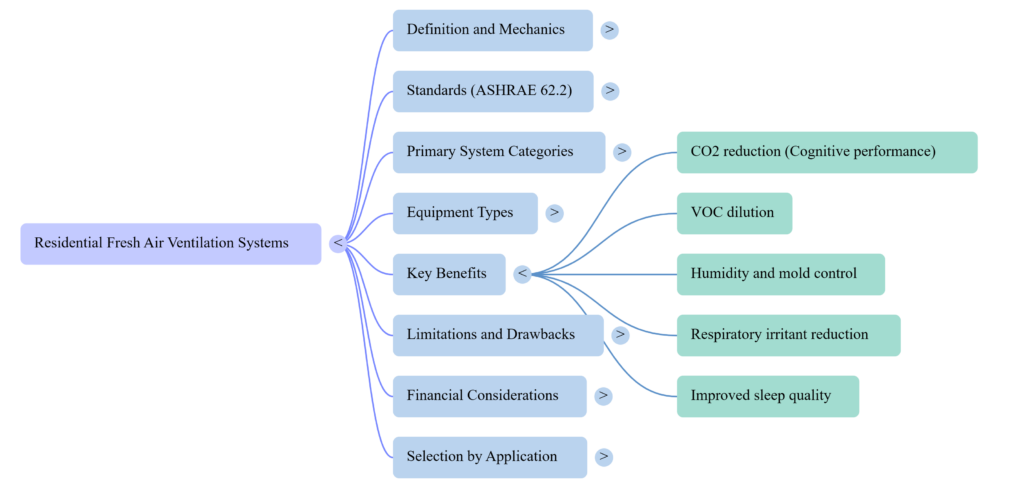
Removes CO₂ and improves cognitive performance. Indoor CO₂ concentrations in unventilated occupied rooms regularly exceed 1,500–2,000 ppm — levels associated with measurable reductions in concentration, decision-making, and sleep quality. A fresh air fan maintains CO₂ below 800 ppm, the threshold where cognitive performance begins to decline.
Eliminates VOC buildup. Furniture, paint, flooring, cleaning products, and building materials all off-gas volatile organic compounds continuously. Without ventilation, these accumulate to concentrations significantly higher than outdoors. A fresh air ventilation fan continuously dilutes and removes VOC-laden air.
Controls humidity and prevents mold. Cooking, showering, and breathing generate 2–4 gallons of moisture per day in a typical household. Without adequate fresh air exchange, humidity builds to levels that promote mold and dust mite growth on walls, in crawl spaces, and behind furniture.
Reduces respiratory irritants. Dust, pet dander, and allergens circulate indefinitely in unventilated spaces. Fresh air dilution — combined with filtered intake — significantly reduces airborne particle concentrations.
Supports better sleep quality. Elevated CO₂ and reduced oxygen availability during sleep in unventilated bedrooms contributes to restless sleep, morning headaches, and daytime fatigue. A bedroom-dedicated fresh air fan running at low CFM overnight measurably improves sleep-related air quality metrics.
Drawbacks and Limitations to Consider
A balanced view of fresh air fan systems includes honest acknowledgment of their limitations:
Installation complexity and cost. A bathroom exhaust fan costs $50–$150 and installs in a few hours. A whole-house HRV or ERV system with ductwork costs $1,500–$3,500 installed — a meaningful investment that may require professional HVAC contractors and permits.
Noise considerations. Cheaper inline fans and older exhaust fans can be audibly disruptive, particularly in bedrooms. Quality ventilation fan systems rated at 0.3–1.0 sones operate nearly silently, but these command premium pricing.
Filter maintenance. Every fresh air fan system that filters incoming air requires periodic filter replacement or cleaning — typically every 3–6 months. Neglected filters restrict airflow, reduce effectiveness, and can become contamination sources themselves.
Climate interaction. In extreme cold (below -15°C), HRV systems can frost in the heat exchanger core, requiring periodic defrost cycles that temporarily reduce efficiency. In very humid tropical climates without an ERV’s moisture management, fresh air supply can actually increase indoor humidity rather than reducing it.
Not a substitute for source control. A fresh air ventilation fan dilutes pollutants but does not eliminate them at the source. Addressing moisture-generating activities, VOC-emitting materials, and combustion appliances at the source remains essential alongside mechanical ventilation.
Which Fresh Air Fan Is Best for Your Home?
The right fresh air fan system depends on your home type, climate, budget, and air quality priorities:
Apartments and small spaces (under 600 sq ft): A through-wall inline supply fan ($80–$200) or a smart bathroom exhaust fan with a continuous low-speed mode provides adequate fresh air supply at minimal cost and installation complexity.
Average single-family home (600–2,500 sq ft): A supply-only inline fresh air system connected to the central HVAC return duct or a standalone whole-house exhaust fan with passive fresh air inlets provides cost-effective ventilation at $200–$600 installed.
New construction or deep energy retrofits: An HRV or ERV system is strongly recommended and may be required by energy code. These systems pay back through reduced heating and cooling costs over time while providing optimal indoor air quality.
Hot, humid climates (Southeast US, Southeast Asia, tropical regions): ERV systems are preferred because they manage both heat and moisture in the incoming air stream, preventing the fresh air supply from overwhelming the air conditioning system.
Cold climates (Canada, Northern Europe, upper Midwest US): HRV systems are the standard choice, recovering heat from exhaust air to minimize the winter heating penalty of ventilation.
Fresh Air Fan Electricity Cost and Running Expenses
Fresh air fan electricity cost is modest for most system types. Apply the standard formula:
Watts × Hours per Day × 30 ÷ 1,000 = Monthly kWh
Bathroom exhaust fan (35W, 4 hrs/day): 35 × 4 × 30 ÷ 1,000 = 4.2 kWh/month = $0.67 USD
Inline fresh air supply fan (75W, 24 hrs continuous): 75 × 24 × 30 ÷ 1,000 = 54 kWh/month = $8.64 USD
HRV system (60W average, 24 hrs continuous): 60 × 24 × 30 ÷ 1,000 = 43.2 kWh/month = $6.91 USD
HRV system on timer (60W, 12 hrs/day): 60 × 12 × 30 ÷ 1,000 = 21.6 kWh/month = $3.46 USD
The electricity cost of running a ventilation fan system continuously is genuinely modest — especially relative to the energy savings that HRV and ERV systems deliver by recovering conditioned air energy from the exhaust stream. A well-sized HRV can reduce annual heating and cooling costs by $100–$300 in climates with significant seasonal temperature swings — more than offsetting its own electricity consumption.
Fresh Air Fan Installation: What to Know
Installation complexity varies enormously across fresh air fan system types:
Bathroom exhaust fans: Straightforward DIY installation for experienced homeowners with basic electrical skills. Requires cutting through ceiling drywall, routing ductwork to an exterior vent, and wiring to a standard circuit. Professional installation typically costs $150–$300.
Inline supply fans through exterior walls: Moderate complexity. Requires core drilling through exterior walls, weatherproof exterior louver installation, and either direct-wire connection or hardwired outlet. Best handled by a handyman or HVAC technician. Cost: $200–$500.
Whole-house HRV or ERV systems: Always requires professional HVAC installation. The unit itself costs $600–$1,500; ductwork design, installation, and commissioning adds $900–$2,500. Total installed cost: $1,500–$4,000 depending on home size and existing ductwork.
Before selecting a fresh air fan system, assess your home’s existing ductwork, attic access, exterior wall construction, and electrical capacity. In many existing homes, a simpler supply-only fan connected to the central air handler return is the most cost-effective entry point to controlled fresh air ventilation.
If your home relies on HVAC systems, check out our Heat Pump Repair Guide to keep your system running efficiently.
Conclusion
Modern homes are increasingly airtight by design — and that efficiency brings an invisible trade-off: without a dedicated fresh air fan, the air you breathe indoors steadily deteriorates in quality hour by hour. CO₂ builds, moisture accumulates, VOCs off-gas from surfaces, and pollutants concentrate without dilution.
A fresh air ventilation fan — whether a simple inline supply unit, a smart exhaust fan with continuous low-speed mode, or a full HRV/ERV system — directly addresses this problem at its source. For most households, the electricity cost of continuous fresh air ventilation is modest: under $10/month for most systems, and often offset entirely by the energy recovery of HRV and ERV technology.
Choosing the right ventilation fan for your home is a decision that repays itself in better sleep quality, improved cognitive clarity, reduced respiratory irritants, and protection against moisture damage and mold. Use the system comparison table and sizing guidance in this guide to identify the fresh air solution that matches your home’s construction type, climate, and budget — then breathe easier knowing your indoor air quality is actively managed.
Explore our Smart Home guides for energy-saving tips, appliance insights, and home efficiency calculators.
Frequently Asked Questions
Q1: What is a fresh air fan and how is it different from a regular fan?
A fresh air fan is designed to bring outdoor air INTO a building through mechanical supply or to exhaust stale indoor air out — maintaining continuous air exchange. A regular ceiling fan or desk fan simply circulates existing indoor air without introducing any fresh outdoor air. Only a dedicated ventilation system actually improves indoor air quality by replacing stale air with fresh outdoor supply.
Q2: What is the difference between a fresh air fan and an exhaust fan?
A fresh air fan supplies outdoor air inward (supply ventilation). An exhaust fan removes stale indoor air outward (extract ventilation). They work opposite ways. Many effective home ventilation strategies use both together — a supply fan bringing in filtered fresh air while an exhaust fan removes stale, moisture-laden air from kitchens and bathrooms simultaneously.
Q3: How much does it cost to run a fresh air fan monthly?
Most residential fresh air fans and exhaust fans draw 25–100W. Running a 60W unit 24 hours daily costs approximately $6.91/month at US average electricity rates ($0.16/kWh). On a timer running 12 hours daily, the same unit costs $3.46/month — making continuous fresh air ventilation one of the most affordable home comfort improvements available.
Q4: Do I need a fresh air fan in a modern airtight home?
Yes — more so than in older homes. Modern energy-efficient construction intentionally minimizes air leakage, which means natural ventilation through gaps is insufficient. ASHRAE 62.2 specifically addresses this: new construction in most jurisdictions now requires mechanical fresh air ventilation. Without it, CO₂, moisture, and VOC concentrations in airtight homes can reach unhealthy levels within hours of occupancy.
Q5: What is an HRV and is it worth the cost?
An HRV (Heat Recovery Ventilator) is a balanced ventilation system that simultaneously supplies fresh air and exhausts stale air while recovering 70–85% of the thermal energy from the outgoing air stream. For homes in climates with significant heating or cooling seasons, the energy recovery often offsets the system’s electricity cost — and the improvement in indoor air quality, humidity control, and comfort typically delivers measurable benefits to occupant health and wellbeing.
Q6: What size fresh air fan do I need for my home?
A basic sizing guide: aim for 0.35 air changes per hour (ACH) for the total home volume, or use ASHRAE 62.2’s formula (0.01 CFM per sq ft + 7.5 CFM per occupant). For a 1,500 sq ft home with 4 occupants: (0.01 × 1,500) + (7.5 × 4) = 15 + 30 = 45 CFM minimum. Most residential fresh air fans and HRV systems offer adjustable airflow from 50–200 CFM, making them appropriately sized for most single-family homes.