Panel Light Guide to LED Ceiling Panel Lights for Every Space
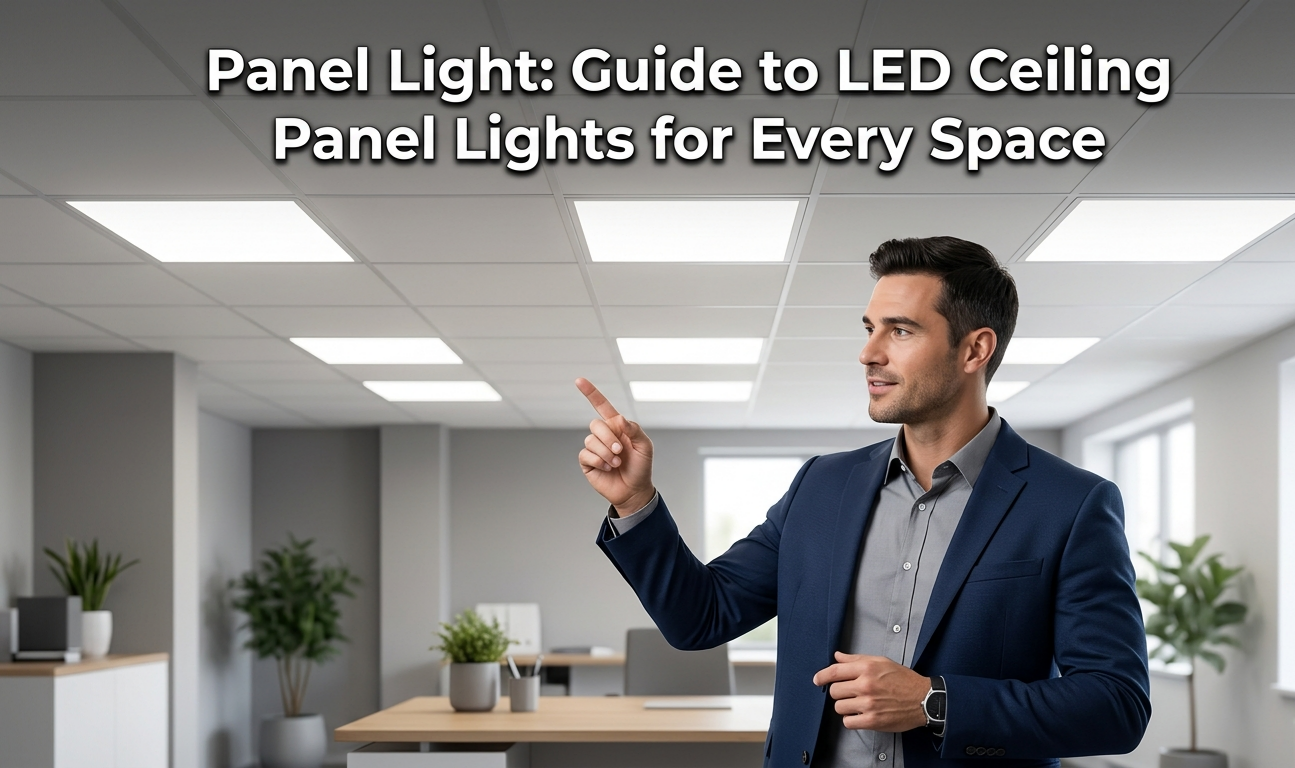
Walk into any modern office, school, hospital, or newly renovated home and the dominant lighting fixture on the ceiling will almost certainly be a flat, bright, evenly glowing panel. The LED panel light has quietly become the defining ceiling fixture of the 2020s — not because of marketing, but because it genuinely outperforms every alternative on the dimensions that matter most to buyers: energy efficiency, light quality, lifespan, and ease of installation.
A panel light is a flat, thin lighting fixture that produces uniform, shadow-free illumination across a wide surface area. Unlike traditional fluorescent tubes or bulb-based downlights that create pools of light and dark zones between fixtures, a well-chosen LED panel light for the ceiling provides even coverage that reduces eye strain, creates a more professional appearance, and consumes a fraction of the power that older fluorescent equivalents required.
This guide explains how to choose, install, and maximise the value of a panel light. It compares recessed and surface-mounted panel light options, shows you how to size panels correctly for any room, examines the actual energy cost differences between LED panels and older lighting technologies, and helps you select the best panels for residential, office, and commercial applications.
Table of contents
What Is a Panel Light and How Does It Work?
A panel light is a flat, thin luminaire that uses LED chips arranged across a light guide plate to produce uniform, diffused illumination from a shallow housing. The defining characteristic of the panel light is its ability to deliver high-quality, even light from a very low-profile fixture — typically between 8mm and 30mm deep — that sits flush with or mounts directly onto a ceiling surface.
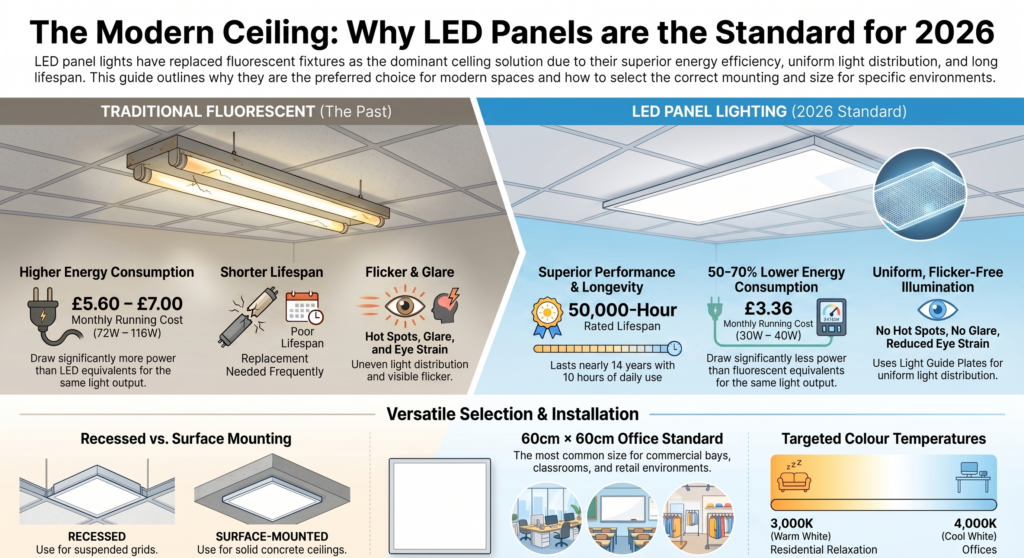
The LED technology inside a modern panel light converts electrical energy into light with dramatically higher efficiency than incandescent, halogen, or fluorescent alternatives. Where a 600mm × 600mm fluorescent fixture typically consumed 72W through four 18W tubes, an LED panel light covering the same area and producing equivalent or superior light output draws only 30–40W. Over the 50,000-hour rated lifespan of a quality LED panel, this efficiency difference represents a meaningful and measurable reduction in electricity costs.
How LED Panel Lights for Ceiling Produce Even Light
The technical secret behind a quality LED panel light for ceiling applications is the light guide plate (LGP). This is a precision-engineered acrylic or polycarbonate panel with microscopic patterns etched or printed on its surface. LEDs positioned along the panel’s edges emit light that enters the guide plate and is scattered uniformly across the entire face by those patterns. The result is perfectly even illumination with no bright spots, no hot zones, and no visible LED positions — even when viewed at a sharp angle.
Cheaper panel lights use a direct-lit configuration in which manufacturers arrange LEDs in a grid behind the diffuser panel rather than placing them along the edges. These cost less to produce and often have shorter lifespans, but they can exhibit visible LED spotting and less even light distribution. When evaluating any LED panel light, the uniformity ratio — the ratio of minimum to maximum light output across the panel face — is the key specification separating premium from budget options.
To estimate the monthly operating cost of LED panel lights, use our Electricity Bill Calculator.
Feature Breakdown: LED Panel Lights for Ceiling — Types, Sizes, and Specifications
Choosing the right panel light for your ceiling requires understanding the available types, sizes, and specifications. The table below outlines standard panel light sizes, their typical wattage and lumen output, the coverage area each size can illuminate, and the applications where each panel performs best:
| Panel Light Size | Typical Wattage | Lumen Output | Coverage Area | Best Application |
|---|---|---|---|---|
| 30cm × 30cm (1×1 ft) | 12–18W | 1,100–1,700 lm | Up to 4 m² | Smaller offices, hallways, kitchens |
| 30cm × 60cm (1×2 ft) | 18–24W | 1,800–2,400 lm | Up to 6 m² | Reception areas, retail corridors |
| 60cm × 60cm (2×2 ft) | 30–40W | 3,000–4,000 lm | Up to 9 m² | Standard office bays, classrooms |
| 60cm × 120cm (2×4 ft) | 40–60W | 4,000–6,000 lm | Up to 14 m² | Warehouses, large open-plan offices |
| Round 22cm (9 inch) | 12–18W | 1,100–1,700 lm | Up to 4 m² | Residential living rooms, bedrooms |
| Round 30cm (12 inch) | 18–24W | 1,800–2,400 lm | Up to 6 m² | Dining rooms, retail displays |
| Surface mounted (any) | Same as recessed equivalent | Same as recessed equivalent | Same coverage | No false ceiling / retrofit use |
The 600mm × 600mm LED panel light is by far the most widely used size in commercial and office applications — it fits standard suspended ceiling grid modules and delivers sufficient light output for most standard office or retail applications with one fixture per ceiling grid section. For residential use, round LED panel lights at 22–30cm diameter have become the dominant replacement for older recessed downlight arrays.
You can estimate the power consumption of LED lighting and other devices using our Home Appliance Energy Calculator.
Recessed Panel Light vs Surface Panel Light — Which Installation Type Is Right?
The panel light for ceiling installation comes in two primary mounting configurations, and choosing between them depends entirely on your ceiling type rather than any difference in light output quality.
A recessed panel light sits flush within a false ceiling or suspended tile grid. The fixture drops into a cut-out in the ceiling material so only the face of the panel is visible — creating the clean, integrated look most associated with modern offices and commercial spaces. Recessed installation requires either an existing suspended ceiling grid or the willingness to create one. It is the standard choice for any new-build or renovation with a false ceiling.
A surface panel light mounts directly onto the ceiling surface with brackets or a mounting frame, with the fixture body visible below the ceiling. This makes it the correct choice for solid concrete ceilings, timber joists without plasterboard depth, garage ceilings, or any installation where creating a recessed cavity is impractical. Surface panel light quality has improved significantly — modern surface-mounted designs are slim, attractive, and produce identical light output to their recessed equivalents.
Panel Light Power Consumption and Energy Cost
One of the most compelling reasons to switch to LED panel lights is the dramatic reduction in energy consumption compared to fluorescent or halogen alternatives. A standard 36W LED panel light for ceiling use produces approximately 3,600 lumens — equivalent to two 58W T8 fluorescent tubes producing 5,400 lumens total, but with significantly more even distribution and no flicker, mercury, or ballast maintenance.
At the UK’s approximate 2025 electricity rate of £0.28 per kWh, a single 40W LED panel light running 10 hours daily costs approximately £0.11 per day, or £3.36 per month. An office with 20 such panels costs roughly £67.20 per month in lighting electricity — compared to £112–£140 per month for equivalent fluorescent coverage. The panel light’s energy cost advantage compounds significantly across large commercial installations.
Pros & Cons: LED Panel Lights — Real Advantages and Genuine Limitations
LED panel lights dominate the commercial and residential lighting market for good reasons — but understanding both their strengths and honest limitations helps you make a buying decision that meets your specific needs without surprises after installation.
Why LED Panel Lights Are the Right Choice for Most Ceilings
- Energy efficiency: an LED panel light consumes 50–70% less electricity than a fluorescent alternative of equivalent light output, with the savings becoming significant at scale across any commercial installation
- Lifespan: quality LED panels are rated to 50,000 hours of operation — at 10 hours daily use, that is nearly 14 years before the light depreciates to 70% of its original output. Fluorescent tubes typically require replacement every 8,000–15,000 hours
- Light quality: high-CRI (Colour Rendering Index 80+) LED panel lights render colours accurately and naturally, reducing eye fatigue in workplaces and making retail merchandise, food, and skin tones appear more true-to-life
- No warm-up time: LED panel lights reach full brightness instantly from the moment they are switched on, unlike fluorescent tubes that flicker and dim for several seconds in cold conditions
- Flicker-free operation: quality LED panel lights use constant-current drivers that eliminate the 50Hz/100Hz flicker associated with fluorescent ballasts — a significant benefit for anyone prone to headaches or eye strain under fluorescent lighting
- Silent operation: no hum, no buzz, no ballast noise — the LED panel light operates in complete silence regardless of temperature or age
Honest Limitations of Panel Lights to Consider Before Buying
Not all panel lights are equal, and the market includes a significant number of products that compromise on driver quality, LED chip grade, and diffuser uniformity to achieve lower price points. A cheap panel light may deliver adequate initial brightness but degrade significantly within two to three years of operation, yellowing the diffuser, flickering under voltage fluctuations, or failing entirely. Investing in a panel light with a credible manufacturer warranty of three years or more is the most reliable indicator of quality at the point of purchase.
Heat management is a second consideration. LED panel lights generate less heat than fluorescent alternatives but still require adequate ventilation above the fixture to maintain LED junction temperatures within operating limits. Panels installed in insulated ceiling voids without adequate clearance may experience reduced lifespan due to heat buildup. Surface panel light installations are generally more naturally ventilated than recessed options for this reason.
Finally, LED panel lights are not easily dimmable without a compatible dimmer switch and a dimmable driver. Not all panel lights include dimmable drivers as standard — check this specification before purchasing if dimming capability is required for your application. Connecting a standard LED panel light to an incompatible trailing-edge or leading-edge dimmer can cause flickering, buzzing, or premature driver failure.
Which Is Best? Choosing the Right Panel Lights for Your Space
With dozens of panel light options across different sizes, mounting types, colour temperatures, and wattages, the right choice depends on matching the fixture’s specifications to the actual requirements of your space. Here is a practical framework for making that decision.
Panel Light for Office and Commercial Spaces
For open-plan offices, classrooms, retail stores, and similar commercial environments, the 60cm × 60cm LED panel light at 30–40W with a colour temperature of 4,000K (Cool White) or 5,000K (Daylight) is the industry standard. This combination delivers bright, neutral light that supports concentration and task visibility without the harsh blue tone of higher colour temperatures. UGR (Unified Glare Rating) below 19 is recommended for office screen environments — this specification controls glare in the direction of computer monitor users and is increasingly required by workplace lighting standards.
Panel Lights for Residential Ceilings — Bedrooms, Living Rooms, and Kitchens
In residential applications, the panel light for ceiling use is most commonly specified in 300mm × 300mm or round formats at 12–18W. A warmer colour temperature — 2,700K (Warm White) or 3,000K (Warm Neutral) — suits living rooms and bedrooms where relaxing, ambient illumination is the goal. Kitchens and bathrooms benefit from a slightly cooler 4,000K for task accuracy. Dimmable panel lights in living areas significantly improve their versatility, allowing the same fixture to provide full task lighting and comfortable evening ambience.
Surface Panel Light for Retrofit and Special Applications
The surface panel light is the practical solution whenever recessed installation is not an option. Modern surface-mounted designs have become indistinguishable from recessed panels in terms of light quality — the only visible difference is the slim mounting frame visible against the ceiling. For garages, warehouses, utility rooms, basements, and older buildings with solid ceilings, a surface panel light delivers professional-grade illumination without any structural ceiling modification.
Explore our Smart Home guides for lighting solutions, energy-saving tips, and home efficiency calculators.
Conclusion
The LED panel light has earned its dominant position in modern ceiling lighting through a combination of genuine performance advantages that older technologies simply cannot match: lower energy consumption, longer lifespan, better light quality, silent operation, and a clean, professional aesthetic that suits every environment from domestic bedrooms to commercial warehouses.
Choosing the right panel light requires matching three specifications to your space: the size and lumen output to your room’s square footage and purpose, the colour temperature to the mood and task requirements of the environment, and the mounting type — recessed for suspended ceilings, surface panel light for solid ceilings — to your structural reality. Get those three decisions right and the LED panel light you install will deliver excellent light for over a decade with minimal maintenance and a fraction of the running cost of the technology it replaces.
Whether you are equipping a single room at home, refitting an entire office floor, or specifying lighting for a new commercial development, the panel light is the most cost-effective, energy-efficient, and visually consistent ceiling lighting solution available in 2026.
Learn how other household devices affect your electricity bill in our Broadband Router Electricity Cost guide.
FAQs
1. What is a panel light and how does it differ from a downlight?
A panel light is a flat, thin ceiling fixture that produces large-area, even illumination from a diffused LED surface. A downlight is a smaller, spot-like fixture that directs a focused beam of light downward from a compact housing. Panel lights are used where wide, uniform coverage is needed — offices, classrooms, large rooms — while downlights are used for accent lighting, smaller areas, or creating directional light effects. For most ceiling applications requiring consistent light distribution, the LED panel light for ceiling use is the more practical and energy-efficient choice.
2. What wattage LED panel light do I need for my room?
As a general rule, aim for approximately 30–50 lumens per square metre for ambient residential lighting and 300–500 lumens per square metre for office or task environments. A 30W LED panel light typically produces 3,000 lumens — suitable for a 6–9 square metre room at office lighting levels, or a larger room at ambient levels. Use the size and lumen reference table in this guide to match panel specifications to your room’s square footage and intended use.
3. What is the difference between a recessed and surface panel light?
A recessed panel light installs inside a cut-out in a suspended or false ceiling, sitting flush with the ceiling surface — only the light panel face is visible. A surface panel light mounts directly onto the ceiling surface with a visible mounting frame. Both types produce identical light quality from the same LED components. The choice between them is determined by ceiling type: recessed for suspended/false ceilings, surface panel light for solid or timber ceilings where creating a recessed cavity is impractical.
4. How long do LED panel lights last?
Quality LED panel lights are rated to 50,000 hours of operation before light output degrades to 70% of the original brightness (L70 rating). At 10 hours of daily use, 50,000 hours represents approximately 13.7 years of operation before significant degradation. Entry-level panel lights with cheaper LED chips and drivers may achieve only 20,000–30,000 hours. Manufacturer warranty length is a reliable proxy for rated lifespan — a panel light with a 5-year warranty will typically outperform one backed by only a 1-year guarantee.
5. How much electricity does a panel light use per month?
A standard 40W LED panel light running 10 hours daily consumes 0.4 kWh per day, or approximately 12 kWh per month. At UK electricity rates of approximately £0.28 per kWh, this costs roughly £3.36 per month per panel. An office with 20 panel lights operating 10 hours daily would cost approximately £67.20 per month in lighting electricity — compared to £112–£140 for equivalent fluorescent coverage. Using a Home Appliance Energy Cost Calculator with your actual tariff rate and hours of use gives you a precise figure for your specific installation.