Types of Wire: Complete Guide to Electrical Wire Types and Uses
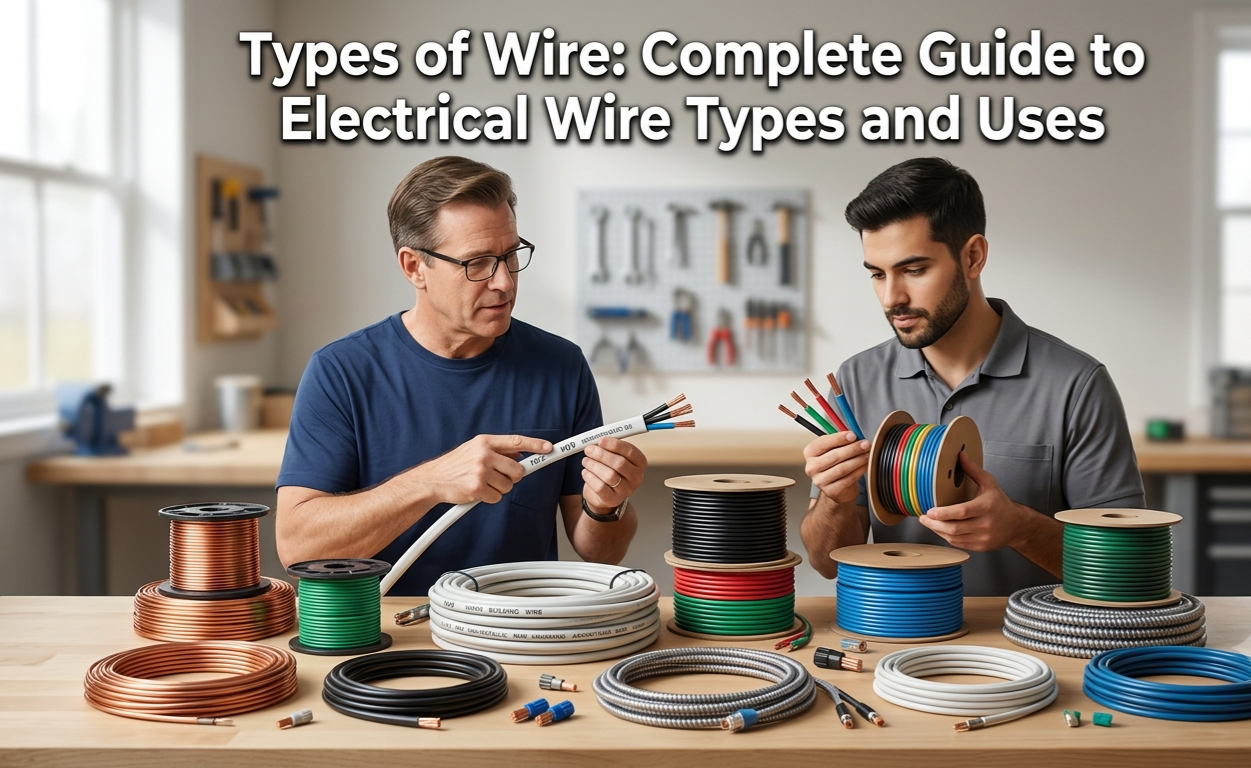
Every electrical project — whether you are replacing a light fixture, wiring a new outlet, connecting a home appliance, or running cable through conduit — begins with the same decision: which wire goes here? Choosing the wrong types of wire creates safety hazards, code violations, and appliance failures that could have been avoided in under five minutes of research. Choosing correctly means a safe installation that lasts decades and performs exactly as designed.
This guide covers every major category of types of wires used in residential, commercial, and low-voltage applications. From copper and aluminum conductors to NM cable, THHN wire, and signal wiring, it also includes a practical wire gauge chart and tips for choosing the right wire for any task.
Table of contents
- Why Understanding Types of Wire Matters
- Main Types of Wire by Conductor Material
- Types of Wire by Construction: Solid vs Stranded
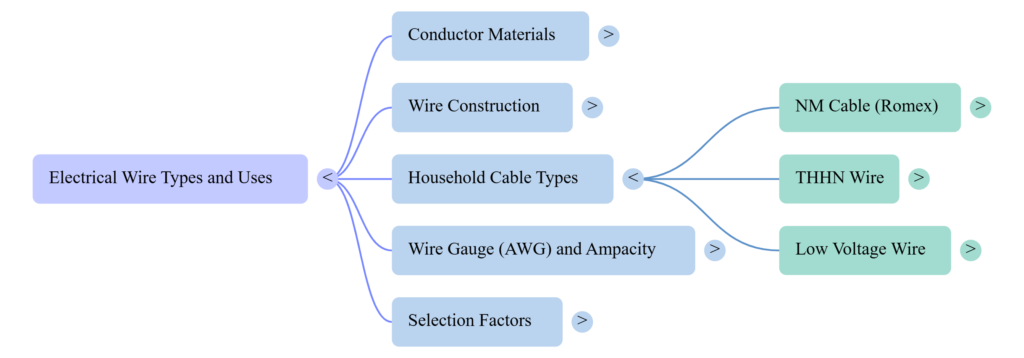
- Household Wiring Types: The Most Common Electrical Cable Types
- Wire Gauge Chart: Choosing the Right Wire Size
- Pros and Cons of Different Wire Types
- Which Type of Wire Is Best for Your Project?
- Conclusion
Why Understanding Types of Wire Matters
The types of wire available today reflect more than a century of electrical engineering refinement. Each wire type exists because a specific combination of conductor material, insulation, and construction serves a distinct purpose better than any generic alternative could.
A wire that performs excellently indoors in dry conditions may fail dangerously when exposed to moisture, heat, or UV. A wire sized for lighting circuit will overheat if pressed into service on appliance that draws three times the current. Electrical wire types are not interchangeable — they are engineered for defined conditions, and the National Electrical Code (NEC) in the United States, or the IET Wiring Regulations in the UK, specifies which type is permitted in which application.
For homeowners, understanding wire types and uses at a foundational level makes conversations with electricians more productive, DIY projects safer, and appliance connections more reliable. For anyone calculating home appliance energy costs, knowing how wire selection affects efficiency and safety ties directly into getting the most value from every watt your household consumes.
Main Types of Wire by Conductor Material
The conductor is the metal core of the wire — the path electricity actually travels through. Two materials dominate: copper and aluminum. Each has distinct properties that determine where it belongs.
Copper Wire Types — The Standard for Residential Electrical Wiring
Copper wire types are the default choice for virtually all residential electrical wiring in modern homes. Copper’s superiority as an electrical conductor comes from several properties working together. It carries current efficiently with minimal resistance, meaning less energy is lost as heat during transmission. It forms secure, durable connections at terminals and junction boxes. Copper Wire is flexible enough to route through walls and conduit without cracking. And it resists corrosion well under typical indoor and outdoor conditions.
The vast majority of household wiring types use copper conductors — from the branch circuits feeding outlets and lighting to the heavier gauge feeds running to appliances like ovens, dryers, and air conditioning units. When electricians and building codes refer to standard wiring without specifying a material, they almost always mean copper.
Copper wire types come in two conductor constructions — solid and stranded — and a wide range of gauges. The wire gauge defines the amount of electrical current it can safely handle, known as its ampacity. Common residential gauges run from 14 AWG for lighting circuits up through 6 AWG and 4 AWG for large appliance feeds and subpanel connections.
To estimate the power requirements of household appliances before selecting wiring, use our Home Appliance Energy Calculator.
Aluminum Wire Types — Where and When They Are Used
Aluminum wire types offer one primary advantage over copper: significantly lower material cost at equivalent current-carrying capacity. For this reason, modern electrical codes prohibit aluminum wiring for most branch circuits in residential buildings. Though aluminum remains fully acceptable and widely used for large-gauge service and feeder applications where secure terminations can properly maintained.
However, aluminum wire types carry limitations that restrict their use in branch circuit wiring throughout the home. Aluminum expands and contracts more than copper with temperature changes, which gradually loosens connections at outlets and terminals over time. Loose connections arc and generate heat — a recognized fire risk. For this reason, modern electrical codes prohibit aluminum wiring for most branch circuits in residential buildings. However, aluminum remains fully acceptable and widely used for large-gauge service and feeder applications where secure terminations can be properly maintained.
Homes built in the 1960s and 1970s may contain aluminum branch circuit wiring throughout. If you live in such a home, having a licensed electrician evaluate the connections is a worthwhile safety investment.
Types of Wire by Construction: Solid vs Stranded
Beyond material, types of wire differ in how the conductor itself is built. This is the solid versus stranded distinction, and it affects how each wire handles, installs, and performs.
Solid wire consists of a single continuous metal conductor running the length of the cable. It holds its shape after bending, makes firm and reliable connections at screw terminals, and is generally the preferred choice for permanent installations inside walls, ceilings, and floors where the wire will not flex after installation. Most household wiring types in fixed installations use solid conductors in gauges from 14 AWG down to 10 AWG.
Stranded wire consists of multiple thin metal filaments twisted together to form a single conductor. This construction makes stranded wire significantly more flexible than solid — it bends repeatedly without metal fatigue and routes easily through tight conduit runs or around corners. Stranded wire is the standard for appliance cords, flexible connections inside electrical panels, and any application where the wire needs to move or flex during normal use. Engineers and installers use it as the construction type for most low-voltage and signal wiring.
The choice between solid and stranded is usually determined by the application rather than personal preference. Building codes and installation requirements specify which is appropriate for each context.
Understanding appliance power usage can also help you estimate household energy expenses with our Electricity Bill Calculator.
Household Wiring Types: The Most Common Electrical Cable Types
Electrical cable types used in homes are not bare conductors — they are multi-conductor assemblies with individual wire insulation plus an outer sheath that bundles and protects everything together. These cables contain two or three insulated conductors plus a bare or green ground wire, all wrapped in plastic jacket.
NM Cable (Romex) — Standard Indoor Household Wiring
People commonly know NM Cable by the brand name Romex and use it as the most widely installed household wiring type in North American residential construction. NM stands for non-metallic sheathed cable. It consists of two or three insulated copper conductors plus a bare copper ground wire, all enclosed in a flexible plastic outer jacket.
NM cable is designed exclusively for dry, indoor, protected locations — inside walls, ceilings, and floors where it will not be exposed to moisture, physical damage, or direct sunlight. It is not rated for outdoor use, underground burial, or installation in conduit in most jurisdictions. Within those limitations, it is the backbone of modern residential branch circuit wiring. Outlets, lighting circuits, switch legs, and small appliance circuits throughout the home are almost universally wired with NM cable.
The label on the outer jacket identifies the NM cable by showing the wire gauge, number of conductors, and cable type. For example, “14-2 NM-B” indicates 14 AWG wire with two insulated conductors plus ground, rated for 90°C dry locations.
THHN Wire — The Workhorse of Commercial and Conduit Wiring
THHN wire is an individual insulated conductor rather than a multi-conductor cable. The designation stands for Thermoplastic High Heat-resistant Nylon-coated — description of two-layer insulation system that gives THHN wire its performance characteristics. It offers resistance to heat up to 90°C in dry locations and 75°C in wet locations. It also includes a nylon outer coating that provides resistance to oils, solvents, and abrasion.
Electricians use THHN wire when they must pull conductors through conduit—metal or plastic pipe that protects wiring in exposed locations, commercial buildings, and installations where NM cable’s plastic jacket cannot provide adequate protection. Individual THHN conductors are pulled through the conduit after it is installed, which allows damaged wire to be replaced without opening walls. The nylon coating on THHN makes this pulling process significantly easier by reducing friction.
In residential construction, electricians commonly install THHN wire in garages, unfinished basements, attic spaces, and outdoor-adjacent areas where code requires conduit. In commercial construction, THHN in conduit is the near-universal wiring method.
Low Voltage Wire — Doorbells, Thermostats, and Data Lines
Not all types of wire carry the line voltages (120V or 240V) of branch circuit wiring. Low voltage wiring covers a broad category of cables that carry signal, control, or data rather than power — or power at voltages typically below 50 volts.
Common low voltage types of wires in homes include:
- Thermostat wire (18/5 or 18/8): Multiconductor wire connecting a thermostat to an HVAC system, carrying 24-volt control signals
- Doorbell wire (18/2): Two-conductor low voltage wire running from a transformer to a doorbell button and chime
- Speaker wire: Two-conductor stranded wire carrying audio signals between amplifiers and speakers
- Cat5e/Cat6 Ethernet cable: Eight-conductor twisted pair cable for network data, classified as low voltage telecommunications wiring
- Coaxial cable (RG-6): Single center conductor with a shielded outer conductor for television and satellite signals
Low voltage wiring operates under different code requirements than line voltage wiring. Many jurisdictions do not require licensed electricians to perform low-voltage installations. However, all work must still meet applicable standards.
Wire Gauge Chart: Choosing the Right Wire Size
Wire gauge determines ampacity — the maximum current a wire can safely carry continuously without overheating. In the American Wire Gauge (AWG) system, counterintuitively, smaller numbers indicate thicker wire with higher ampacity.
| Wire Gauge (AWG) | Max Ampacity | Typical Application |
| 14 AWG | 15 amps | Lighting circuits, standard outlets |
| 12 AWG | 20 amps | Kitchen outlets, bathroom circuits, small appliances |
| 10 AWG | 30 amps | Dryers, water heaters, air conditioners |
| 8 AWG | 40 amps | Electric ranges, large AC units |
| 6 AWG | 55 amps | Subpanel feeds, large appliance circuits |
| 4 AWG | 70 amps | Large subpanel feeds, EV charger circuits |
| 2 AWG | 95 amps | Main panel feeds, service entrance |
Selecting wire that is undersized for the circuit breaker protecting it creates an overheating risk. Selecting wire that is oversized costs more than necessary but creates no safety concern. When in doubt, the next size up is always the safer choice.
Pros and Cons of Different Wire Types
Advantages Worth Knowing
Copper wire types deliver the best combination of conductivity, longevity, and connection reliability for residential wiring. Copper connections remain secure across decades of thermal cycling, making it safest and most maintenance-free option for fixed household installations.
Stranded wire provides flexibility that solid wire cannot match, making it essential for appliance cords, panel wiring, and any installation involving movement. Its ability to flex repeatedly without failure extends service life significantly in applications where rigid wire would crack.
NM cable simplifies residential installation substantially — a single cable pull routes all necessary conductors in one pass, reducing labor time and simplifying identification during future work on the circuit.
THHN wire in conduit offers a significant long-term advantage: when individual conductors are damaged or need upgrading, they can be pulled from the conduit and replaced without opening walls — a maintenance benefit that pays off substantially over the lifetime of a building.
Low voltage wiring can typically be installed by capable homeowners without licensed electrician involvement in most jurisdictions, reducing installation costs for thermostats, doorbells, and network wiring substantially.
Limitations to Plan Around
Aluminum wire types require special consideration at every connection point. Use only aluminum-rated (AL/CU) terminals because standard copper-rated terminals do not work with aluminum conductors. Apply anti-oxidant compound to all connections. Ignoring these requirements creates the connection degradation that gives aluminum wiring its problematic reputation.
NM cable is limited to protected indoor locations. Using it in garages, outdoors, or in conduit (in most jurisdictions) creates code violations and genuine safety risks. It is an excellent product within its defined application and a problematic one outside of it.
Solid wire in gauges below 10 AWG becomes significantly harder to work with — it is stiff, difficult to route through tight spaces, and less forgiving of repeated bending. Below 10 AWG, stranded construction becomes increasingly practical even for fixed installations.
Which Type of Wire Is Best for Your Project?
You determine the right answer to this question using four factors: the installation location, the circuit’s voltage and current, whether the wire runs in conduit or freely, and local electrical code requirements.
For standard residential electrical wiring inside walls, ceilings, and floors in dry indoor locations: 14/2 or 12/2 NM cable with copper conductors is the correct choice for the vast majority of outlets, lighting, and small appliance circuits. Match the gauge to the circuit breaker — 14 AWG for 15-amp circuits, 12 AWG for 20-amp circuits.
For larger appliances — dryers, ranges, water heaters, and HVAC equipment: use the gauge specified by the appliance manufacturer and confirmed by the circuit protection. This is commonly 10 AWG, 8 AWG, or 6 AWG copper depending on the load.
For exposed wiring in garages, basements, or outdoor-adjacent locations requiring conduit: individual THHN copper conductors pulled through rigid or flexible conduit are the appropriate choice. Size the conductors to match the circuit and use proper weatherproof conduit fittings for any outdoor exposure.
For low voltage control and data wiring: use the wire type specified for the application — thermostat wire for HVAC, Cat6 for data networks, RG-6 coaxial for television. These systems have their own specifications independent of the line voltage wiring elsewhere in the building.
If you are unsure which wire type suits your project, consult a licensed electrician for a brief assessment. Doing so often costs far less than fixing a wiring mistake later.
For high-power kitchen appliances, read our How Many Amps Does a Microwave Use guide to better understand electrical requirements.
Conclusion
The types of wire available for electrical work are not arbitrary — each exists because it solves a specific combination of performance requirements that other options handle less well. Copper NM cable dominates residential electrical wiring because it balances safety, reliability, ease of installation, and code compliance for the conditions it is designed for. THHN handles everything NM cable cannot. Low voltage wiring serves the signal and control functions that line voltage wiring was never designed to carry.
Understanding electrical wire types at this level transforms wire selection from a guessing exercise into a straightforward decision based on location, load, and code. It makes DIY projects safer, conversations with electricians more efficient, and home electrical systems more reliably maintained over time.
For homeowners focused on managing appliance energy costs, the connection to wiring is direct: undersized wire on high-draw appliances creates resistance that wastes energy as heat and degrades components over time. Properly sized wire for every circuit in your home is not just a safety requirement — it is part of running your home efficiently.
Explore our Smart Home guides for electrical safety tips, energy-saving advice, and home efficiency calculators.
Frequently Asked Questions
What are the main types of wire used in homes?
The primary types of wire in residential construction are NM cable (Romex) for most branch circuits inside walls and ceilings, THHN wire pulled through conduit for exposed or outdoor-adjacent installations, and low voltage cables for thermostats, doorbells, and data networks. All branch circuit wiring in modern homes uses copper conductors. Manufacturers use aluminum only for large service entrance and feeder cables.
What is the difference between solid and stranded wire?
Solid wire consists of a single metal conductor and holds its shape after bending — it is the standard for fixed installations inside walls and ceilings. Stranded wire consists of multiple thin filaments twisted together, giving it flexibility for repeated bending. Stranded wire is used in appliance cords, panel wiring, and any application requiring flexibility. Both types of wires use the same AWG gauge designations and carry equivalent current for a given gauge.
What gauge wire do I need for a 20-amp circuit?
A 20-amp circuit requires 12 AWG copper wire minimum. Using 14 AWG on a 20-amp circuit is a code violation and a fire hazard — the wire cannot safely carry the current the breaker permits. The rule is straightforward: 15-amp circuits use 14 AWG, 20-amp circuits use 12 AWG, and 30-amp circuits use 10 AWG copper.
Is it safe to use aluminum wiring in a home?
Aluminum wiring in the large-gauge service entrance and main feeder cables is completely standard and safe when properly installed and terminated. Aluminum branch circuit wiring throughout the home — found in some homes built in the 1960s and 1970s — requires careful evaluation. The connection points are the concern, not the wire itself. An electrician can inspect connections and upgrade terminals or use approved connection methods to make aluminum branch wiring safe for continued service.
What is THHN wire and when is it required?
THHN wire is an individual insulated copper conductor with a nylon outer coating, rated for 90°C operation. It is the standard wire type used when conductors must be pulled through conduit — metal EMT, PVC, or flexible conduit used to protect wiring in exposed locations, commercial buildings, garages, and outdoor installations. It is not used as a standalone cable like NM cable but is pulled through pre-installed conduit as individual conductors. Its smooth nylon coating makes pulling through long conduit runs significantly easier.
How do I know which type of wire is right for my appliance connection?
Start with the appliance manufacturer’s wiring specifications — these appear in the installation instructions and specify the required wire gauge and circuit ampacity. Match the wire gauge to that specification and to the circuit breaker protecting the circuit. Use the appropriate wire type for the location: NM cable for protected indoor installations, THHN in conduit for exposed or outdoor locations. If the appliance requires a dedicated circuit (ovens, dryers, and large AC units typically do), ensure the wire gauge runs uninterrupted from the breaker to the appliance connection point without splices.