Hair Dryer Wattage: How Many Watts Does a Hair Dryer Use?
Hair dryer wattage is one of the most searched appliance questions online — and for good reason. Whether you are checking if your bathroom outlet can handle your new blow dryer, calculating your monthly electricity cost, or choosing a travel model that works on 220V circuits abroad, understanding hair dryer wattage is the starting point for every smart decision.
Most people reach for the nearest hair dryer without a second thought about power consumption. But the difference between a 1,000-watt travel model and a 2,000-watt salon-grade dryer is not just drying speed — it is a meaningful difference in electricity draw, monthly running cost, and outlet safety. This guide covers everything you need to know about hair dryer wattage, from typical ranges and cost calculations to the best options for every use case.
Table of contents
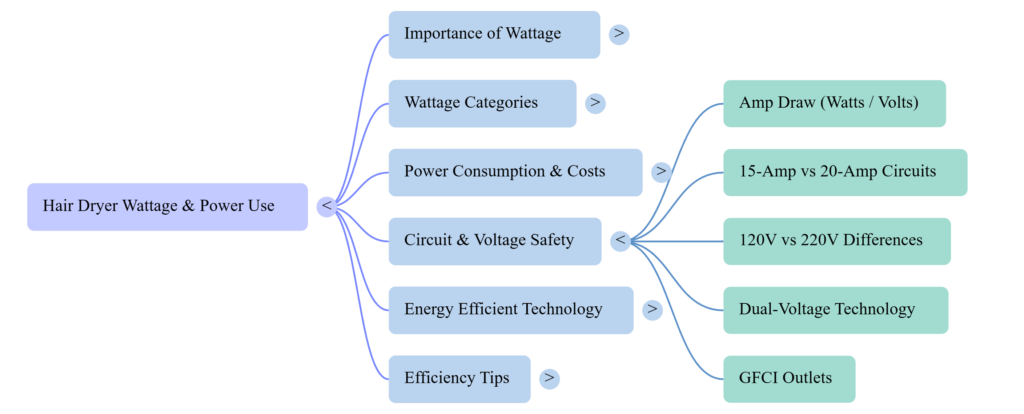
- What Is Hair Dryer Wattage and Why Does It Matter?
- How Many Watts Does a Hair Dryer Use?
- Typical Hair Dryer Wattage by Type
- Hair Dryer Power Consumption Reference Table
- Professional and Salon Hair Dryer Wattage
- Travel Hair Dryer Wattage: What You Need to Know
- How Much Electricity Does a Hair Dryer Use Monthly?
- Hair Dryer Watt to Amp Conversion Explained
- Low Watt vs. High Watt Hair Dryer: Which Is Better?
- Energy Efficient Hair Dryer Options
- Tips to Reduce Hair Dryer Electricity Consumption
- Conclusion
What Is Hair Dryer Wattage and Why Does It Matter?
Hair dryer wattage is a measure of how much electrical power the appliance consumes during operation. Higher wattage means more power flows through the heating element and motor, producing hotter air and stronger airflow — which translates directly to faster drying time.
Understanding your hair dryer’s wattage matters for three practical reasons. First, it determines electricity cost: a 2,000W hair dryer used daily costs meaningfully more than a 1,200W model over time. Second, it determines outlet compatibility: high-wattage dryers on 15-amp circuits can trip breakers when other bathroom appliances run simultaneously. Third, it determines travel safety: plugging a 1,875W North American hair dryer into a 220V European outlet without a proper converter can permanently damage the appliance or create a fire hazard.
Wattage is always printed on the appliance label or listed in the product specifications. For hair dryers, the figure you see is input wattage — what the dryer draws from your home’s electrical supply — which equals the output power since hair dryers convert virtually all input electricity directly into heat and airflow.
How Many Watts Does a Hair Dryer Use?
The direct answer: most household hair dryers use between 800 watts and 2,400 watts, depending on type, size, and heat setting.
How many watts does a hair dryer use varies significantly across categories:
- Compact and travel models: 800W–1,200W
- Standard home hair dryers: 1,200W–1,875W
- High-performance home models: 1,875W–2,000W
- Professional and salon dryers: 2,000W–2,400W
The most common wattage for household hair dryers sold in North America is 1,875 watts — a figure set by UL safety standards as the maximum for standard 15-amp bathroom outlets at 120V. This wattage cap exists specifically because bathrooms typically run on 15-amp circuits, and 1,875W draws approximately 15.6 amps — right at the circuit’s rated limit.
To estimate the energy consumption of your hair dryer and other household devices, use our Home Appliance Energy Calculator.
Typical Hair Dryer Wattage by Type
Understanding typical hair dryer wattage by category helps you compare options and make informed purchasing decisions. The three main categories differ significantly in power consumption, drying performance, and electricity cost.
Travel hair dryers prioritize low wattage and compact size. At 800W–1,200W, they dry hair more slowly but are compatible with weaker voltage systems and consume less electricity. Many are dual-voltage, automatically adjusting to 110V or 220V — essential for international travel.
Standard home hair dryers cover the widest wattage range (1,200W–1,875W). Most consumers own a model in this category. At the common 1,875W ceiling, these dryers deliver strong airflow and quick drying without exceeding standard outlet capacity.
Professional and salon hair dryers operate at 2,000W–2,400W. These are engineered for continuous daily use in commercial environments, featuring more powerful motors, advanced heating elements, and higher airflow volumes. Some require dedicated 20-amp circuits.
Hair Dryer Power Consumption Reference Table
This table shows hair dryer watts by category, calculated amp draw, and estimated monthly electricity cost based on 15 minutes of daily use.
| Hair Dryer Type | Wattage Range | Amps (120V) | Monthly kWh | Monthly Cost (USD @ $0.16) |
|---|---|---|---|---|
| Compact / Travel | 800W–1,000W | 6.7–8.3A | 6.0–7.5 kWh | $0.96–$1.20 |
| Mid-Range Home | 1,200W–1,500W | 10.0–12.5A | 9.0–11.3 kWh | $1.44–$1.80 |
| Standard Home (1875W) | 1,875W | 15.6A | 14.1 kWh | $2.25 |
| High-Performance Home | 2,000W | 16.7A | 15.0 kWh | $2.40 |
| Professional / Salon | 2,000W–2,400W | 16.7–20.0A | 15.0–18.0 kWh | $2.40–$2.88 |
Monthly kWh calculated as: Watts × (15 min/day × 30 days ÷ 60) ÷ 1,000.
This table illustrates that even the highest-wattage home hair dryer costs under $3/month at average U.S. electricity rates for typical daily use — making hair dryers a relatively affordable appliance to operate despite their high peak wattage.
How Much Power Does a Hair Dryer Use Per Session?
To calculate per-session energy use, apply this formula:
kWh per session = Wattage × Minutes of use ÷ 60 ÷ 1,000
Examples:
- 1,000W travel dryer, 10 minutes: 1,000 × 10 ÷ 60 ÷ 1,000 = 0.167 kWh per session
- 1,875W home dryer, 15 minutes: 1,875 × 15 ÷ 60 ÷ 1,000 = 0.469 kWh per session
- 2,200W salon dryer, 20 minutes: 2,200 × 20 ÷ 60 ÷ 1,000 = 0.733 kWh per session
At $0.16/kWh, that salon-level session costs approximately $0.12 per use — less than most people imagine for an appliance that draws over 2,000 watts. The short duration of hair drying sessions is what keeps the actual electricity cost modest.
You can calculate the real monthly operating cost of a hair dryer using our Electricity Bill Calculator.
Professional and Salon Hair Dryer Wattage
Professional hair dryer wattage operates in a fundamentally different performance tier than consumer models. Salon-grade dryers typically deliver 2,000W–2,400W of continuous power, engineered to withstand 6–8 hours of daily use in commercial environments without overheating or degrading.
The practical difference at home is real: a 2,200W salon dryer reduces drying time by 30–40% compared to a standard 1,875W home model on thick or long hair. For people with high hair volume, the time savings can be significant — and because drying time decreases, total energy consumed per session may not be dramatically higher despite the wattage difference.
However, salon hair dryer wattage at 2,000W+ exceeds the safe operating range of standard 15-amp bathroom outlets. Professional models are best suited for bathrooms with a dedicated 20-amp circuit or a ground fault circuit interrupter (GFCI) outlet rated for higher loads. Using a 2,400W salon dryer on a standard 15-amp circuit simultaneously with other bathroom appliances is a reliable way to trip a breaker.
Travel Hair Dryer Wattage: What You Need to Know
Travel hair dryer wattage is critically important for international travelers. The reason comes down to voltage: North America uses 120V, while most of Europe, Asia, Australia, and Africa uses 220–240V.
A standard 1,875W hair dryer designed for 120V will be instantly destroyed if plugged into a 220V outlet — the voltage doubling causes the heating element to burn out within seconds. This is why travel hair dryer wattage is always lower (800W–1,200W) and why the best travel models include dual-voltage technology.
A dual-voltage travel hair dryer automatically detects the outlet voltage and adjusts its internal circuitry accordingly. Look for the label “100–240V” on the appliance — this confirms universal compatibility. Models marked “120V only” require a voltage converter, not just a plug adapter, to work safely abroad.
The trade-off for lower travel hair dryer wattage is drying speed — a 1,000W travel model dries hair noticeably more slowly than a 1,875W home dryer. For occasional travel use, this is an entirely acceptable compromise for the safety and convenience of universal voltage compatibility.
How Much Electricity Does a Hair Dryer Use Monthly?
To calculate how much electricity does a hair dryer use over a full month, scale the per-session formula to your actual usage pattern:
Monthly kWh = Wattage × Daily Minutes × 30 ÷ 60,000
Scenarios for a standard 1,875W hair dryer:
- 10 min/day: 1,875 × 10 × 30 ÷ 60,000 = 9.4 kWh/month (~$1.50 USD)
- 15 min/day: 1,875 × 15 × 30 ÷ 60,000 = 14.1 kWh/month (~$2.25 USD)
- 25 min/day: 1,875 × 25 × 30 ÷ 60,000 = 23.4 kWh/month (~$3.75 USD)
For households in the Philippines on Meralco rates (~₱12.00/kWh), the same 15-minute daily usage costs approximately ₱169/month — a modest but real monthly expense.
Unlike refrigerators or air conditioners that run continuously, blow dryer electricity usage is entirely session-based. There is zero standby power draw from a hair dryer — when it is off, it draws nothing.
Hair Dryer Watt to Amp Conversion Explained
Understanding hair dryer watt to amp conversion protects you from overloading bathroom circuits. The formula is identical to all appliance amp calculations:
Amps = Watts ÷ Volts
At 120V (North America):
- 1,000W ÷ 120V = 8.3 amps
- 1,500W ÷ 120V = 12.5 amps
- 1,875W ÷ 120V = 15.6 amps
- 2,200W ÷ 120V = 18.3 amps
At 220V (International):
- 1,000W ÷ 220V = 4.5 amps
- 1,800W ÷ 220V = 8.2 amps
- 2,200W ÷ 220V = 10.0 amps
The standard 1,875W hair dryer draws 15.6 amps at 120V — essentially at the limit of a 15-amp bathroom circuit. Running a hair dryer simultaneously with a curling iron (625W, 5.2A) or electric shaver (15W, 0.1A) on the same 15-amp circuit can push total draw past the breaker’s rated capacity. Bathroom GFCIs exist for safety, but a dedicated outlet for high-wattage styling appliances is always the smarter setup.
Hair dryer amp usage at 220V is roughly half the North American figure for the same wattage — which is why the same appliance feels less “stressful” on the electrical system in higher-voltage countries.
Low Watt vs. High Watt Hair Dryer: Which Is Better?
Choosing between a low-watt and high-watt hair dryer comes down to four factors: drying speed, hair health, electricity cost, and outlet compatibility.
High-wattage hair dryers (1,875W–2,400W) dry hair faster — full stop. Faster drying means less total heat exposure time, which many stylists argue is better for hair health than prolonged low-heat drying. If speed matters and your outlet can handle the load, high wattage wins on practical performance.
Low-wattage hair dryers (800W–1,200W) use less electricity per session, run safely on weaker circuits and 220V systems, and are significantly lighter and more compact. For fine or short hair that dries quickly, the difference in drying time between 1,000W and 1,875W may be only 2–3 minutes — barely noticeable in practice.
For the majority of home users with standard hair, a 1,500W–1,875W hair dryer hits the ideal balance of performance, electricity cost, and outlet safety. In frequent travelers, a dual-voltage 1,000W–1,200W model is the practical choice regardless of drying speed preferences.
Energy Efficient Hair Dryer Options
Not all high-wattage dryers waste energy equally. Energy efficient hair dryer technology has advanced significantly, with three key innovations reducing actual energy needed per drying session:
Ionic technology produces negative ions that break moisture into tiny, lightweight particles, making it easier for water to spread evenly through the hair. This process enables hair to manage moisture more efficiently, reducing drying time while helping maintain a balanced level of hydration. An ionic hair dryer can reduce drying time by 30–50% compared to a conventional model at the same wattage — meaning total energy consumed per session drops significantly even if peak wattage is identical.
Ceramic and tourmaline heating elements distribute heat more evenly than traditional coil elements. Even heat distribution means less total time at high power settings, reducing both energy use and heat damage to hair.
DC motor hair dryers are lighter and run more quietly than traditional AC motors, but more importantly for energy efficiency, they maintain consistent airflow at lower wattage draws. Many modern DC-motor models deliver equivalent drying performance at 1,200W–1,500W that older AC-motor designs required 1,875W to achieve.
When evaluating hair dryer wattage for energy efficiency, look for ionic certification combined with multiple heat and speed settings — the ability to run at lower settings for light drying tasks meaningfully reduces monthly electricity consumption.
If you’re comparing appliance energy usage, check out our Iron Box Power Consumption guide.
Tips to Reduce Hair Dryer Electricity Consumption
Reducing hair dryer electricity consumption does not require buying a new appliance. These practical adjustments lower electricity use starting today:
Towel dry thoroughly before using the dryer. Removing excess water manually before turning on the hair dryer can cut drying time by 20–30%. Less dryer time means less energy consumed per session regardless of wattage.
Use the lowest effective heat setting. Many people habitually use maximum heat when medium heat would achieve the same result in only slightly more time. Running a 1,875W dryer at 70% heat for 12 minutes uses less energy than running it at full power for 10 minutes.
Clean the air filter regularly. Hair dryers draw air through a filter at the rear. When lint and hair accumulate, airflow decreases, the motor works harder, and efficiency drops. A quick monthly filter cleaning maintains peak performance.
Use a diffuser attachment for curly or wavy hair. Diffusers distribute heat more broadly and evenly, allowing lower heat settings to achieve the same styling result — reducing total wattage draw per session.
Do not over-dry. Hair is dry when it feels dry to the touch, not when the dryer timer runs out. Many people continue using the dryer past the point of effective moisture removal, wasting electricity without improving results.
Conclusion
Hair dryer wattage is one of the most practical specifications to understand before purchasing or using any styling appliance. From the 800W travel model that works safely on any voltage system to the 2,400W salon dryer that cuts professional drying time in half, wattage determines performance, cost, and safety in equal measure.
For most households, a 1,500W–1,875W hair dryer delivers the optimal combination of drying speed, monthly electricity cost (under $3 at average US rates), and standard outlet compatibility. Frequent travelers benefit most from a certified dual-voltage model in the 1,000W–1,200W range.
Explore our Smart Home guides for appliance energy usage, electricity-saving tips, and home efficiency calculators.
Use the formulas and reference table in this guide to calculate your exact monthly electricity cost based on your specific model’s wattage and daily usage pattern. Small adjustments — lower heat settings, thorough towel drying, and regular filter cleaning — can meaningfully reduce your hair dryer’s electricity consumption without sacrificing results.
Frequently Asked Questions
Q1: What is the standard hair dryer wattage for home use?
The most common hair dryer wattage for household models in North America is 1,875 watts — the maximum safe wattage for standard 15-amp bathroom circuits at 120V. Most mid-range and premium home hair dryers target this specification.
Q2: Does a hair dryer use a lot of electricity?
Relative to its wattage, no. A 1,875W hair dryer used for 15 minutes daily consumes approximately 14 kWh per month — costing around $2.25 at average U.S. rates. High wattage combined with short session duration keeps monthly costs modest.
Q3: What wattage hair dryer is safe for travel?
A dual-voltage hair dryer rated at 800W–1,200W and labeled “100–240V” is safe for international travel. Never use a 120V-only hair dryer in a 220V outlet without a proper voltage converter — a plug adapter alone will not protect the appliance.
Q4: How many amps does a 1875-watt hair dryer use?
A 1,875W hair dryer at 120V draws 15.6 amps (1,875 ÷ 120 = 15.625A). This is at the practical limit of a standard 15-amp bathroom circuit. Avoid running other high-draw appliances on the same circuit while using the dryer.
Q5: How much does it cost to run a hair dryer every day for a year?
A 1,875W hair dryer used 15 minutes daily for one year consumes approximately 171 kWh annually. At $0.16/kWh, that is $27.36 per year — a very modest annual electricity cost for a daily-use appliance.