Games Console Electricity Usage Charge: The Complete Guide
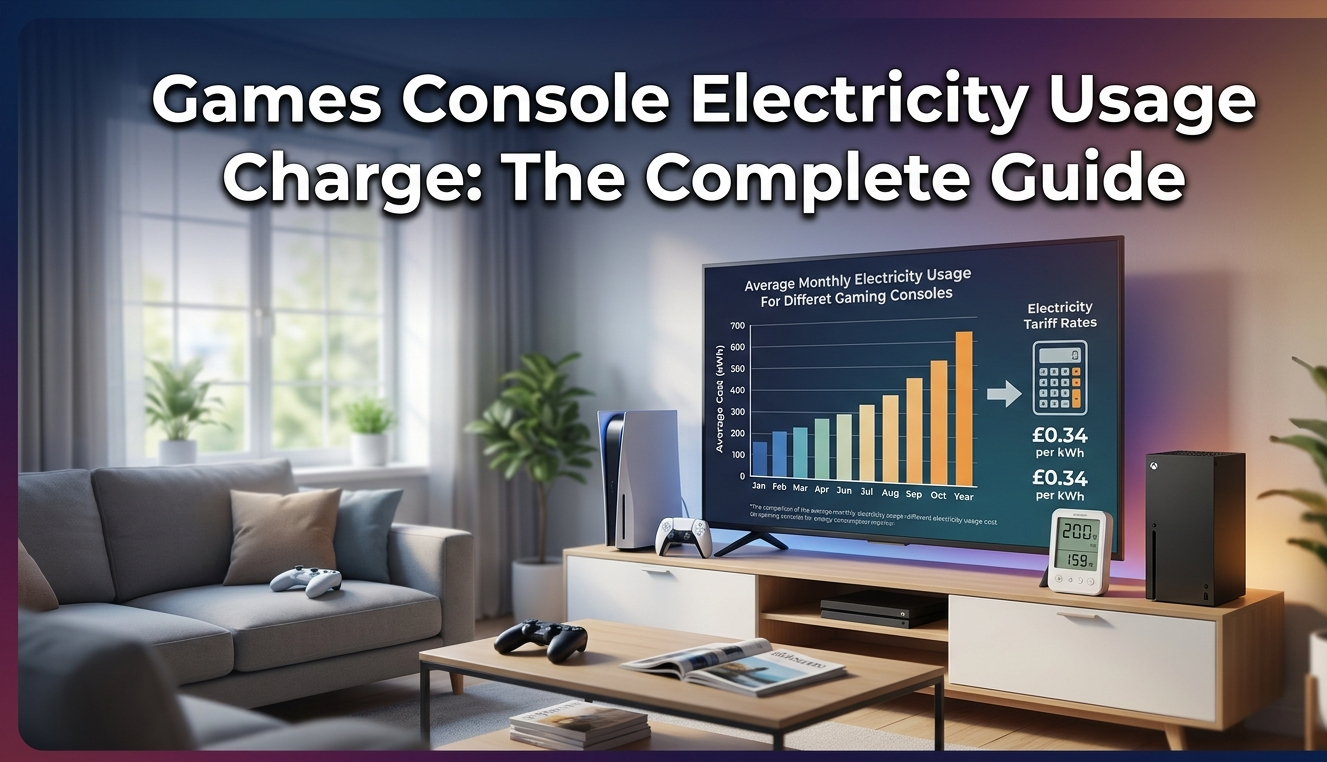
If you have ever glanced at your electricity bill and wondered what is pushing the numbers up, your gaming setup could be a bigger culprit than you think. Understanding the games console electricity usage charge is the first step toward smarter energy management at home. Whether you are a casual weekend gamer or someone who logs six hours a day, knowing exactly how much power your console pulls from the wall helps you budget better and reduce unnecessary waste.
In this guide, we break down the wattage figures for the most popular consoles, show you how to calculate your personal games console electricity usage charge, and give you practical tips to keep those running costs as low as possible.
Table of contents
- What Is Games Console Electricity Usage Charge?
- Feature Breakdown: Console Power Consumption in Detail
- Console Power Consumption at a Glance
- How to Calculate Your Games Console Electricity Usage Charge
- Pros & Cons of High-Power vs Energy-Efficient Consoles
- Which Console Is Best for Energy Efficiency?
- Tips to Reduce Your Console Running Costs
- Conclusion
What Is Games Console Electricity Usage Charge?
The games console electricity usage charge is the amount of money you spend on electricity specifically to power your gaming console. It is calculated from three variables: the console’s wattage (how much power it draws), the number of hours you use it, and the price your energy supplier charges per kilowatt-hour (kWh).
Modern gaming consoles are significantly more powerful than their predecessors — and that power comes at an energy cost. The PS5 and Xbox Series X are the two most power-hungry machines currently on the market, while the Nintendo Switch sits at the opposite end of the spectrum as a highly energy-efficient option.
For most households, the games console electricity usage charge is a modest but real line item. Over a full year, it can easily reach £20–£50 or more depending on how often you play and your local electricity rate.
Feature Breakdown: Console Power Consumption in Detail
How Many Watts Does a PS5 Use?
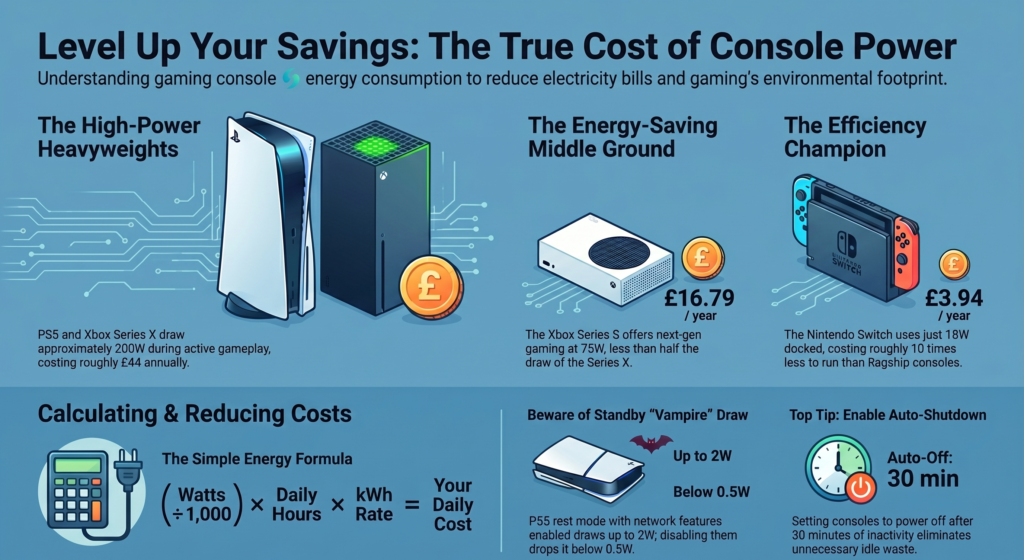
The PS5 is Sony’s flagship console and one of the most powerful home gaming machines ever released. During active gameplay, PS5 wattage typically sits between 150W and 200W depending on the game being played and the version of the console (disc edition vs. digital edition). Graphically demanding titles push the hardware harder and consume more power, while simpler games or menu navigation draw significantly less.
Sony’s official specifications list the PS5 at a maximum rated power of 350W, though real-world usage consistently lands well below that peak. Streaming video or playing less intensive games tends to drop PS5 wattage closer to 70–100W.
To estimate how much your gaming console adds to your monthly utility bill, use our Electricity Bill Calculator.
How Many Amps Does a PS5 Use?
To calculate how many amps a PS5 uses, apply the simple formula: Amps = Watts ÷ Volts. At 200W on a standard 120V US supply, the PS5 draws approximately 1.67 amps. On a 230V UK supply, that same 200W translates to around 0.87 amps. This figure matters if you are connecting multiple devices to an extension lead or planning your home circuit load.
PS5 Active vs Standby Power Draw
One often-overlooked element of the games console electricity usage charge is standby or rest mode consumption. The PS5 in rest mode (with USB charging and network features enabled) draws approximately 1.3–2W. Left in standby for 22 hours a day across a full year, that adds a small but genuine cost to your energy bill. Disabling network features in rest mode drops consumption to under 0.5W.
How Much Power Does an Xbox Series X Use?
The Xbox Series X carries a very similar profile to the PS5 when it comes to peak gaming power. How many watts does an Xbox Series X use? Microsoft’s official data confirms the Xbox Series X draws up to 200W during demanding gameplay. How much power does an Xbox Series X use during video streaming? That figure drops significantly — to around 15W — making streaming on the Xbox an energy-friendly activity.
The Xbox Series X also features an energy-saving shutdown mode that cuts standby consumption to under 0.5W, a meaningful improvement over older console generations.
Nintendo Switch Electricity Usage
The Nintendo Switch is the clear winner on energy efficiency among major current-gen consoles. Docked and playing a demanding title, the Switch draws approximately 10–18W. In handheld mode, that figure drops further to around 7–10W. The Switch’s power adapter is rated at just 39W maximum, making its games console electricity usage charge a fraction of what you pay to run a PS5 or Xbox.
ou can estimate the power consumption of gaming consoles and other devices using our Home Appliance Energy Calculator.
Console Power Consumption at a Glance
The table below summarises peak active wattage and estimated electricity running costs based on two hours of daily gaming at a rate of 30p/kWh (UK average 2024):
| Console | Peak Watts (Gaming) | Est. Cost/Hour | Monthly Cost (2 hrs/day) | Annual Cost |
| PS5 (Disc) | ~200W | 6.0p / $0.06 | £3.60 / $3.60 | £43.80 / $43.80 |
| Xbox Series X | ~200W | 6.0p / $0.06 | £3.60 / $3.60 | £43.80 / $43.80 |
| Xbox Series S | ~75W | 2.3p / $0.02 | £1.38 / $1.38 | £16.79 / $16.79 |
| Nintendo Switch (Docked) | ~18W | 0.5p / $0.01 | £0.32 / $0.32 | £3.94 / $3.94 |
| Nintendo Switch (Handheld) | ~10W | 0.3p / $0.01 | £0.18 / $0.18 | £2.19 / $2.19 |
Figures use 30p per kWh. Adjust for your local electricity tariff for a personalised games console electricity usage charge calculation.
How to Calculate Your Games Console Electricity Usage Charge
Working out your personal games console electricity usage charge takes only a minute. Use this simple three-step formula:
- Find your console’s wattage (see the table above or check the label on the power brick).
- Multiply: (Watts ÷ 1,000) × Daily Hours Used = Daily kWh
- Multiply Daily kWh × Your kWh Rate = Daily Cost
Example: A PS5 running at 200W for 2 hours a day on a 30p/kWh tariff costs: (200 ÷ 1,000) × 2 × 0.30 = £0.12 per day, or about £3.60 per month.
For a quicker result, use the Home Appliance Energy Cost Calculator on this site — just enter your console’s wattage, daily usage hours, and electricity rate to get an instant games console electricity usage charge estimate.
Pros & Cons of High-Power vs Energy-Efficient Consoles
High-Power Consoles (PS5, Xbox Series X)
Pros: Cutting-edge graphics, 4K gaming, fast load times via NVMe SSD, rich game libraries, and future-proof hardware.
Cons: Higher games console electricity usage charge — roughly £40–£50 per year at average UK rates. Greater heat output requires adequate ventilation. Standby power can silently add to bills if energy-saving settings are not enabled.
Energy-Efficient Consoles (Nintendo Switch, Xbox Series S)
Pros: Dramatically lower games console electricity usage charge — the Switch costs under £4 per year at the same rate. Smaller physical footprint, quieter operation, and lower heat output.
Cons: Less graphical horsepower, smaller libraries for demanding AAA titles, and reduced performance ceiling compared to current-gen flagships.
Which Console Is Best for Energy Efficiency?
If minimising your games console electricity usage charge is the priority, the Nintendo Switch wins outright. Its handheld design and modest hardware mean it costs roughly 10 times less to run per year than a PS5 or Xbox Series X.
For players who want full-power next-gen gaming with relatively controlled running costs, the Xbox Series S offers a compelling middle ground — delivering solid 1440p performance at less than half the power draw of its bigger sibling.
For households where gaming is a core entertainment activity and energy costs are already managed efficiently elsewhere, the PS5 or Xbox Series X remains the premium choice — the annual games console electricity usage charge difference of around £27 compared to a Series S is modest in the context of a full home energy bill.
Don’t forget that networking devices also consume electricity. Read our Broadband Router Electricity Cost guide to learn more.
Tips to Reduce Your Console Running Costs
Minor changes in how you use your gaming console can lead to meaningful savings on electricity costs over time, with the impact becoming increasingly noticeable throughout the year:
1. Enable energy-saving or auto-shutdown mode on your PS5 or Xbox. Setting the console to power off after 30 minutes of inactivity eliminates idle waste.
2. Disable background downloads and network access during rest mode. This reduces standby draw from around 1.5W to under 0.5W on a PS5.
3. Use smart plug with energy monitoring to track real-time consumption and identify when your console is drawing more power than expected.
4. Opt for digital-only gaming sessions when graphically lighter titles are available — streaming services on a console use a fraction of the gaming wattage.
5. Consider upgrading older consoles. A PS4 Pro draws up to 165W while delivering far less performance than a PS5 — meaning you could actually lower your games console electricity usage charge by upgrading.
You can further reduce electricity expenses by upgrading your lighting. See our LED Lights Price, Power Consumption & Monthly Costs Explained guide.
Conclusion
Understanding your games console electricity usage charge puts you firmly in control of one of the more overlooked corners of household energy spending. Whether you game on a power-hungry PS5, a balanced Xbox Series X, or the ultra-efficient Nintendo Switch, knowing the wattage figures and running costs empowers you to make smarter choices — from enabling power-saving settings to choosing which console best fits your lifestyle and budget.
The games console electricity usage charge for a PS5 or Xbox Series X running two hours a day amounts to roughly £3.60 per month, or just under £44 per year at current UK rates. That figure can be cut significantly by adjusting standby settings, enabling auto-shutdown, and using an energy monitor to track real-time consumption.
Explore our Smart Home guides for appliance energy usage, electricity-saving tips, and home efficiency calculators.
Use the Home Appliance Energy Cost Calculator on this site to get a personalized games console electricity usage charge figure based on your exact usage pattern and energy tariff. Small changes to your gaming habits can add up to a genuinely meaningful saving over a full year — and every penny counts when household energy costs remain high.
FAQs
Q1: How much does it cost to run a PS5 per hour?
At a rate of 30p/kWh, a PS5 drawing 200W costs approximately 6p per hour during active gameplay. Lighter tasks like streaming reduce this to around 2–3p per hour.
Q2: How many watts does a PS5 use compared to an Xbox Series X?
Both the PS5 and Xbox Series X draw up to 200W during heavy gaming. In practice, real-world wattage varies by game and activity, and both consoles include power-saving modes that can significantly cut consumption.
Q3: How many amps does a PS5 use?
On a UK 230V supply, the PS5 draws roughly 0.87 amps at 200W. On a US 120V supply, that rises to approximately 1.67 amps. These figures are well within the safe range for standard household outlets.
Q4: Is the Nintendo Switch cheaper to run than a PS5?
Yes — significantly so. The Nintendo Switch (docked) uses around 18W versus the PS5’s 200W, translating to roughly 10 times lower electricity costs per hour of use.
Q5: Does leaving a console on standby cost money?
Yes, though the amount is small. A PS5 in rest mode with network features enabled uses approximately 1.3W. Left on standby for 22 hours a day, that adds around £1–£2 per year — a minor but avoidable cost.
Q6: How do I use the Home Appliance Energy Cost Calculator for my console?
Enter your console’s wattage (from the table above), your average daily usage in hours, and your electricity tariff (per kWh). The calculator will instantly generate your estimated games console electricity usage charge per day, month, and year.