Amps to kW Calculator – Convert Amps to Kilowatts Instantly
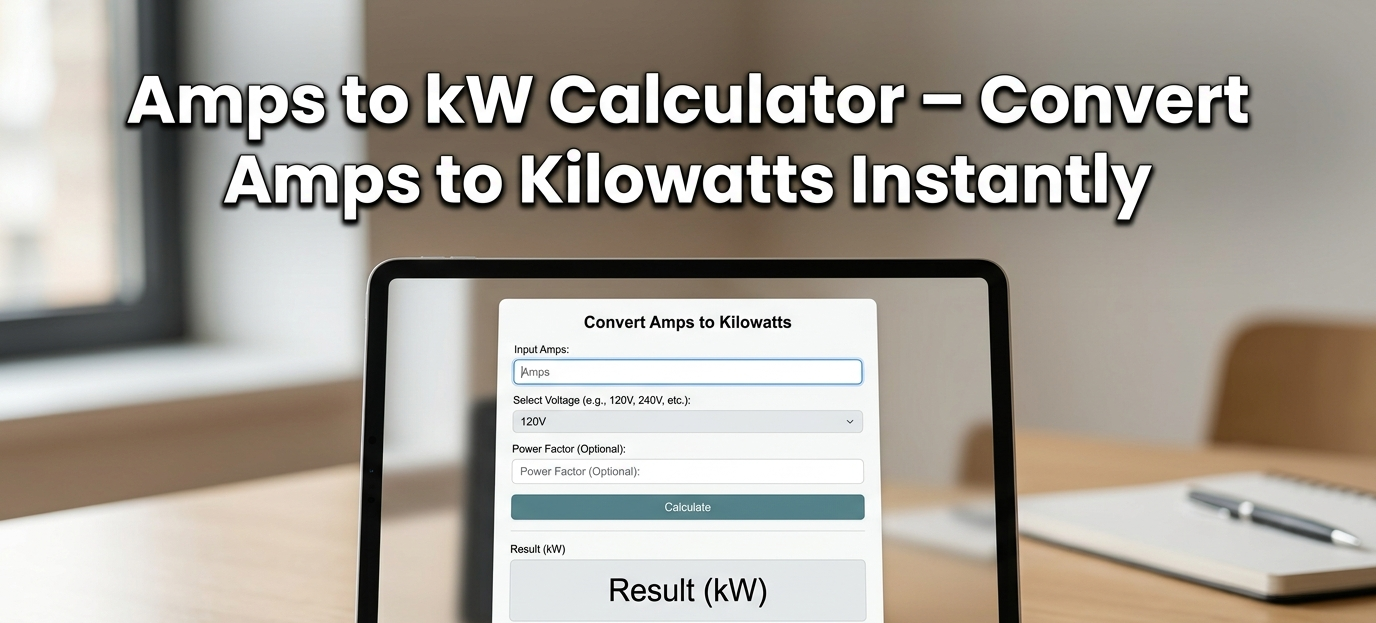
If you’ve ever looked at a circuit breaker, a generator spec sheet, or an electrician’s quote and seen current measured in amps while your appliance or backup system is rated in kilowatts, you’ve run into the exact problem this guide solves. An amps to kw calculator bridges that gap, turning a current reading into a usable power figure — but the formula behind it depends on a few details that are easy to overlook: voltage, phase type, and power factor.
This guide walks through the complete amps to kW formula, a ready-to-use conversion chart, separate explanations for single-phase and three-phase systems, and several worked examples — including the commonly searched 48 amps to kw conversion. By the end, you’ll be able to convert any amp value to kilowatts confidently, and understand exactly why the result can shift depending on your electrical setup.
Table of contents
- What Is an Amps to kW Calculator?
- Amps to kW Formula
- How to Convert Amps to kW
- Amps to kW Conversion Chart
- Single-Phase Amps to kW Calculator
- Three-Phase Amps to kW Calculator
- Amps to kW Conversion Examples
- Common Mistakes When Converting Amps to kW
- A Quick Worked Example for Backup Power Planning
- Why This Matters for Battery Backup Sizing
- Conclusion
- Frequently Asked Questions
What Is an Amps to kW Calculator?
An amps to kw calculator is a tool (or formula) that converts electrical current, measured in amperes (amps), into electrical power, measured in kilowatts (kW). The key thing to understand is that amps alone don’t tell you power — current is only one half of the equation. Power also depends on voltage, and in AC systems, on power factor and the number of phases involved.
This is why a simple “amps to kw” search often returns a calculator rather than a single fixed number: the actual kW result changes depending on whether you’re working with a 120V household circuit, a 230V appliance, or a 415V three-phase industrial supply. An accurate amps to kw calculator accounts for all of these variables rather than assuming one fixed voltage.
People typically reach for this calculation when they’re sizing electrical equipment, checking whether a circuit can handle a particular load, comparing appliance specs, or — increasingly common — figuring out how much battery backup or generator capacity they need to support a given current draw.
Before converting amps to kilowatts, estimate the total appliance load using our Home Appliance Energy Calculator.
Amps to kW Formula
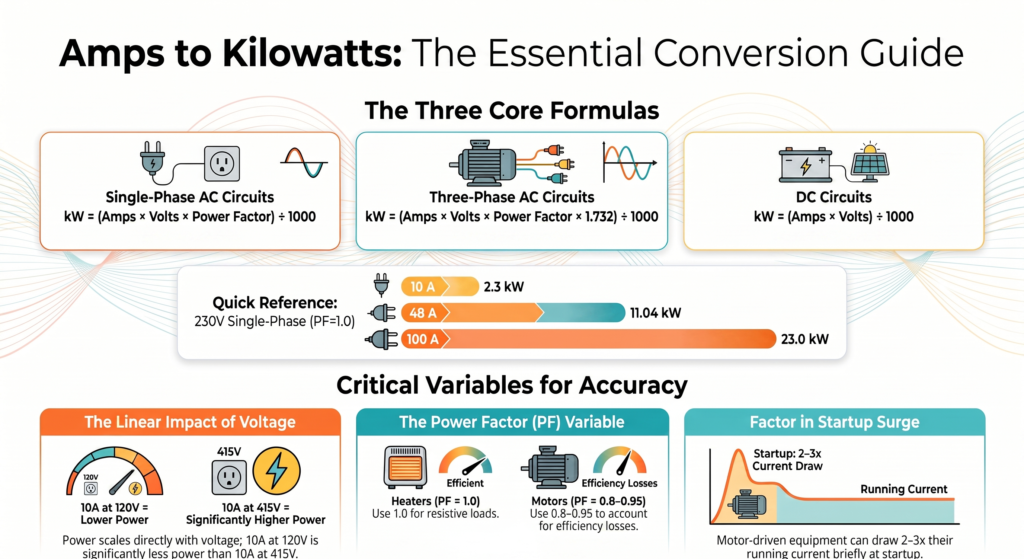
The exact amps to kw formula depends on the type of electrical system you’re working with. Here are the three most common versions:
DC circuits: kW = (Amps × Volts) ÷ 1000
Single-phase AC circuits: kW = (Amps × Volts × Power Factor) ÷ 1000
Three-phase AC circuits: kW = (Amps × Volts × Power Factor × √3) ÷ 1000
The √3 (approximately 1.732) in the three-phase formula accounts for the phase relationship between the three conductors in a three-phase system, which delivers power differently than a single-phase circuit.
Amps to kW Formula Explained
Breaking the formula down into its parts makes it much easier to apply correctly:
- Amps — the current flowing through the circuit, measured with a clamp meter or read from equipment specs.
- Volts — the electrical potential of the supply (common values include 120V, 230V, and 415V depending on region and system type).
- Power Factor — a number between 0 and 1 representing how efficiently the current is being converted into usable power. Purely resistive loads (like heaters) often have a power factor close to 1, while motors and inductive loads typically sit between 0.8 and 0.95.
- √3 — used only in three-phase calculations, reflecting how the three phases combine to deliver power.
Without knowing voltage and (for AC systems) power factor, “amps to kw” doesn’t have one universal answer — it depends entirely on these additional values.
After converting electrical load into kilowatts, use our Electricity Bill Calculator to estimate monthly energy costs.
How Voltage Affects kW Calculation
Voltage has a direct, linear effect on the result. A current of 10 amps produces very different power figures depending on the voltage behind it:
- 10A at 120V (single-phase, PF = 1) → 1.2 kW
- 10A at 230V (single-phase, PF = 1) → 2.3 kW
- 10A at 415V (three-phase, PF = 1) → roughly 7.19 kW
This is exactly why a generic “amp to kw” answer without context can be misleading. Always confirm your voltage and phase type before trusting a conversion figure for anything beyond a rough estimate.
How to Convert Amps to kW
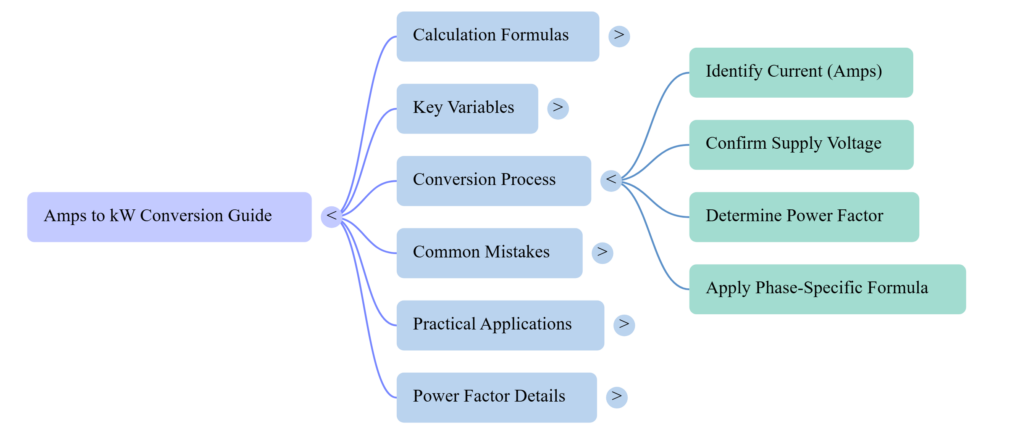
Converting amps to kW manually is a straightforward four-step process:
- Identify your current (amps) — read it from a meter, nameplate, or specification sheet.
- Confirm your voltage — check your supply or equipment rating (commonly 120V, 230V, or 400–415V for three-phase).
- Determine power factor — use 1.0 for purely resistive loads, or check the equipment’s nameplate or datasheet for motors and inductive loads (commonly 0.8–0.95).
- Apply the correct formula — DC, single-phase, or three-phase, based on your system type, and divide by 1000 to express the result in kilowatts rather than watts.
Following these four steps with an amps to kw converter or simple calculator removes the guesswork and ensures your result reflects your actual electrical setup, not a generic assumption.
Amps to kW Conversion Chart
For quick reference, here’s a conversion chart showing common amp values to kW at a standard 230V single-phase supply with a power factor of 1.0 (note: real-world power factor and voltage will shift the exact figure slightly):
| Current (Amps) | Power at 230V Single-Phase (kW) |
| 1 A | 0.23 kW |
| 5 A | 1.15 kW |
| 10 A | 2.3 kW |
| 20 A | 4.6 kW |
| 48 A | 11.04 kW |
| 63 A | 14.49 kW |
| 100 A | 23 kW |
This chart covers the most frequently searched values, including 1 amps to kw and 48 amps to kw, using a standard voltage assumption. If your actual voltage or power factor differs, simply apply the formula above with your specific numbers for a precise result.
To better understand electrical conversions, read our How to Find Watts guide covering volts, amps, and watts formulas.
Single-Phase Amps to kW Calculator
For single phase amps to kw conversions — the type most relevant to household circuits and many small appliances — the formula is:
kW = (Amps × Volts × Power Factor) ÷ 1000
Single-phase power is the standard for most residential electrical systems, where voltage is typically 120V or 230V depending on the country. For purely resistive household loads like electric heaters or incandescent lighting, power factor is close to 1, simplifying the calculation considerably. For appliances with motors, like refrigerators or air conditioners, a slightly lower power factor (often listed on the nameplate) gives a more accurate result.
Three-Phase Amps to kW Calculator
For three phase amps to kw conversions — common in commercial and industrial settings — the formula includes the additional √3 factor:
kW = (Amps × Volts × Power Factor × √3) ÷ 1000
Three-phase systems are used for larger motors, industrial equipment, and commercial buildings because they deliver power more efficiently and with more stable output than single-phase systems at the same current level. If you’re converting current readings from a three-phase panel or motor, using the single-phase formula by mistake will significantly understate the actual power — always confirm phase type before calculating.
Why Power Factor Matters
Power factor often gets skipped in casual conversions, but it has a real impact on accuracy. It represents the ratio between real power (the power actually doing useful work) and apparent power (the total power apparently being drawn, measured in kVA). A power factor of 1 means all the current is being converted into useful work; anything lower means some power is being used inefficiently, often due to motors, transformers, or other inductive loads.
Ignoring power factor in your amps to kw calculation isn’t usually a huge error for simple resistive loads, but for motors and industrial equipment, it can shift your result by 10–20%, which matters considerably when you’re sizing electrical infrastructure or backup power capacity.
Amps to kW Conversion Examples
To make the formula concrete, here are two worked examples using commonly searched values.
Example 1: 48 amps to kw (three-phase, 415V, PF = 0.9)
kW = (48 × 415 × 0.9 × 1.732) ÷ 1000 kW ≈ 31.05 kW
This is a realistic figure for a moderately sized three-phase industrial motor or commercial panel circuit.
Example 2: 1 amps to kw (single-phase, 230V, PF = 1)
kW = (1 × 230 × 1) ÷ 1000 kW = 0.23 kW
This tiny figure illustrates why low-current devices (like small electronics) draw a very small fraction of a kilowatt, while larger industrial circuits can climb into double-digit kW figures quickly once you factor in higher voltage and three-phase power.
Common Mistakes When Converting Amps to kW
A handful of recurring errors show up when people calculate amps to kw manually or plug numbers into a calculator without double-checking their inputs:
- Assuming a fixed voltage. Many online tools default to 230V, but if your actual supply is 120V, 400V, or something else, your result will be off by a significant margin.
- Using the single-phase formula for a three-phase circuit (or vice versa). This is one of the most common mistakes in industrial settings, where misreading a panel’s phase configuration can lead to a result that’s off by a factor of nearly 1.7.
- Ignoring power factor for motor loads. Treating every load as if it has a power factor of 1 overstates real power for anything with a motor, transformer, or other inductive component.
- Forgetting to divide by 1000. Watts and kilowatts are easy to mix up; forgetting the final division step gives you a number 1,000 times too large.
- Not accounting for inrush current. Motors in devices briefly draw far more current at startup than during normal operation, which greatly affects backup power sizing but engineers often overlook in a simple steady-state conversion.
Catching these five issues before you finalize a calculation will eliminate the vast majority of conversion errors people run into with amps to kW.
Accurate amp calculations are also important when selecting circuit protection. Read our Breaker Size Calculator guide for more details.
A Quick Worked Example for Backup Power Planning
To see how all of this comes together in a practical scenario, consider a small workshop running a single 230V, single-phase air compressor that draws 20 amps during normal operation, with a power factor of 0.92.
Step 1: Basic conversion. kW = (20 × 230 × 0.92) ÷ 1000 = 4.232 kW running load
Step 2: Account for startup surge. Motor-driven equipment like air compressors often draws 2–3 times its running current for a brief moment at startup. At a conservative 2.5× multiplier: 4.232 × 2.5 ≈ 10.58 kW momentary surge requirement
Step 3: Size backup power accordingly. A battery backup or inverter for this compressor would need to comfortably handle a brief 10+ kW surge, even though its continuous running draw afterward settles back down to roughly 4.2 kW.
This example shows why a single converted number from an amps to kw calculator is a great starting point, but real-world equipment sizing benefits from layering in power factor and surge considerations on top of the basic formula.
Why This Matters for Battery Backup Sizing
If you’re using a battery backup calculator to plan backup power for your home or business, converting your circuit’s amp rating into kW is often the very first step. Battery backup systems, inverters, and generators are almost always rated in kW or kVA, while breaker panels and many appliance specs are still listed in amps.
Skipping this conversion — or doing it with the wrong voltage or phase assumption — is one of the most common reasons backup power systems end up undersized. Before sizing your battery backup, convert every major circuit or appliance’s amp rating into kW using the correct formula for your system type, then add a reasonable safety margin for inrush current on anything with a motor (pumps, compressors, refrigeration units), since these draw considerably more than their steady-state rating for a brief moment at startup.
Conclusion
Converting amps to kilowatts isn’t a single fixed number — it depends on voltage, phase type, and power factor, which is exactly why a proper amps to kw calculator is more useful than a generic lookup table. Once you understand the formula behind single-phase and three-phase conversions, you can confidently work out real power figures for any circuit, appliance, or piece of equipment you’re dealing with.
The most valuable habit to take from this guide: never trust a converted kW figure without confirming the voltage and phase type behind it, and always add a buffer for startup surge when you’re using these numbers to size a battery backup or generator system. That one extra step is the difference between a backup power setup that performs reliably and one that fails right when you need it most.
Explore our Smart Home guides for electrical calculations, energy-saving tips, and appliance power usage.
Frequently Asked Questions
How do I convert amps to kW?
Multiply amps by volts (and power factor for AC systems, plus √3 for three-phase), then divide by 1000. The exact formula depends on whether your system is DC, single-phase, or three-phase.
What is 48 amps in kW?
At 415V three-phase with a power factor of 0.9, 48 amps converts to approximately 31.05 kW. The exact figure changes with voltage, phase type, and power factor.
Does voltage affect the amps to kW conversion?
Yes, significantly. Power scales directly with voltage, so the same amp reading produces a much higher kW figure on a 415V three-phase circuit than on a 120V single-phase circuit.
Is the amps to kW formula different for three-phase power?
Yes. Three-phase calculations include an additional √3 (about 1.732) multiplier to account for how power is distributed across the three phases, compared to the simpler single-phase formula.
Why do I need power factor to convert amps to kW accurately?
Power factor reflects how efficiently current is converted into usable power. Skipping it for resistive loads (PF close to 1) makes little difference, but for motors and inductive equipment, it can shift your result by 10–20%.
Can I use an amps to kw calculator instead of doing the math manually? Yes — an amps to kw calculator applies the correct formula instantly based on your voltage and phase type, which is especially useful when converting several different circuits or appliances quickly.