Wisconsin Paycheck Calculator: Know Your Exact Take-Home Pay Before Payday

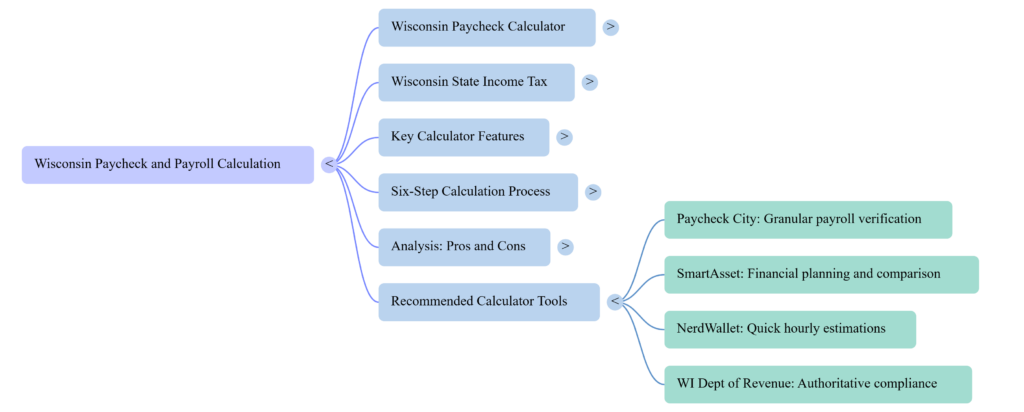
Wisconsin taxes wages on a four-bracket scale from 3.5% to 7.65%, with a standard deduction that shrinks as your income rises. That makes Wisconsin paychecks harder to estimate by hand, so use the Wisconsin paycheck calculator below to see your 2026 take-home pay in Milwaukee, Madison, Green Bay or anywhere else in the state.
Last reviewed November 2026 with 2026 IRS brackets and the Wisconsin Department of Revenue 2026 rate schedule.
Wisconsin Paycheck Calculator (2026)
| Gross pay per paycheck | – |
| Federal income tax | – |
| Social Security (6.2%) | – |
| Medicare (1.45%) | – |
| Wisconsin income tax | – |
| 401(k) contribution | – |
| Take-home per paycheck | – |
| Take-home per year | – |
2026 estimate: federal brackets and standard deduction, FICA, and Wisconsin tax using the 3.5% / 4.4% / 5.3% / 7.65% brackets after the sliding Wisconsin standard deduction and a $700 personal exemption per filer. Credits and other deductions are not included.
Table of contents
Wisconsin Payroll Taxes at a Glance
| Deduction | 2026 rate | Notes |
|---|---|---|
| Federal income tax | 10% to 37% | After the $16,100 single or $32,200 joint standard deduction |
| Social Security | 6.2% | On wages up to $184,500 |
| Medicare | 1.45% | Plus 0.9% above $200,000 (single) |
| Wisconsin income tax | 3.5% to 7.65% | Four brackets after a sliding standard deduction and personal exemption |
| Local income tax | None | Wisconsin cities do not tax wages |
2026 Wisconsin Income Tax Brackets
| Rate | Single taxable income | Married filing jointly taxable income |
|---|---|---|
| 3.5% | $0 to $15,110 | $0 to $20,150 |
| 4.4% | $15,110 to $51,950 | $20,150 to $69,260 |
| 5.3% | $51,950 to $332,720 | $69,260 to $443,630 |
| 7.65% | Over $332,720 | Over $443,630 |
The Wisconsin standard deduction tops out at $13,960 for single filers and $25,840 for married couples filing jointly, then phases down as income rises until it disappears for higher earners. That is why middle-income Wisconsin workers often pay more state tax than the headline brackets suggest.
Wisconsin Take-Home Pay at Common Salaries
Single filer, biweekly pay, standard deductions and no pre-tax benefits.
| Annual salary | Federal income tax | FICA | Wisconsin tax | Take-home per year | Biweekly take-home |
|---|---|---|---|---|---|
| $50,000 | $3,820 | $3,825 | $1,577 | $40,778 | $1,568 |
| $60,000 | $5,020 | $4,590 | $2,070 | $48,320 | $1,858 |
| $75,000 | $7,670 | $5,738 | $2,944 | $58,649 | $2,256 |
| $100,000 | $13,170 | $7,650 | $4,428 | $74,752 | $2,875 |
Wisconsin Hourly Paycheck Examples
| Hourly wage | Weekly gross (40 hrs) | Annual gross | Est. annual take-home (single) |
|---|---|---|---|
| $15 | $600 | $31,200 | about $26,599 |
| $20 | $800 | $41,600 | about $34,443 |
| $25 | $1,000 | $52,000 | about $42,287 |
| $30 | $1,200 | $62,400 | about $50,123 |
Working Across State Lines
Wisconsin has reciprocity agreements with Illinois, Indiana, Kentucky and Michigan. If you live in one of those states and work in Wisconsin, or the other way round, you can usually file a form with your employer so only your home state withholds income tax.
Tips to Increase Your Wisconsin Take-Home Pay
- Update Form WT-4 and your federal W-4 after life changes so withholding matches your real tax.
- Use pre-tax benefits such as a traditional 401(k), HSA or Section 125 health premiums.
- Check reciprocity if you cross a state line to work.
- Look at Wisconsin credits such as the homestead credit and the renter’s and homeowner’s school property tax credit when you file.
How We Calculated These Figures
- Federal tax uses 2026 IRS brackets and the standard deduction.
- Social Security is 6.2% on wages up to $184,500; Medicare is 1.45%.
- Wisconsin tax uses the 2026 brackets and sliding standard deduction published by the Wisconsin Department of Revenue, plus a $700 personal exemption. Because the deduction phase-out is approximated, treat state figures as close estimates.
- Hourly examples assume 2,080 hours a year. See our editorial policy.
Frequently Asked Questions
What are the Wisconsin tax brackets for 2026?
For single filers: 3.5% up to $15,110, 4.4% up to $51,950, 5.3% up to $332,720 and 7.65% above that.
How much is taken out of a paycheck in Wisconsin?
For a single filer earning $60,000, federal tax, FICA and Wisconsin tax together take about 19.5% of gross pay, leaving roughly $1,858 every two weeks.
Does Milwaukee have a city income tax?
No. No Wisconsin city charges a local income tax on wages.
Why does Wisconsin take more than expected?
The standard deduction shrinks as income rises, so more of each extra dollar is taxed. Most full-time workers end up paying 4.4% or 5.3% on their last dollars of income.
Related Calculators
Compare with our Michigan, Kentucky, Arizona and Washington paycheck calculators, or try the salary to hourly calculator.