CT Paycheck Calculator Guide Connecticut Take-Home Pay
Connecticut consistently ranks among the highest-burden states for income tax in the country, making accurate paycheck calculation more financially consequential here than in lower-tax states. A worker who miscalculates their Connecticut take-home pay by even a small percentage faces monthly budgeting shortfalls that compound across the year.. The CT paycheck calculator is the tool that eliminates this guesswork — applying Connecticut’s graduated income tax rates, the CT-W4 state withholding form, federal withholding, and FICA obligations to produce a transparent, accurate net pay figure for every paycheck. This complete guide covers everything from how to calculate gross pay through Connecticut’s specific tax rates, what take-home pay means in practice, how the CT paycheck calculator compares to tools for other states, and which resources deliver the most reliable Connecticut payroll calculation results.
Table of contents
- What Is the CT Paycheck Calculator?
- What Is Take-Home Pay? — The Core Concept
- How to Calculate Gross Pay — The Starting Point
- Connecticut Income Tax Rates — What the CT Paycheck Calculator Applies
- Feature Breakdown — CT Paycheck Calculator Requirements
- $52,000 a Year Is How Much Biweekly — Connecticut Example
- Pros and Cons of CT Paycheck Calculator Tools
- Which Is Best — Selecting the Right CT Paycheck Calculator
- Conclusion
What Is the CT Paycheck Calculator?
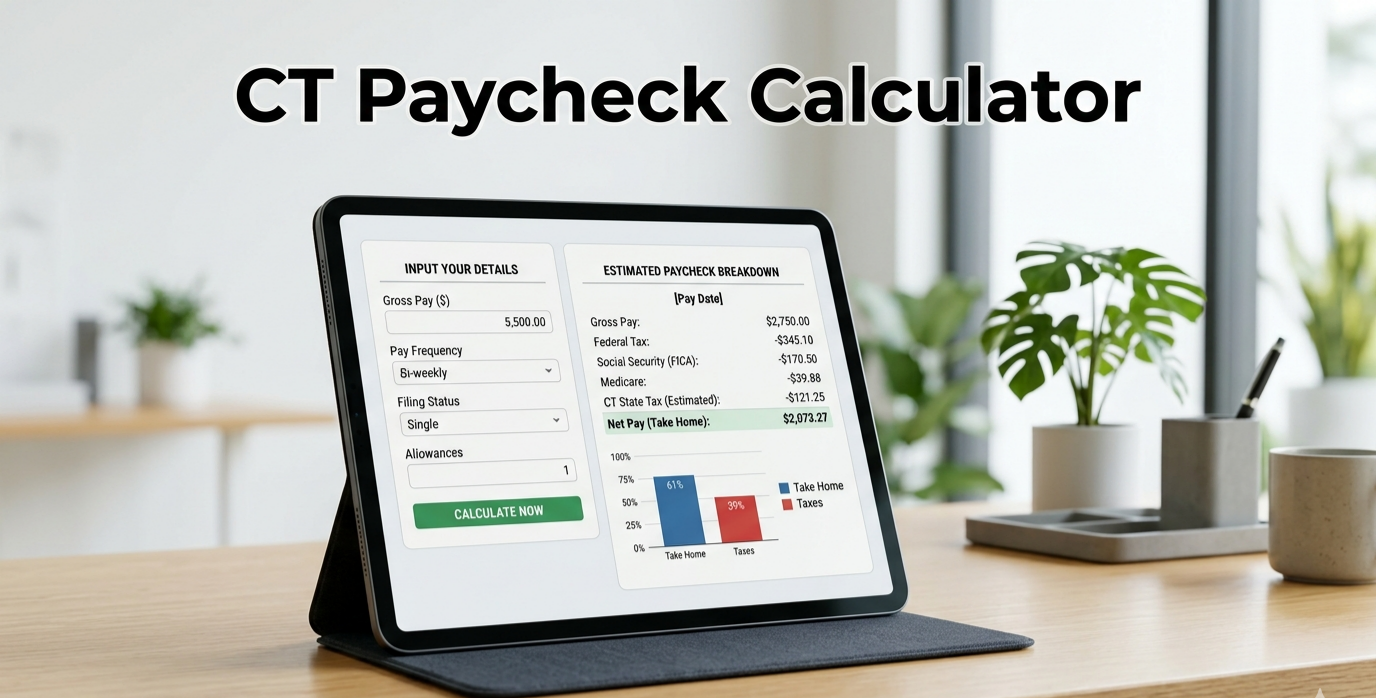
The CT paycheck calculator is a digital productivity tool purpose-built to handle Connecticut’s specific tax structure — converting gross earnings into net take-home pay by applying Connecticut’s graduated state income tax brackets, federal withholding tables, FICA taxes, and benefit deductions in the correct calculation sequence.
Connecticut’s graduated income tax creates the primary complexity that makes the CT paycheck calculator genuinely necessary. Unlike flat-rate states where a single percentage applies to all income, Connecticut uses multiple brackets with progressively higher marginal rates — meaning different portions of income are taxed at different rates, and the effective tax rate varies by income level. This bracket structure requires correct income allocation rather than simple percentage multiplication.
The CT paycheck calculator serves employees verifying their paychecks, employers confirming payroll accuracy, and job seekers evaluating Connecticut compensation against offers from other states. Connecticut’s relatively high combined tax burden makes the CT paycheck calculator particularly important for workers relocating from lower-tax states who need to understand how their gross salary translates to real monthly income under Connecticut tax rules.
Explore more guides in our Digital Productivity category for practical salary, payroll, and financial calculation resources.
What Is Take-Home Pay? — The Core Concept
What is take-home pay is a foundational question that the CT paycheck calculator answers concretely for every Connecticut worker. Take-home pay — also called net pay — is the amount remaining from gross earnings after all mandatory and voluntary withholding has been applied.
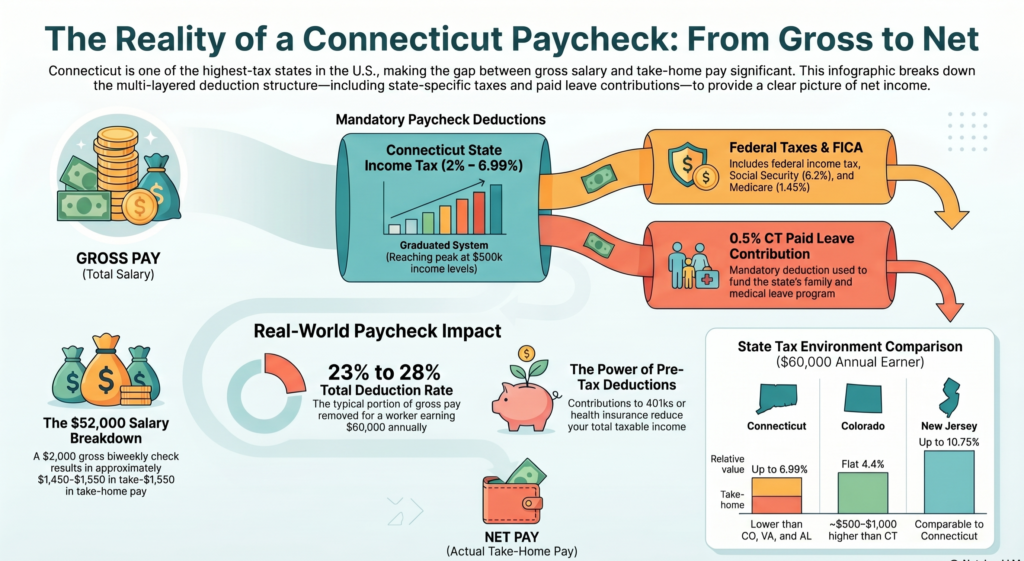
Take-home pay differs from gross pay through the subtraction of federal income tax, state income tax, FICA taxes, and any voluntary benefit deductions. The gap between gross pay and take-home pay is typically 20% to 35% for Connecticut workers depending on income level, filing status, and county of residence — a significant proportion that makes understanding the CT paycheck calculator’s output essential for realistic financial planning.
Connecticut workers generally experience a larger gross-to-net gap than workers in flat-rate states or no-income-tax states because Connecticut’s graduated rates reach 6.99% at the top bracket — one of the higher top marginal rates nationally. The CT paycheck calculator makes this gap explicit and transparent rather than leaving workers to discover it when their first paycheck arrives.
How to Calculate Gross Pay — The Starting Point
How to calculate gross pay is the essential first step that feeds the CT paycheck calculator and every payroll calculation.
For salaried employees, gross pay per period is calculated by dividing annual salary by the total number of pay periods in the year. A worker earning $78,000 annually paid biweekly receives $78,000 ÷ 26 = $3,000 gross per biweekly paycheck.
For hourly employees, gross pay is calculated by multiplying the hourly rate by hours worked during the pay period. A worker earning $22 per hour who works 80 hours in a biweekly period earns 80 × $22 = $1,760 gross. Hours above 40 in any single workweek are subject to the FLSA overtime premium — the employer must pay 1.5× the regular rate for those hours before the CT paycheck calculator applies withholding.
For employees with bonuses or supplemental pay, the gross pay calculation adds the supplemental amount to regular wages for the period, though the federal and Connecticut withholding rates applied to supplemental pay may differ from regular withholding rates.
Understanding how to calculate gross pay precisely matters because every subsequent CT paycheck calculator step — federal withholding, Connecticut state withholding, FICA — applies to this gross pay figure, meaning errors in gross pay determination flow through every subsequent calculation.
Use our Salary to Hourly Calculator to convert salary figures into hourly earnings.
Connecticut Income Tax Rates — What the CT Paycheck Calculator Applies
Connecticut’s graduated income tax rate schedule for 2025 applies progressively higher marginal rates to higher income tiers. The rates range from 2% at the lowest bracket through 4.5%, 5.5%, 6%, 6.5%, 6.9%, and 6.99% at the highest bracket — with bracket thresholds varying by filing status.
| Connecticut Income Tax Bracket (Single Filer) | Rate |
| $0 to $10,000 | 2.0% |
| $10,001 to $50,000 | 4.5% |
| $50,001 to $100,000 | 5.5% |
| $100,001 to $200,000 | 6.0% |
| $200,001 to $250,000 | 6.5% |
| $250,001 to $500,000 | 6.9% |
| Over $500,000 | 6.99% |
The CT paycheck calculator applies this progressive structure through correct bracket allocation — computing the tax on each income tier separately and summing them. A single filer earning $75,000 annually does not pay 5.5% on all $75,000; they pay 2% on the first $10,000, 4.5% on the next $40,000, and 5.5% on the remaining $25,000 — an effective state rate considerably lower than the 5.5% marginal rate.
Connecticut also has a phase-out of the personal exemption at higher income levels — effectively increasing the tax burden above what the bracket rates alone suggest for high earners. The CT paycheck calculator incorporates this phase-out to produce accurate results across all income levels.
Feature Breakdown — CT Paycheck Calculator Requirements
A reliable CT paycheck calculator requires specific capabilities to produce results that match actual Connecticut payroll processing.
Connecticut graduated bracket application with phase-outs is the essential state-specific requirement. The tool must allocate taxable income correctly across Connecticut’s seven-bracket schedule and apply the personal exemption phase-out at the appropriate income thresholds.
CT-W4 form compatibility is required for accurate Connecticut state withholding. Connecticut employees complete the CT-W4 — a state-specific withholding certificate — rather than relying solely on the federal W-4 for state withholding direction. The CT paycheck calculator must accommodate CT-W4 inputs to produce state withholding figures consistent with employer payroll processing.
Multiple pay frequency support handles weekly, biweekly, semi-monthly, and monthly payroll correctly. Connecticut’s graduated structure makes pay-frequency annualisation particularly important — the correct annualisation method affects which portions of income fall into which brackets per paycheck.
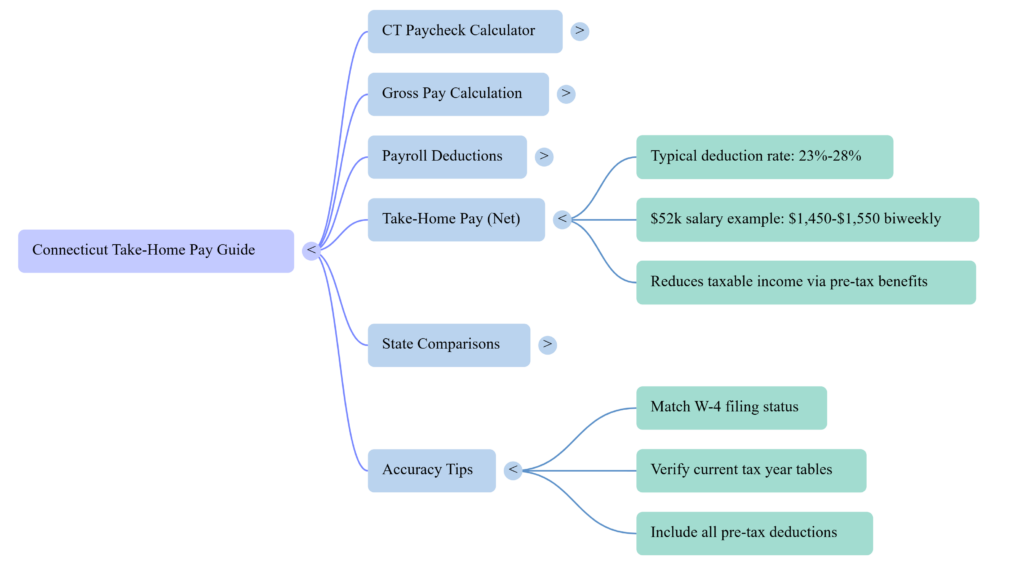
Pre-tax deduction handling reduces Connecticut taxable income for qualified benefit contributions — 401k, health insurance, HSA, FSA — before state withholding is calculated. This reduction is meaningful in Connecticut because the marginal rates are relatively high, making pre-tax deductions more valuable in percentage terms than in lower-tax states.
Supplemental pay calculation applies Connecticut’s flat supplemental withholding rate to bonus payments rather than the regular progressive method — a distinction that affects accuracy for employees receiving bonuses or commissions.
$52,000 a Year Is How Much Biweekly — Connecticut Example
The question $52,000 a year is how much biweekly is one of the most searched salary conversion queries — and the CT paycheck calculator makes it immediately answerable for Connecticut workers.
Gross biweekly calculation: $52,000 ÷ 26 = $2,000 gross per biweekly paycheck
After applying the CT paycheck calculator for a single filer with standard CT-W4 settings, no pre-tax deductions, and biweekly pay frequency:
Connecticut state income tax on $52,000 annually: approximately $1,800 to $2,000 annually — approximately $69 to $77 per biweekly period at the 4.5% bracket level for most of this income tier.
Federal income tax on $52,000 for a single filer: approximately $4,500 to $5,500 annually — approximately $173 to $212 per biweekly period.
Social Security: $2,000 × 6.2% = $124 per period. Medicare: $2,000 × 1.45% = $29 per period.
Estimated biweekly take-home: approximately $1,560 to $1,620 — confirming why the CT paycheck calculator is essential for turning the gross biweekly figure of $2,000 into the realistic net figure that monthly budgeting requires.
Pros and Cons of CT Paycheck Calculator Tools
Advantages:
Connecticut’s seven-bracket graduated structure with personal exemption phase-outs makes the state tax component genuinely complex — the CT paycheck calculator eliminates the bracket allocation arithmetic that manual calculation requires, produces accurate marginal vs. effective rate results, and handles the phase-out mechanism that most mental estimations ignore entirely.
The CT-W4 compatibility that quality CT paycheck calculator tools provide ensures state withholding figures match actual employer payroll processing — a critical accuracy factor that tools using only federal W-4 data for both federal and state withholding cannot achieve.
Scenario modelling for Connecticut workers evaluating compensation against the Alabama salary calculator, the NJ take home pay calculator, or the paycheck calculator Colorado is particularly valuable — Connecticut’s high rates make cross-state comparison informative, and the CT paycheck calculator makes those comparisons concrete.
Disadvantages:
Connecticut’s bracket thresholds and phase-out mechanisms change periodically, and tools not updated to reflect current-year figures produce incorrect results that overstate or understate withholding depending on which direction rates have moved.
Connecticut’s relatively high income tax burden at all bracket levels means that errors in CT paycheck calculator results — from incorrect bracket allocation, wrong CT-W4 inputs, or outdated rates — produce larger dollar-amount discrepancies than equivalent errors in low-rate states.
Workers with Connecticut source income who reside in other states, or Connecticut residents working in neighbouring states, face complex withholding situations that standard CT paycheck calculator tools do not fully address without professional payroll guidance.
Which Is Best — Selecting the Right CT Paycheck Calculator
For detailed payroll verification:
Paycheck City’s Connecticut calculator provides the most granular component breakdown — separating every withholding element, accommodating CT-W4 inputs explicitly, and handling pre-tax deductions correctly through the full calculation sequence. The best choice for employers confirming Connecticut payroll accuracy and employees investigating specific withholding discrepancies.
For financial planning and state comparison:
SmartAsset’s Connecticut tool contextualises take-home pay within Connecticut’s overall tax environment and enables clear comparison against states like Colorado, Virginia, and Alabama — critical information for workers evaluating relocation or comparing multi-state job offers.
For quick estimates:
NerdWallet’s Connecticut calculator provides fast take-home figures with minimal input — appropriate when rapid assessment is the priority rather than component-level verification.
For the official Connecticut income tax withholding tables, current bracket thresholds, phase-out schedules, and CT-W4 instructions, the Connecticut Department of Revenue Services provides the authoritative source documentation that validates any CT paycheck calculator tool’s accuracy.
Conclusion
The CT paycheck calculator is the essential tool for accurate Connecticut take-home pay calculation — and Connecticut’s combination of a seven-bracket graduated income tax structure, personal exemption phase-outs at higher incomes, and top marginal rates reaching 6.99% makes that accuracy more financially consequential than in most other states. Understanding how to calculate gross pay correctly, knowing what take-home pay means after Connecticut’s full withholding stack is applied, and using a CT paycheck calculator that applies current bracket rates with correct CT-W4 inputs are the three foundations of confident Connecticut payroll calculation.
Whether you are verifying a current Connecticut paycheck, comparing Connecticut take-home pay against the Alabama salary calculator or paycheck calculator Colorado results, or planning a household budget around a $52,000 salary, the right CT paycheck calculator delivers the transparent, accurate net pay breakdown that every sound financial decision in Connecticut depends on.
FAQs
What is the CT paycheck calculator?
The CT paycheck calculator is a digital tool that converts Connecticut gross earnings into accurate net take-home pay by applying Connecticut’s graduated seven-bracket income tax, federal withholding, Social Security, Medicare, and benefit deductions in the correct sequence.
How to calculate gross pay for a Connecticut hourly worker?
Multiply the hourly rate by hours worked in the pay period. Hours above 40 in any workweek require the 1.5× FLSA overtime premium before the CT paycheck calculator applies withholding to the resulting gross pay.
What is take-home pay in Connecticut compared to gross pay?
Connecticut workers typically take home 65% to 80% of gross pay depending on income level, filing status, and benefit elections — the gap driven primarily by federal income tax, Connecticut’s graduated state income tax up to 6.99%, and FICA taxes.