Load Calculation Formula: How to Calculate Electrical Load Accurately
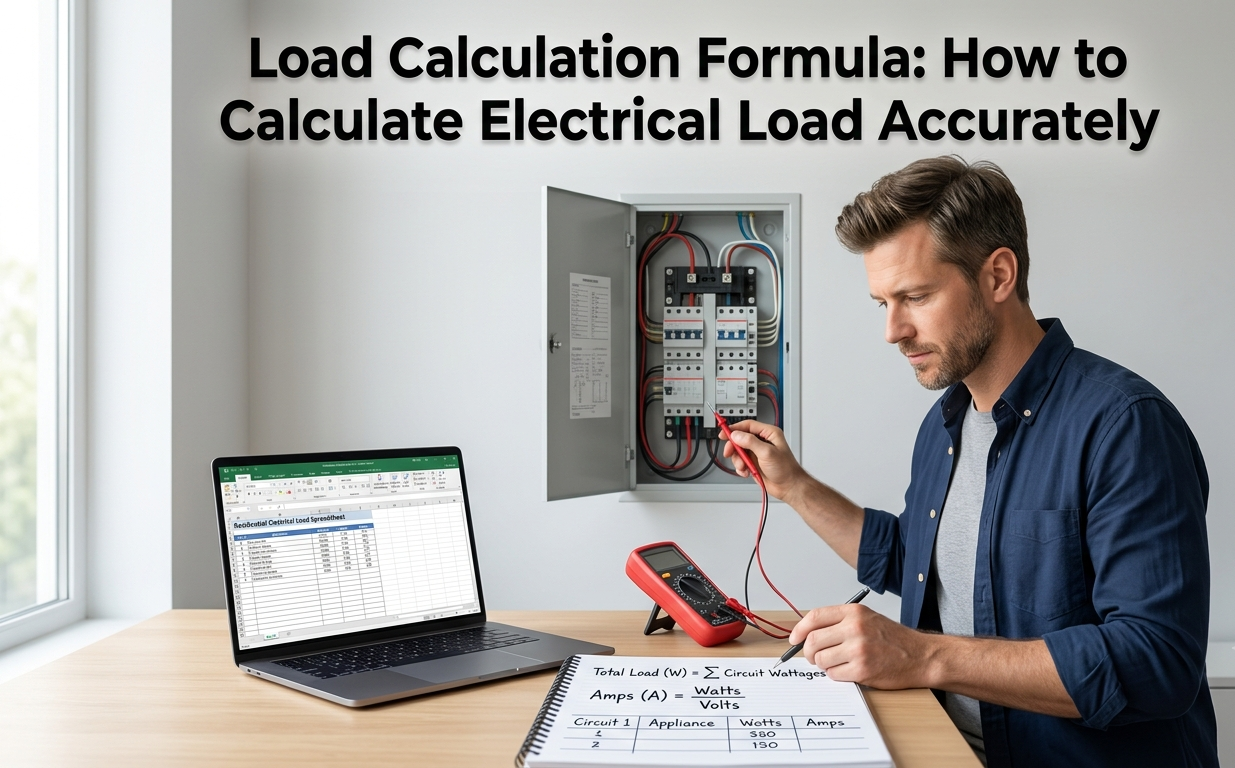
The load calculation formula is the foundation of every safe and code-compliant electrical installation. Whether you are sizing a service panel for a new home, determining the transformer capacity needed for a commercial building, planning battery backup for critical equipment, or verifying that an existing electrical system can safely support additional loads, the load calculation formula gives you the precise figures that every downstream electrical decision depends on.
Without an accurate load calculation, electrical panels get undersized and trip constantly, conductors overheat, transformers fail prematurely, and battery backup systems run out of capacity before the emergency is over. This guide explains the load calculation formula in full: the basic wattage calculation, the single-phase and three-phase variations, NEC demand factors that reduce calculated load for realistic sizing, worked examples for residential and commercial applications, and practical guidance on applying the formula to battery backup and power continuity planning.
Table of contents
- What Is the Load Calculation Formula?
- Load Calculation Formula Explained: Key Concepts
- Load Calculation Formula by Load Type: NEC Reference Guide
- Load Calculation Formula for Homes: A Complete Worked Example
- Load Calculation Formula for Battery Backup Systems
- Pros and Cons of Performing a Full Load Calculation
- Common Mistakes to Avoid During Electrical Load Calculations
- Which Load Calculation Formula Should You Use?
- Conclusion
What Is the Load Calculation Formula?
The load calculation formula is a structured method for determining the total electrical demand that a building, circuit, or system places on its supply source — expressed in watts (W), volt-amperes (VA), or kilowatts (kW). The formula combines the power consumption of every connected load, applies applicable demand factors where the National Electrical Code (NEC) permits, and produces a total demand figure used to size service entrances, feeder conductors, distribution panels, transformers, generators, and battery backup systems.
At its most fundamental level, the load calculation formula uses the relationship between power, voltage, and current:
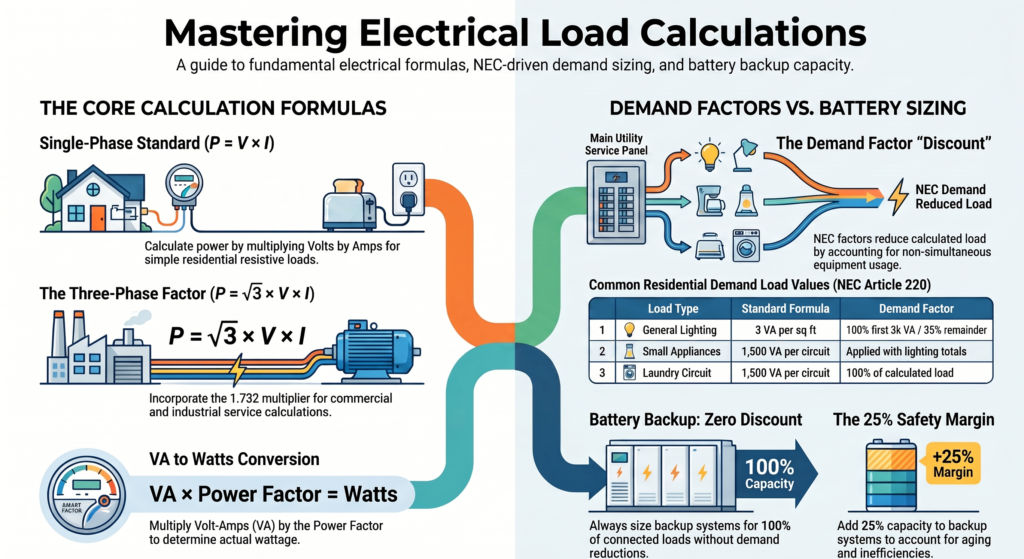
P (Watts) = V (Volts) × I (Amps) [for single-phase resistive loads]
P (Watts) = V × I × PF [for loads with a power factor < 1]
(Watts) = √3 × VL × IL × PF [for three-phase loads]
These are the building blocks. The complete load calculation formula for a residential or commercial facility aggregates individual load calculations using these relationships, applies NEC-specified demand factors where applicable, and produces a total connected load and a total demand load — two distinct figures that serve different purposes in electrical design.
Load Calculation Formula Explained: Key Concepts
Connected Load vs. Demand Load
Every load calculation formula distinguishes between two values: connected load and demand load. Connected load is the simple sum of all equipment nameplate ratings — every watt of every device that could theoretically run simultaneously. Demand load applies NEC demand factors to produce a more realistic figure that accounts for the statistical likelihood that not every load will operate at full capacity simultaneously.
For example, a residential load calculation might show a connected lighting load of 8,000 VA, but the NEC allows a demand factor that reduces the first 3,000 VA to 100% (3,000 VA) and everything above 3,000 VA to 35% (1,750 VA for the remaining 5,000 VA) — producing a demand load of 4,750 VA rather than 8,000 VA. This demand-based load calculation formula prevents electrical systems from being severely oversized while still ensuring safe and reliable operation under realistic conditions.
Load Calculation Using Watts, Volts, and Amps
For any individual circuit or device, the load calculation formula begins with the relationship between the three fundamental electrical quantities. If you know the wattage and voltage:
Current (Amps) = Watts ÷ Volts
A 1,200-watt hair dryer on a 120-volt circuit draws 1,200 ÷ 120 = 10 amps. A 4,500-watt electric water heater on a 240-volt circuit draws 4,500 ÷ 240 = 18.75 amps. You can also use our Power Consumption Calculator to estimate the electricity usage of individual appliances and electrical equipment. These individual load calculations aggregate into the total connected load calculation formula for the panel or service entrance.
If the device rating is given in VA (volt-amperes) rather than watts — common for UPS systems, transformers, and some electronic equipment — convert to watts by multiplying by the power factor: Watts = VA × PF. For most IT equipment, PF ≈ 0.8; for purely resistive loads (heaters, incandescent lighting), PF = 1.0.
Single-Phase Load Calculation Formula
For a single-phase residential or small commercial service, the standard load calculation formula follows NEC Article 220 Part III (for existing dwellings) or Part IV (for new or altered dwellings):
Total Calculated Load (VA) = General Lighting Load + Small Appliance Load + Laundry Load + Fixed Appliance Loads + HVAC Load (largest of heating or cooling) + Electric Range Demand + Dryer Demand
The general lighting load calculation formula for residential uses: VA = Floor Area (sq ft) × 3 VA/sq ft, per NEC 220.12. For a 2,000 sq ft home: 2,000 × 3 = 6,000 VA of general lighting load before demand factors.
Once all individual load calculations are completed, the service size is confirmed: Service Amps = Total Demand VA ÷ Service Voltage. For a 240-volt single-phase service: if total demand load is 24,000 VA, service amps = 24,000 ÷ 240 = 100 amps (confirming a 100-amp service is adequate, or flagging the need for a 200-amp upgrade).
Three-Phase Load Calculation Formula
For commercial, industrial, or large residential three-phase services, the load calculation formula uses the three-phase power relationship:
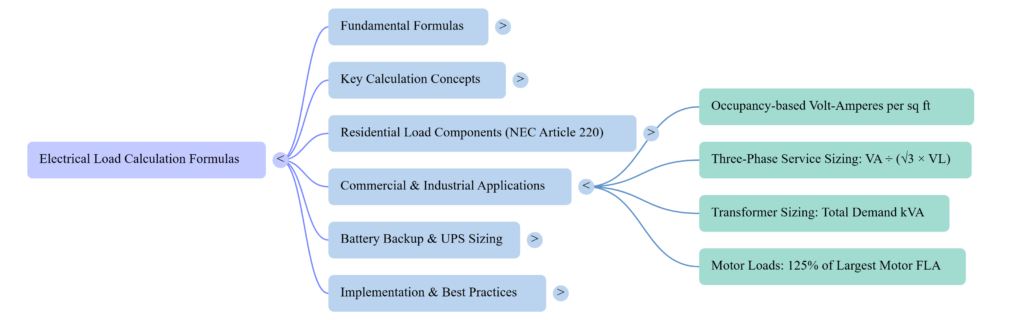
Total Load (VA) = √3 × VL × IL = 1.7321 × Line Voltage × Total Current
Or rearranged to find the required service current from a known total load:
Required Service Current (A) = Total Demand VA ÷ (√3 × Line Voltage)
For a commercial building with a total calculated demand load of 150 kVA on a 480-volt three-phase service:
Required Current = 150,000 ÷ (1.7321 × 480) = 150,000 ÷ 831.4 = 180.4 amps → specify a 200-amp three-phase service.
The three-phase load calculation formula is also used for transformer sizing: the transformer kVA rating must equal or exceed the total demand load in kVA calculated for the facility.
Load Calculation Formula by Load Type: NEC Reference Guide
Different load types use different versions of the load calculation formula, with varying demand factors specified in NEC Article 220. Use this reference table for the most common load categories:
| Load Type | Load Calculation Formula | NEC Reference | Demand Factor Applied |
| General lighting (residential) | 3 VA per sq ft × total floor area | NEC 220.12 | No — 100% of calculated load |
| Small appliance circuits | 1,500 VA × number of circuits | NEC 220.52(A) | No — 100% of calculated load |
| Laundry circuit | 1,500 VA per circuit | NEC 220.52(B) | No — 100% of calculated load |
| Electric range / oven | NEC Table 220.55 demand values | NEC 220.55 | Yes — table demand factors apply |
| Clothes dryer | 5,000 VA minimum or nameplate | NEC 220.54 | Yes — demand factor for 4+ dryers |
| Air conditioning / HVAC | Nameplate ampere rating × voltage | NEC 220.60 | Largest load only (not additive) |
| Electric water heater | Nameplate wattage (no demand factor) | NEC 220.53 | No — 100% of nameplate |
| General commercial load | Volt-amperes per sq ft × area | NEC 220.14 | Yes — occupancy-based factors |
| Motor loads | 125% of motor FLA (largest motor) | NEC 430.24 | Yes — see NEC Article 430 |
| Battery backup / UPS loads | Total connected load VA × 1.25 | NEC 230.79 / 705 | No — size for full connected load |
Load Calculation Formula for Homes: A Complete Worked Example
To demonstrate how the load calculation formula works in practice, here is a complete residential calculation for a 1,800 sq ft single-family home with a 240-volt single-phase service:
Step 1 — General Lighting Load
1,800 sq ft × 3 VA/sq ft = 5,400 VA connected. Apply NEC demand factor (NEC 220.42): First 3,000 VA at 100% = 3,000 VA; Remaining 2,400 VA at 35% = 840 VA. Demand lighting load = 3,840 VA.
Step 2 — Small Appliance and Laundry Circuits
Two 1,500 VA small appliance circuits = 3,000 VA. One 1,500 VA laundry circuit = 1,500 VA. Total = 4,500 VA. Apply NEC 220.42 demand factor: First 3,000 VA at 100% = 3,000 VA; Remaining 1,500 VA at 35% = 525 VA. Demand = 3,525 VA.
Step 3 — Fixed Appliances
Water heater: 4,500 W. Dishwasher: 1,200 W. Disposal: 900 W. Total fixed appliances = 6,600 VA. NEC 220.53 permits 75% demand factor for four or more fixed appliances: 6,600 × 0.75 = 4,950 VA demand.
Step 4 — Range, HVAC, and Other Large Loads
Electric range: use NEC Table 220.55 — 8,000 VA demand for a single range rated 8.75 kW. Air conditioner (largest of heating or cooling): 5,000 VA. Electric dryer: 5,000 VA minimum per NEC 220.54.
Step 5 — Total Demand Load and Service Size
Total demand load = 3,840 + 3,525 + 4,950 + 8,000 + 5,000 + 5,000 = 30,315 VA. Service current = 30,315 ÷ 240 = 126.3 amps → a 150-amp or 200-amp service is required. A standard 100-amp service would be undersized for this home.
Load Calculation Formula for Battery Backup Systems
When applying the load calculation formula to battery backup and UPS system sizing, the calculation differs from utility service sizing in one important way: demand factors are generally not applied. A battery backup system must be capable of powering all connected critical loads simultaneously at full rated capacity, because you cannot predict which loads will be active during the outage the system is designed to address.
The load calculation formula for battery backup sizing is:
Total Critical Load (W) = Σ (Individual Load Watts) — no demand factor reduction
Battery Capacity Required (Wh) = Total Critical Load (W) × Required Runtime (hours) ÷ Inverter Efficiency
For example: A server room with a total critical load calculation of 3,500 watts requiring 4 hours of backup at 85% inverter efficiency needs: 3,500 × 4 ÷ 0.85 = 16,471 Wh = 16.5 kWh of battery capacity. This is the figure used to specify the battery bank, inverter rating, and charging system for the installation.
To estimate the battery capacity required for your backup needs, use our Battery Backup Calculator to calculate the expected runtime and power requirements.
How Smart Home Technology Affects Electrical Load
Smart home technology can improve convenience, automation, and energy monitoring. However, different devices have different electrical requirements.
Understanding these differences makes it easier to plan upgrades without overlooking important loads.
Smart Lighting Systems
Smart bulbs, connected switches, LED strips, and automated lighting controllers contribute to household electrical demand.
LED lighting generally has lower rated power than many traditional lighting technologies, but the total connected lighting load still needs consideration.
To understand the running expenses of household devices, try our Home Appliance Energy Cost Calculator to estimate their electricity costs.
Smart Security Systems
Security cameras, video doorbells, motion sensors, alarm systems, and network equipment may operate continuously.
Although individual devices often have relatively low power ratings, their combined consumption can contribute to the property’s baseline electrical demand.
Smart Heating and Cooling
Smart thermostats usually control heating and cooling equipment rather than supplying the main heating or cooling power themselves.
For load assessments, consider the electrical requirements of the actual HVAC equipment, heat pump, or electric heating system.
Electric Vehicle Chargers
EV chargers can introduce substantial additional electrical demand into residential properties.
Before installation, the electrician should evaluate the existing supply, panel capacity, proposed charger rating, circuit requirements, and any applicable load-management arrangements.
The IET’s guidance on electrical diversity and load curtailment discusses how managed EV charging can affect domestic maximum demand. electrical.theiet.org
Smart Energy Management Systems
Smart energy management equipment can monitor consumption and coordinate certain electrical loads.
Depending on the system, load management may help prevent selected appliances from operating simultaneously. However, it does not remove the need for an appropriate electrical design and properly rated protective equipment.
Smart home technology can improve convenience, automation, and energy monitoring. However, different devices have different electrical requirements.
Pros and Cons of Performing a Full Load Calculation
Why a Complete Load Calculation Formula Always Pays Off
- Prevents panel undersizing that causes nuisance tripping, overheating, and potentially dangerous wiring conditions in the walls
- Identifies opportunities to apply NEC demand factors, which can reduce the required service size by 15–30% for residential installations — directly reducing installation cost
- Provides the defensible documentation required for building permits, utility interconnection applications, and insurance claims involving electrical systems
- Ensures generator and battery backup systems are sized to actually support the intended load rather than failing prematurely during an outage
- Allows proactive identification of circuits approaching capacity before adding new loads — preventing expensive emergency panel upgrades
Common Challenges With Load Calculations
- Nameplate ratings often exceed actual running loads — especially for motors, which draw less than nameplate at partial load, and for electronic equipment with active power factor correction
- NEC demand factor tables require careful interpretation — applying the wrong table or misreading the dwelling type (existing vs. new construction) produces incorrect results
- Three-phase load calculations require tracking loads per phase to identify imbalance, which adds complexity beyond the basic load calculation formula
- Future load growth is difficult to factor in — best practice is to size the service at 125% of current calculated demand to allow for expansion
Common Mistakes to Avoid During Electrical Load Calculations
Even a simple Load Calculation Formula can produce misleading results if the underlying information is incorrect.
Watch out for these common mistakes:
- Using incorrect appliance ratings: Always check the manufacturer’s specifications rather than assuming that similar appliances have identical power requirements.
- Confusing watts with kilowatt-hours: Watts measure power, while kWh measures energy consumed over time.
- Ignoring simultaneous operation: Several high-power appliances may operate together, increasing actual electrical demand.
- Ignoring power factor: Some AC equipment requires power factor consideration when converting current and voltage into real power.
- Overlooking new equipment: EV chargers, electric heaters, heat pumps, and additional kitchen appliances can significantly change residential demand.
- Assuming connected load equals maximum demand: These figures describe different aspects of an electrical installation.
- Choosing breakers from a simple calculation: Breaker selection also depends on conductor ratings, installation conditions, fault protection, and applicable electrical regulations.
Which Load Calculation Formula Should You Use?
For Residential Service Sizing
Use the NEC Article 220 Part IV optional calculation method for new or significantly altered dwellings, or Part III for existing dwellings. The optional method (NEC 220.82) uses a simplified demand factor approach that applies one combined demand percentage to the total load above a base amount, making it faster to apply while remaining code-compliant. For complex homes with multiple large appliances, the standard method produces a more accurate and often lower calculated demand.
For Commercial and Industrial Service Sizing
Commercial load calculations follow NEC 220.14 for branch circuits and NEC 220.40 through 220.44 for feeder and service sizing. The load calculation formula for commercial buildings uses volt-ampere-per-square-foot values based on occupancy type (offices, retail, warehouses, hospitals) combined with specific appliance and motor loads calculated individually. Commercial calculations almost always require a licensed electrical engineer due to the complexity of occupancy-specific demand factors and local code amendments.
For Battery Backup and Generator Planning
Apply the load calculation formula without demand factors: sum all critical load watts, add 25% safety margin, and use this figure as the minimum generator or inverter kW rating. Then calculate battery capacity from this load × required runtime ÷ inverter efficiency. This conservative approach ensures the backup system can handle the full simultaneous load during the most demanding operating scenario — which is the only scenario that matters when the utility supply has failed.
Conclusion
The load calculation formula is the most important tool in electrical system design — the calculation that every other sizing decision depends on. From the basic P = V × I relationship that governs individual circuit calculations to the complete NEC Article 220 demand load methodology for sizing residential and commercial services, applying the load calculation formula correctly ensures that electrical systems are safe, code-compliant, and right-sized for their intended purpose.
For battery backup planning specifically, the load calculation formula applied without demand factors gives you the honest, full-load capacity figure that generators and battery systems must deliver. Undersizing based on optimistic demand assumptions is not a risk worth taking when the backup system’s entire purpose is to perform when the primary source fails.
Whether you are calculating the load for a residential panel upgrade, sizing a transformer for a new commercial facility, planning a battery backup system for a critical process, or simply verifying that an existing service can accommodate additional equipment, the load calculation formula provides the technical foundation to make every decision correctly — and to document it in a way that stands up to review, inspection, and the test of real-world performance.
Frequently Asked Questions
1. What is the basic load calculation formula?
The foundational load calculation formula is: Power (Watts) = Voltage (V) × Current (A) for single-phase resistive loads, or Power = Voltage × Current × Power Factor for loads that include reactive components. For three-phase systems, the load calculation formula becomes: Power (W) = √3 × Line Voltage × Line Current × Power Factor. These base formulas are applied to every individual circuit or load, then summed with applicable NEC demand factors to produce the total calculated demand load for the service entrance or feeder being designed.
2. How do I calculate the electrical load for a house?
A residential load calculation follows NEC Article 220. Start with general lighting load: floor area × 3 VA/sq ft. Add small appliance loads (1,500 VA per circuit, minimum two circuits required by NEC). Add a laundry circuit (1,500 VA). Apply NEC 220.42 demand factors to the combined lighting and appliance load. Add fixed appliances at nameplate ratings (with 75% demand factor for four or more per NEC 220.53). Add the electric range demand from NEC Table 220.55, HVAC load, and dryer load. Total demand ÷ service voltage gives the minimum service amperage required.
3. What is the difference between connected load and demand load in a load calculation?
Connected load is the simple sum of all nameplate ratings — every watt of every device that could run simultaneously. Demand load applies NEC demand factors to produce a realistic operating load that accounts for the statistical probability that not every load runs at full capacity at the same time. For most residential load calculations, the NEC demand factors reduce the total calculated load by 15–35% below the connected load. For battery backup sizing, demand factors should not be applied — always size backup systems for the full connected critical load.
4. How does the load calculation formula differ for three-phase systems?
The load calculation formula for three-phase systems incorporates the √3 (square root of 3, approximately 1.7321) factor that reflects the vector relationship between the three phases: P (W) = √3 × VL × IL × PF, or for apparent power S (VA) = √3 × VL × IL. To find the required service current from a known total load: IL = Total VA ÷ (√3 × VL). Three-phase load calculations also require checking load balance across the three phases to minimize neutral current and prevent transformer overloading on any single phase.
5. Can I use the load calculation formula for sizing battery backup systems?
Yes — the load calculation formula is essential for battery backup sizing, with one important difference from utility service sizing: do not apply NEC demand factors. Battery backup and UPS systems must handle all critical loads simultaneously at full rated capacity. The battery backup load calculation formula is: Total Critical Load (W) = Σ individual load watts (no demand reduction). Battery Capacity (Wh) = Total Critical Load × Required Runtime (hours) ÷ Inverter Efficiency. Add 20–25% margin to the result to account for battery aging and real-world discharge inefficiencies.
6. What are the most common mistakes in electrical load calculations?
The five most common load calculation errors are: (1) Using nameplate wattage instead of measured actual load, which overstates demand; (2) Applying demand factors to battery backup loads where they should not be used; (3) Missing loads — particularly air conditioners, water heaters, or EV chargers added after the original calculation; (4) Using the single-phase load calculation formula on a three-phase system without including the √3 factor; and (5) Forgetting to apply the 125% continuous load multiplier to circuits that are loaded for three hours or more, per NEC 210.19 and 210.20.