PESCO Bill Calculator: Calculate Electricity Bill by Units and Tariffs

Electricity bills in KPK and tribal areas arrive once a month — but surprise in the amount does not have to. A PESCO bill calculator gives consumers the ability to estimate what their bill will be before it reaches their door, verify a bill they have already received, and understand exactly how each rupee in the total is justified. For the millions of households and businesses served by PESCO across Khyber Pakhtunkhwa, Malakand Division, and former FATA regions, this kind of financial visibility matters enormously.
Whether you want to run a quick pesco unit calculator estimate, understand how the electric bill calculation formula works under NEPRA’s slab system, compare the pesco bill calculator with the iesco bill calculator, lesco bill calculator, or gepco bill calculator, or simply find out how to check your bill online — this guide covers everything with practical clarity.
Table of contents
- What Is the PESCO Bill Calculator and Why Use It?
- How PESCO Electricity Bills Are Structured
- How to Use the PESCO Unit Calculator — Step-by-Step Formula
- PESCO Online Bill Calculator — Checking Your Bill Digitally
- PESCO Tariff Rates and Fixed Charges
- Bill Calculator Comparison: PESCO vs IESCO vs LESCO vs GEPCO
- Pros and Cons of Using a PESCO Bill Calculator
- Why Your Estimated Bill May Differ From the Actual PESCO Bill
- Practical Ways to Manage Electricity Consumption
- Which Bill Calculator Is Best for Consumers?
- Conclusion
What Is the PESCO Bill Calculator and Why Use It?
A PESCO bill calculator is a formula-based tool that converts monthly electricity consumption — measured in kilowatt-hours or units — into a rupee bill amount by applying PESCO’s current NEPRA-approved tariff slabs, fixed charges, and applicable taxes. The result closely approximates what the official bill will show when it arrives.
Three situations make the pesco electricity bill calculator genuinely valuable. First, households trying to budget monthly expenses benefit from knowing their likely bill amount in advance based on their meter readings or estimated usage. Second, consumers who receive a bill that appears too high use the calculator as an independent verification tool — if the calculated amount differs significantly from the billed amount, it signals a potential meter reading error or billing discrepancy worth investigating. Third, anyone evaluating a new appliance purchase — an air conditioner, water heater, or industrial equipment — uses the electricity unit cost calculator to quantify exactly how many additional rupees that appliance will add monthly.
The PESCO bill calculator is not just a convenience — it is a financial literacy tool that helps consumers understand their electricity costs and manage household energy expenses. Explore more guides in our Smart Home category to learn about electricity calculations, appliance energy use, and practical home energy management.
How PESCO Electricity Bills Are Structured
Every pesco bill calculation follows the same framework, built from the same core components. Understanding these components is what separates a consumer who can verify and challenge an incorrect bill from one who simply pays whatever arrives.
PESCO is one of Pakistan’s regional electricity distribution companies (DISCOs), regulated by the National Electric Power Regulatory Authority (NEPRA). Like all DISCOs, PESCO charges consumers based on NEPRA-approved tariff rates that apply uniformly across the country’s distribution network, with the same slab structure applying to PESCO, IESCO, LESCO, and GEPCO residential consumers.
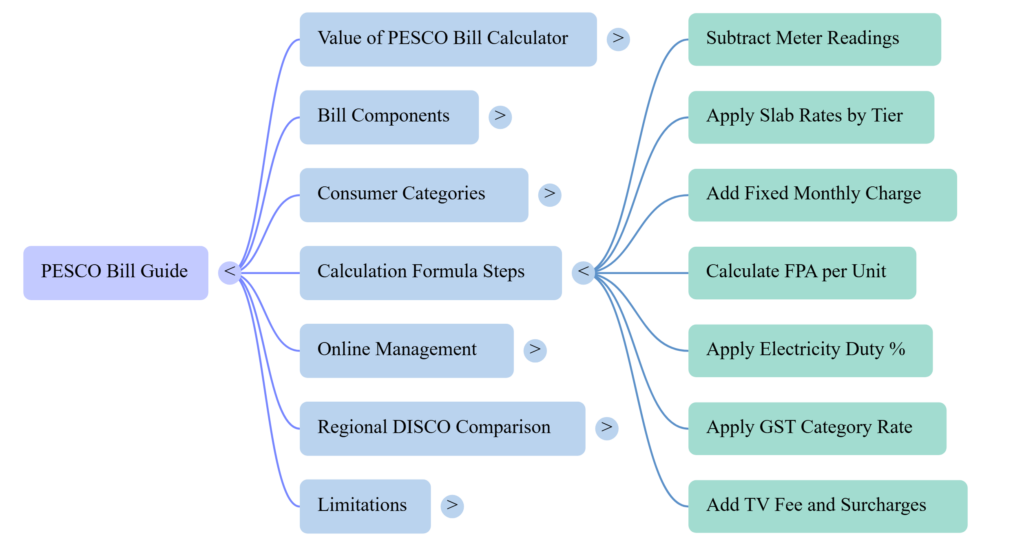
The monthly electricity bill calculator for PESCO includes these key components in every bill:
- Unit charges: The core consumption charge calculated by applying slab rates to total monthly units
- Fixed monthly charge: A set amount per billing period regardless of consumption level
- Fuel Price Adjustment (FPA): A variable per-unit charge that reflects monthly changes in electricity generation fuel costs — it can be positive or negative
- Electricity Duty: A provincial tax applied as a percentage of unit charges
- General Sales Tax (GST): Applied at rates that differ between protected and unprotected consumer categories
- TV License Fee: A small fixed charge collected with the electricity bill on behalf of the government
The pesco online bill calculator must incorporate all of these elements to produce an accurate estimate. Tools that calculate only unit charges and ignore taxes produce figures well below actual bill amounts.
PESCO Tariff Slabs — Protected vs Unprotected Consumers
The most important structural feature of pesco bill calculation is the distinction between protected and unprotected consumers — a classification that determines both the per-unit rate and the tax treatment of the entire bill.
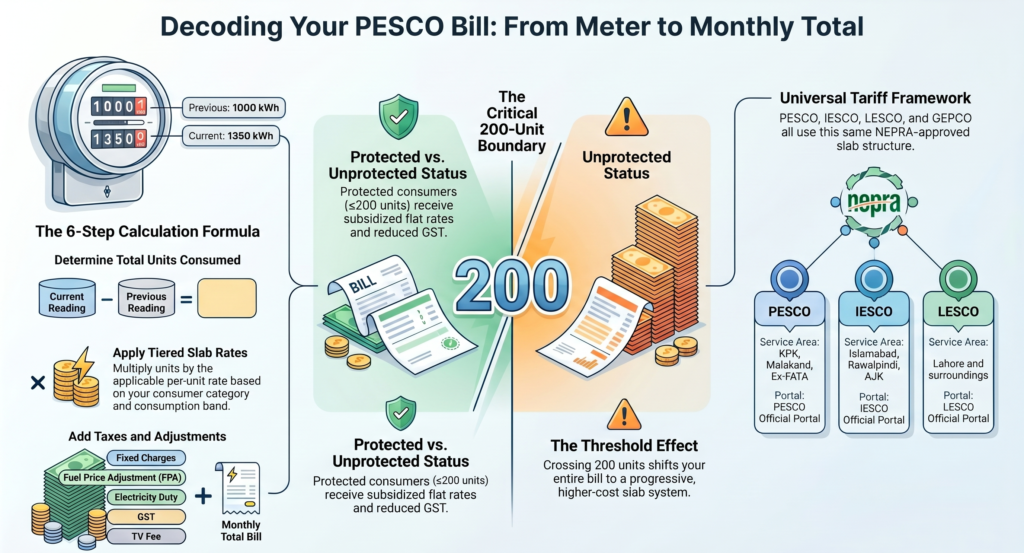
Protected status is not determined by a single month’s consumption alone. It generally applies to eligible non-time-of-use residential consumers with a sanctioned load below 5 kW who have used 200 units or fewer in each of the previous six consecutive months. Consumers who exceed the applicable eligibility limits may be treated as unprotected under the relevant billing rules. Always check the tariff category printed on your electricity bill. They receive a subsidized flat-rate tariff designed to keep electricity accessible for lower-income households. Protected consumers also benefit from reduced or zero-rated GST on their bills. The per-unit cost for protected consumers is fixed below the market rate and does not change with consumption as long as the total remains at or below 200 units.
Unprotected consumers consume more than 200 units monthly. Their bills are calculated using a progressive slab system where the per-unit rate increases at each consumption tier. The first band of units is charged at the lowest rate; additional units in the next band are charged at a higher rate; units beyond that at progressively higher rates still. This means the pesco tariff calculator must apply different rates to different portions of the total consumption rather than a single flat rate across all units.
Important: NEPRA revises tariff rates through official notifications, sometimes quarterly. Always verify current slab rates through PESCO’s official website or the latest NEPRA tariff order before relying on any specific per-unit figure for financial decisions.
Taxes, Surcharges, and Fixed Charges on Your PESCO Bill
Beyond unit charges, several items add to the total on every PESCO bill:
The Fuel Price Adjustment changes every billing month based on the national power generation cost data published by NEPRA. In months when generation costs are high, the FPA adds materially to the bill. In months when fuel or hydel generation is efficient, FPA can reduce the total. The FPA per unit is multiplied by total units consumed and added or subtracted from the bill total.
Electricity duty is a provincial tax levied as a percentage of the basic unit charge and varies slightly by province. GST and other government levies are calculated according to applicable tax rules and the relevant bill components. Their treatment should not be assumed from protected or unprotected status alone. Check the latest government notification and the itemized charges on your PESCO bill.
Fixed charges depend on the applicable residential tariff and sanctioned load. Some connections may have fixed charges calculated per kW, while minimum monthly charges may apply under specified conditions. Check the current tariff schedule for the correct treatment of your connection.
How to Use the PESCO Unit Calculator — Step-by-Step Formula
The pesco unit calculator process is straightforward when broken into steps. You need your meter readings for the current and previous billing period, the current NEPRA slab rates, and the applicable fixed charge and tax rates.
Electric Bill Calculation Formula for PESCO Consumers
The electric bill calculation formula for PESCO follows this sequence:
Calculate units consumed: Current meter reading minus previous meter reading = total units for the billing period. Example: 5,200 (current) − 4,880 (previous) = 320 units consumed
Apply slab rates by tier: Identify which consumer category applies (protected ≤200 units; unprotected >200 units). For unprotected consumers, apply the rate for the first slab tier to the units in that band, the higher rate for the next band, and so on until all 320 units are accounted for. Sum the costs across all bands for the total unit charge.
Add fixed monthly charge: Add the fixed charge applicable to your connection type (single-phase residential or three-phase).
Calculate and apply FPA: Multiply total units consumed by the current month’s FPA per unit. Add (or subtract if negative) the result to the running total.
Apply electricity duty: Calculate electricity duty and other applicable levies according to the current provincial rules and the calculation base specified in the relevant billing schedule.
Apply GST: Calculate GST on the applicable base amount at the rate matching your consumer category.
Add TV license fee and finalize: Add any other applicable fixed charges or fees shown in the current tariff and billing schedule.
Total Bill = Unit charges (by slab) + Fixed charge ± FPA + Electricity duty + GST + TV fee
For a broader estimate of household electricity costs, use our Electricity Bill Calculator to understand how monthly consumption affects your payable amount.
PESCO Bill Estimate Example for a Residential Household
For a household consuming 320 units in a billing month — classified as an unprotected consumer — the pesco bill estimate calculation would apply different rates across the slab tiers rather than one uniform rate. Crossing the 200-unit threshold can affect a consumer’s protected or unprotected classification, depending on the applicable six-month eligibility rules. The resulting bill may therefore be higher than a simple calculation of the additional units suggests. Use the tariff category and slab rules in the latest applicable notification when estimating the amount.
This is the key insight that makes the pesco electricity bill calculator most useful. Consumers near the 200-unit boundary benefit enormously from understanding exactly how crossing that threshold affects their entire bill. For current exact amounts, use an online electricity bill calculator that incorporates the active NEPRA tariff.
PESCO Online Bill Calculator — Checking Your Bill Digitally
The pesco online bill calculator and bill check service operates through PESCO’s consumer portal, allowing any consumer with their reference number to view their current bill, verify unit consumption, and download a duplicate copy — all without visiting an office.
To access your bill online:
- Navigate to the PESCO official website.
- Locate the Bill Inquiry or Online Bill section on the homepage.
- Enter your 14-digit reference number (printed on every previous bill).
- Submit the query to retrieve your current bill.
The portal displays the complete bill breakdown including units consumed, unit charges by slab, FPA amount, taxes, fixed charges, total payable, and due date. You can download the bill in PDF format, and this copy can be used as an official duplicate for payment. It is accepted at all authorized bank branches, mobile banking apps, and retail payment centers.
For consumers who have misplaced their reference number, the consumer ID printed on your electricity meter or original connection documents can also be used for lookup at PESCO service centers.
PESCO Tariff Rates and Fixed Charges
PESCO tariff rates can vary according to the consumer category, sanctioned load, and applicable tariff notification. A reliable estimate should use the latest effective NEPRA schedule rather than an outdated per-unit rate. Consumers should also distinguish between the base tariff, applicable adjustments, taxes, and fixed charges when comparing an estimate with the actual bill.
The applicable PESCO tariff schedule includes more than a single energy rate. Depending on the connection category, the schedule may specify variable charges per unit, fixed monthly charges, and other conditions.
NEPRA’s 2026 tariff documentation includes a PESCO-specific residential schedule. It distinguishes between sanctioned-load categories and provides separate treatment for different residential consumption bands and TOU connections.
Before using a rate table, confirm:
- The tariff notification’s effective date.
- Whether the figures are base rates or government-applicable consumer-end rates.
- Whether a fixed charge applies to your connection.
- Whether the tariff is for protected, unprotected, lifeline, or TOU consumption.
- Whether a later notification or adjustment has changed the applicable amount.
Fixed charges are important because they may apply in addition to the variable energy charge. The calculation can also depend on sanctioned load and the conditions specified in the applicable tariff.
For this reason, a PESCO Bill Calculator should use the correct tariff schedule rather than relying on an old rate copied from a previous year’s bill.
Bill Calculator Comparison: PESCO vs IESCO vs LESCO vs GEPCO
Pakistan’s electricity distribution is divided among multiple regional DISCOs, each serving a defined geographic area. While all operate under the same NEPRA tariff framework, understanding the service areas and any regional distinctions helps consumers identify the correct bill calculator for their location.
| DISCO | Service Area | Tariff Framework | Online Bill Check |
| PESCO | KPK, Malakand, Ex-FATA | NEPRA unified tariff | PESCO official portal |
| IESCO | Islamabad, Rawalpindi, AJK | NEPRA unified tariff | IESCO official portal |
| LESCO | Lahore and surrounding districts | NEPRA unified tariff | LESCO official portal |
| GEPCO | Gujranwala, Sialkot, Hafizabad region | NEPRA unified tariff | GEPCO official portal |
Since all four DISCOs operate under the same NEPRA tariff structure, the pesco bill calculator formula — unit charges by slab plus fixed charges plus FPA plus taxes — applies equally to the iesco bill calculator, lesco bill calculator, and gepco bill calculator.
PESCO, IESCO, LESCO, and GEPCO operate under NEPRA’s regulated tariff framework. However, consumers should verify the applicable tariff category, adjustments, and bill components for their own connection. Each DISCO also uses its own consumer reference numbers and online bill portal. The primary differences between them are geographic service coverage and the specific portal used to access bills online. Tariff slab rates and tax components are standardized by NEPRA across all DISCOs.
Pros and Cons of Using a PESCO Bill Calculator
Where the PESCO Bill Calculator Adds Clear Value
Advance financial planning: Knowing an estimated bill amount several days before the official bill arrives allows households to plan payments, transfer funds, or arrange for collection without the pressure of a last-minute due date.
Independent bill verification: When a received bill seems disproportionately high relative to perceived usage, running the same unit count through a pesco bill calculation using current slab rates quickly confirms whether the amount is mathematically correct — or identifies a discrepancy worth raising with PESCO.
Appliance cost modeling: Consumers considering energy-intensive additions — a split AC unit, a geysir, or an industrial motor — use the electricity unit cost calculator to translate estimated additional monthly kWh into a rupee figure before making the purchase. This converts abstract wattage figures into concrete monthly cost impact.
Consumers considering energy-intensive additions — a split AC unit, a geyser, or an industrial motor — can use a Home Appliance Energy Cost Calculator to estimate the monthly running cost before making a purchase.
Boundary awareness: Households that typically consume around 180 to 210 units monthly benefit from monitoring their consumption carefully. The shift from protected to unprotected consumer status at 200 units has a disproportionate effect on the bill total. A pesco unit calculator helps these households track where they stand mid-month.
Limitations to Use Alongside the Benefits
Rate changes reduce long-term accuracy: NEPRA revises tariff rates and FPA figures regularly. A pesco electricity bill calculator using rates from several months ago will produce inaccurate estimates. Always confirm that the rate inputs reflect the current NEPRA notification.
Estimation versus measurement: Without an actual current meter reading, any pesco bill estimate relies on assumed consumption. Real consumption varies with weather, occupancy, and appliance use — particularly in KPK where winter heating and summer cooling needs create significant seasonal variation.
Tax calculation complexity: The interaction of FPA, electricity duty, and GST with the base unit charge involves multiple percentage calculations applied in a specific sequence. Simplified calculators that apply a flat percentage to total units significantly underestimate the tax component.
Why Your Estimated Bill May Differ From the Actual PESCO Bill
An estimate and an issued electricity bill may not match exactly. This does not automatically mean that the calculator or the bill is incorrect.
Common reasons include:
- Different tariff selection: The selected category may not match the tariff printed on your bill.
- Incorrect unit entry: A wrong meter reading or billing period changes the consumption figure.
- Missing fixed charges: Some basic calculators do not include charges linked to sanctioned load.
- Monthly adjustments: FPA and other notified adjustments can change the final amount.
- Taxes and duties: A calculator may exclude charges that appear on the actual bill.
- Outstanding balance: Previous unpaid amounts or late payment charges can increase the payable total.
- TOU consumption: Peak and off-peak units may have been combined incorrectly.
If the difference is substantial, compare the calculator inputs with your latest bill. Check the meter readings, tariff category, billing period, and additional charge lines before deciding that the bill contains an error.
Practical Ways to Manage Electricity Consumption
Understanding your bill is useful, but reducing unnecessary electricity consumption can also help manage monthly expenses. Start by reviewing which appliances use the most electricity and how long they operate each day.
Use our Power Consumption Calculator to estimate how much electricity different household appliances consume based on their wattage and operating time.
- Switch off lights and appliances when they are not needed.
- Use energy-efficient lighting where suitable.
- Avoid leaving high-power appliances running unnecessarily.
- Check air-conditioner settings and maintenance.
- Monitor electricity usage during the month instead of waiting for the bill.
- Compare monthly meter readings to identify unusual increases.
Which Bill Calculator Is Best for Consumers?
The correct answer is the bill calculator that matches your geographic location and DISCO:
KPK, Malakand, and ex-FATA consumers: Use the pesco bill calculator — PESCO is your service provider and only its reference numbers and online portal apply to your account.
Islamabad and Rawalpindi consumers: The iesco bill calculator and IESCO portal are your tools. The tariff slabs are identical, but your reference number connects to IESCO’s system, not PESCO’s.
Lahore region consumers: The lesco bill calculator applies. LESCO serves Lahore and surrounding districts under the same NEPRA tariff framework.
Gujranwala region consumers: The gepco bill calculator and GEPCO portal serve your area.
For any Pakistani consumer regardless of DISCO, the calculate electricity bill online process through your DISCO’s official portal is the most accurate and convenient option for checking your actual bill. Manual calculation using the electric bill calculation formula is the best approach for advance estimation and bill verification.
The pesco bill calculator and its DISCO equivalents serve the same purpose: financial clarity, bill verification, and smarter appliance decisions. The right one is simply whichever DISCO supplies your electricity.
Conclusion
A PESCO bill calculator does more than produce a number — it gives consumers in KPK and surrounding areas genuine visibility into how their electricity cost is built, what drives it up, and where they have real control. The slab structure means that consumption choices near the 200-unit boundary have disproportionate financial consequences. The FPA means that even stable consumption can produce varying monthly bills. And the interaction of taxes and fixed charges means that the per-unit rate alone never tells the complete story.
Understanding the electric bill calculation formula — and applying it through either an online tool or manual calculation — is the foundation for smart energy budgeting in any Pakistani household. The same framework that powers the pesco electricity bill calculator applies directly to the iesco bill calculator, lesco bill calculator, and gepco bill calculator, because all four DISCOs operate under the same NEPRA tariff system.
For consumers who want to go further — modeling the monthly cost impact of specific appliances, identifying which devices drive the highest unit usage, or planning energy upgrades — combining the pesco bill calculator with a home appliance energy cost calculator creates a complete, actionable picture of household electricity economics.
Frequently Asked Questions
How do I calculate my PESCO electricity bill manually?
Use the electric bill calculation formula: subtract your previous meter reading from the current reading to get units consumed. Apply PESCO’s current NEPRA slab rates to those units tier by tier. Add the fixed monthly charge. Apply the current FPA per unit (positive or negative). Calculate electricity duty and GST on the applicable bases. Add the TV license fee. The sum equals your estimated total payable — the same structure used by every pesco bill calculation tool.
What is the difference between a protected and unprotected PESCO consumer?
Protected status generally depends on eligible residential consumers using 200 units or fewer in each of the previous six consecutive months, along with the applicable sanctioned-load and tariff conditions. Unprotected status applies when the consumer does not meet the relevant eligibility requirements. Check your bill’s consumer category for confirmation.
How does the PESCO bill calculator differ from the IESCO, LESCO, or GEPCO calculator?
The core bill calculator formula and tariff structure is identical across all four DISCOs because all operate under NEPRA’s unified tariff. The differences are geographic service area and the specific portal used for online bill access. Your reference number is DISCO-specific — a PESCO reference number cannot be used on the IESCO or LESCO portal.
How do I check my PESCO electricity bill online?
Visit the PESCO official website, navigate to the Bill Inquiry section, enter your 14-digit reference number, and submit. Your current bill appears immediately with full itemized details and a download option. The downloaded PDF is a valid duplicate for payment purposes.
Why does my PESCO bill vary so much between summer and winter months?
Consumption variation in KPK is typically driven by seasonal appliance use — air conditioning in summer months and heating equipment in winter. Both significantly increase unit consumption, pushing many households from protected to unprotected consumer status during peak season. A pesco bill estimate for different monthly consumption levels clearly shows the tariff impact of this seasonal variation.