Electricity Bill Calculator Guide to Calculating Electricity Bill Accurately

Rising energy costs have made understanding your electricity bill more important than ever — yet most people pay their bills without knowing how they calculated the amount or whether the bill accurately reflects their actual consumption. An electricity bill calculator is the tool that bridges this gap, converting the raw data of wattage and hours into the precise costs that appear on your monthly statement. Whether you want to calculate my electricity bill before it arrives, verify a charge that looks unusually high, or work out the running cost of a specific appliance, this complete guide covers the electricity bill calculation process from first principles through practical examples — for both UK and general international users.
Table of contents
- What Is an Electricity Bill Calculator?
- How to Calculate Electricity Bill — The Core Formula
- How to Calculate Electricity Bill From Meter Reading UK
- Electricity Bill Calculator UK — Understanding UK Tariffs
- Electricity Bill Calculation Formula — Key Variables
- Calculate My Electricity Bill — Appliance-by-Appliance Method
- Factors That Affect Your Electricity Bill
- How to Reduce Electricity Costs Using Calculator Insights
- Conclusion
What Is an Electricity Bill Calculator?
An electricity bill calculator is a digital tool or mathematical formula that converts electricity consumption data — measured in kilowatt-hours — into a monetary cost based on the applicable unit rate. It takes as inputs the wattage of appliances, hours of use, and the price per unit charged by the energy supplier, and produces as output the estimated or actual cost of that electricity consumption.
The electricity bill calculator is equally useful for verification. If your energy supplier has produced a bill from a meter reading, the electricity bill calculator allows you to independently confirm that the calculation was performed correctly using the right tariff rate — giving you the confidence to challenge a bill that appears incorrect or the reassurance that an unexpectedly high charge is genuinely the result of your consumption patterns.
How to Calculate Electricity Bill — The Core Formula
Understanding how to calculate electricity bill requires grasping one foundational concept: the kilowatt-hour (kWh), which is the unit of energy measurement used in all domestic and commercial electricity billing worldwide.
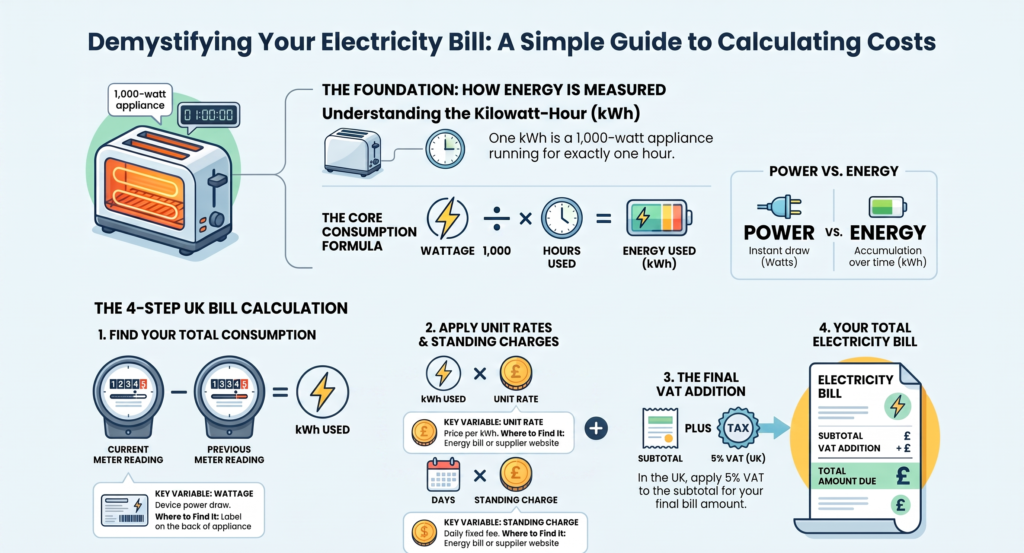
One kilowatt-hour is the energy consumed by a 1,000-watt appliance running for exactly one hour. A 2,000-watt electric kettle running for 30 minutes uses 1 kWh. A 100-watt bulb operating continuously for 10 hours consumes 1 kilowatt-hour (kWh) of electricity. Every electricity bill is essentially count of how many kWh you consumed in billing period, multiplied by price per kWh.
The electricity bill calculation formula:
Energy used (kWh) = Appliance wattage (W) ÷ 1,000 × Hours used
Bill cost = Energy used (kWh) × Unit rate (price per kWh)
Practical example: A 1,500-watt electric heater running for 4 hours per day for 30 days:
1,500 ÷ 1,000 × 4 × 30 = 180 kWh consumed
At a unit rate of 25p per kWh (UK example): 180 × £0.25 = £45.00 for the month
This is exactly what any electricity bill calculator does automatically — it simply performs this multiplication for each appliance or for total consumption, then sums the results.
How to Calculate Electricity Bill From Meter Reading UK
For UK consumers specifically, the most common electricity bill calculation scenario is working out the charge from consecutive meter readings — the method energy suppliers use to generate quarterly or monthly bills.
How to calculate electricity bill from meter reading UK follows a four-step process.
Step 1 — Find your consumption: Subtract your previous meter reading from your current meter reading. If your current reading is 14,520 kWh and your previous reading was 14,270 kWh, your consumption for period is 250 kWh.
Step 2 — Apply the unit rate: Multiply units consumed by your unit rate. At 28p per kWh: 250 × £0.28 = £70.00
Step 3 — Add the standing charge: UK energy tariffs include a daily standing charge covering the fixed cost of maintaining your supply connection. If your standing charge is 60p per day across 30 days: 30 × £0.60 = £18.00
Step 4 — Add VAT: In the UK, domestic electricity is subject to 5% VAT. Total before VAT: £88.00. With 5% VAT: £88.00 × 1.05 = £92.40 total bill
This complete sequence is what the electricity bill calculator UK tools automate — performing each calculation correctly and accounting for UK-specific features like the standing charge and domestic VAT rate.
How to Work Out Electricity Cost From Meter Reading?
How to work out electricity cost from meter reading is essentially the same process described above but presented from the perspective of a consumer who wants to calculate their cost before waiting for a bill. This approach is particularly useful for people who suspect they are being estimated rather than billed on actual readings, or who want to budget ahead of a quarterly bill arriving.
Read your electricity meter — either a digital display or rotating dial mechanism — and note the reading alongside the date. Wait until your billing period ends, take a second reading, subtract the first from the second, and apply the formula.
For properties with multiple-rate tariffs — Economy 7 or Economy 10 in the UK, which charge different rates for day and night usage — the process requires reading each rate register separately and applying the appropriate unit rate to each consumption figure before summing the totals.
Electricity Bill Calculator UK — Understanding UK Tariffs
The electricity bill calculator UK calculation must account for several features that are specific to the UK energy market and differ from other countries’ billing structures.
Ofgem reviews and sets the Energy Price Cap every quarter, restricting the maximum unit rates and standing charges suppliers can apply to standard variable tariff customers. Understanding where the price cap currently sits is essential context for any UK electricity bill calculator, since the cap determines the maximum per-unit cost that most residential customers will pay.
UK energy tariffs distinguish between several rate structures. Single-rate tariffs charge the same price per kWh at all times of day. Economy 7 tariffs charge a lower night rate and a higher day rate, incentivising off-peak consumption. Time-of-Use tariffs, increasingly available with smart meters, vary rates dynamically based on grid demand conditions.
The unit rate and standing charge together determine your total electricity cost, and any electricity bill calculator UK tool must accommodate both to produce an accurate result. Entering only the unit rate without the standing charge produces an estimate that understates the actual bill, which is a common error in simplified online calculators.
Electricity Bill Calculation Formula — Key Variables
| Variable | What It Is | Where to Find It |
| Unit rate | Price per kWh charged by your supplier | Energy bill or supplier website |
| Standing charge | Daily fixed connection charge | Energy bill or supplier website |
| Consumption (kWh) | Total units used in billing period | Meter reading subtraction |
| VAT rate | 5% for UK domestic electricity | Applied to subtotal |
| Billing period | Number of days covered by the bill | Statement dates |
| Appliance wattage | Power draw of individual devices | Appliance label or manual |
Calculate My Electricity Bill — Appliance-by-Appliance Method
For consumers who want to understand not just the total but the source of their electricity costs, the appliance-level electricity bill calculator approach provides the most detailed and actionable insight.
List every significant electrical appliance in your home and note its wattage from the label, manual, or an online database. Estimate the average daily hours of use for each appliance. Apply the formula — watts ÷ 1,000 × hours per day × days in period = kWh consumed — for each appliance. Multiply by your unit rate to get the appliance-level cost. Sum all appliances to produce your estimated total bill.
This approach consistently surprises consumers by revealing that certain appliances they assumed were minor contributors — older refrigerators, tumble dryers, immersion heaters, and electric storage heaters — account for the majority of household consumption, while devices assumed to be expensive — televisions, phone chargers, broadband routers — contribute relatively little to the total.
To calculate how much electricity individual household appliances consume, use our Home Appliance Energy Calculator to estimate their energy usage over different periods.
Factors That Affect Your Electricity Bill
The electricity bill calculator produces an estimate based on input data, but several factors in the real world cause actual bills to differ from simple estimates.
Standby power consumption is one of the most consistently underestimated factors. Modern electronics consume power even when not in active use — televisions, game consoles, microwaves with clock displays, and broadband routers all draw continuous standby power that accumulates over hundreds of hours monthly.
Appliance Usage
Heating, cooling, water heating, cooking, laundry, and refrigeration can all contribute to household electricity use. The effect of each appliance depends on its power rating, operating time, settings, and efficiency.
A high-wattage appliance does not necessarily use more electricity than every lower-wattage appliance. Operating time matters. A 2,000-watt appliance used for 15 minutes consumes 0.5 kWh, while a 100-watt device running continuously for five hours also consumes 0.5 kWh.
Air conditioning can also contribute to household electricity costs. Read our guide on the AC Power Consumption Calculator to learn how to estimate your air conditioner’s electricity usage and running cost.
Seasonal Changes
Seasonal variation affects almost every household’s electricity consumption significantly. Heating, lighting, and hot water demands all shift between summer and winter, creating genuine variation in monthly consumption that makes annual averages misleading for monthly budgeting.
Compare bills across similar periods and consider the weather before assuming a sudden increase is caused by an appliance fault.
Electricity Tariff
Your tariff determines how much you pay for electricity. A fixed-rate tariff may keep the unit price unchanged for an agreed period, while a variable tariff can change according to its terms. Time-of-use tariffs charge different rates at different times.
If your rate changes during the billing period, you may need to calculate each part separately. Apply the old rate to the usage charged under that rate and the new rate to the remaining usage.
Household Size and Daily Habits
More occupants can mean more cooking, laundry, hot water, lighting, and device use. However, household size alone does not determine electricity consumption. Insulation, appliance efficiency, working patterns, property size, and heating systems also matter.
Explore our Smart Home category for more practical guides on household electricity, appliance energy consumption, and home energy management.

How to Reduce Electricity Costs Using Calculator Insights
An electricity bill calculator can help you identify which household appliances contribute most to your electricity expenses. By understanding their energy consumption, you can make informed decisions about how and when to use them.
High-energy appliances such as electric showers, heaters, ovens, and tumble dryers may increase household electricity costs. Reducing unnecessary usage, switching appliances off when not needed, and choosing energy-efficient models can help manage consumption.
Another useful step is to check the energy efficiency of household appliances before purchasing new ones. Energy-efficient refrigerators, washing machines, lighting, and other devices may use less electricity than comparable less-efficient models. Checking the energy label and comparing estimated running costs can help you make a more informed buying decision.
UK customers can also compare available electricity tariffs to find a suitable unit rate. For official information about domestic electricity pricing and the price cap in Great Britain, visit Ofgem’s consumer guidance. Finally, use your electricity bill calculator to compare estimated costs before and after making changes to your appliance usage. This gives you a clearer picture of how your electricity habits affect household expenses and helps you identify practical ways to manage energy consumption.
Common Mistakes When Calculating an Electricity Bill
A small input error can make an estimate misleading. Watch for these common problems:
- Confusing watts with kWh: Watts measure power; kWh measures energy consumed over time.
- Using the wrong unit rate: Check whether the rate is in dollars, cents, pounds, or pence per kWh.
- Forgetting fixed charges: A usage-only calculation may understate the amount payable.
- Ignoring time-of-use rates: Peak and off-peak consumption may have different prices.
- Using an incorrect billing period: Compare readings and rates over matching dates.
- Adding a charge twice: Some tariffs or calculator inputs may already include certain costs.
- Treating an estimate as the final bill: Supplier adjustments, meter corrections, taxes, and credits can change the amount due.
If your estimate is very different from your supplier’s bill, compare the meter readings, dates, tariff rates, and individual bill components before assuming the supplier has made an error.
Use an Online Calculator to Estimate Your Electricity Bill
You can calculate the cost manually with the formulas above, but an online tool makes it easier to test different usage levels and electricity rates. It can also help you compare a typical month with a higher-consumption month or see how a change in tariff could affect your estimated costs.
Use our Electricity Bill Calculator to enter your monthly kWh consumption, select a supported country or provide a custom rate, and estimate your daily, monthly, and annual electricity costs. The tool also supports peak and off-peak pricing inputs, which can be useful if your tariff charges different rates at different times.
For the most meaningful result, use the rate shown on your own bill rather than relying on a general average. If your supplier charges a separate standing or customer fee, check whether the calculator includes a field for it. If it does not, add that amount to the result separately.
Remember that the calculator provides an estimate based on the information entered. It cannot confirm your supplier’s meter reading, account balance, tariff eligibility, or final bill adjustments.
Conclusion
The electricity bill calculator transforms what most people experience as an opaque monthly charge into a transparent, fully understandable calculation built on straightforward multiplication. Knowing how to calculate electricity bill from meter readings, understanding the UK-specific standing charge and VAT components that the electricity bill calculator UK must include, and applying appliance-level calculation to identify your highest-cost devices together give you complete command over your energy spending. The formula is always the same — consumption multiplied by rate — and once you understand it, every electricity bill becomes a number you can verify, predict, and actively work to reduce.
Frequently Asked Questions
What is an electricity bill calculator?
An electricity bill calculator is a tool that multiplies electricity consumption in kilowatt-hours by the applicable unit rate to produce an estimated or verified electricity cost. It can calculate total bill estimates or the running cost of individual appliances.
How to calculate electricity bill from meter reading UK specifically?
UK bills include three components: unit consumption at the applicable unit rate, a daily standing charge for the number of days in the billing period, and 5% VAT applied to the subtotal. All three must be included for an accurate UK electricity bill calculation.
What is the electricity bill calculation formula?
Units consumed (kWh) × unit rate + (standing charge × billing days) + VAT = total bill. For individual appliances: watts ÷ 1,000 × hours used = kWh, then multiply by unit rate for the cost.
How accurate are electricity bill calculators?
Electricity bill calculators are accurate when the input data is accurate — correct wattage figures, actual meter readings rather than estimates, and the correct current unit rate. The formula itself is exact; accuracy depends entirely on the quality of inputs.
How to work out electricity cost from meter reading for a multi-rate tariff?
Read each rate register separately from your meter. Multiply each register’s consumption by its applicable rate — day rate for daytime units, night rate for off-peak units — then add both results alongside your standing charge and VAT for the total.



5 Comments