Work From Home Tax Deductions: Guide to Saving More in 2026
If you work remotely — whether as a freelancer, self-employed consultant, or home-based business owner — understanding work from home tax deductions could put hundreds or even thousands of dollars back in your pocket every year. Yet many remote workers leave these legal tax savings unclaimed simply because they are unsure what qualifies, how to calculate it, or how to document it correctly.
This guide breaks down every aspect of work from home tax deductions: who qualifies, what expenses count, how to calculate your deduction, and what records to keep to stay audit-ready. Whether you are new to remote work or a seasoned freelancer refining your tax strategy, this resource gives you the clarity and confidence to claim every deduction you are legally entitled to.
Table of contents
- What Are Work From Home Tax Deductions?
- Who Is Eligible for a Home Office Deduction?
- How to Calculate Your Home Office Tax Deduction
- Simplified vs. Actual Expense Method: Key Differences
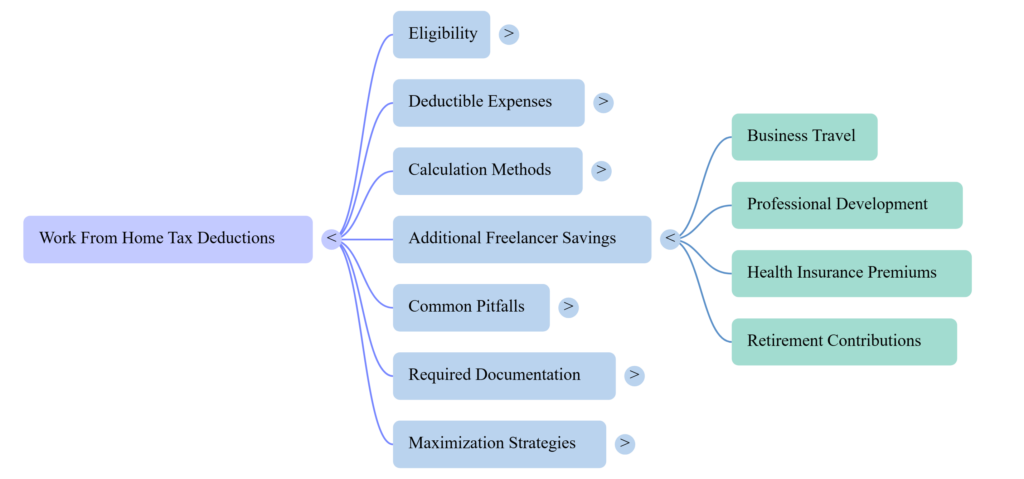
- Tax Deductions for Freelancers and Self-Employed Workers
- Common Mistakes to Avoid When Claiming Home Office Deductions
- Tips to Maximize Your Work From Home Tax Savings
- Pros and Cons of Claiming Work From Home Tax Deductions
- Which Method Is Best for Your Situation?
- Conclusion
What Are Work From Home Tax Deductions?
employed individuals, freelancers, and business owners who use part of their home for business purposes. Depending on the calculation method and IRS eligibility rules, deductible expenses may include a portion of rent, utilities, insurance, and general home maintenance, as well as certain direct expenses related to the home office.
Not every remote worker qualifies. W-2 employees generally cannot claim a federal home office deduction for unreimbursed employee expenses. To qualify, self-employed individuals must meet specific IRS requirements, including regular and exclusive business use of the qualifying space, unless an exception applies.
Eligible business expenses can reduce your business’s taxable profit and may lower your overall federal income tax liability. The exact tax impact depends on your income, business structure, filing situation, and the deductions you qualify to claim. It is important to understand that not everyone qualifies. The IRS has specific eligibility rules, especially for employees versus self-employed individuals, which we will cover in detail below.
Who Is Eligible for a Home Office Deduction?
Eligibility for work from home tax deductions depends largely on your employment status. Here is what you need to know:
Self-Employed Individuals and Freelancers
If you run your own business, operate as a freelancer, or work as an independent contractor, you are generally eligible to claim home office expenses. Your home workspace must meet two critical IRS tests:
- Exclusive Use: The area must be used solely and regularly for business. A guest bedroom that occasionally doubles as a workspace does not qualify.
- Principal Place of Business: Your home office must be your main place of business, or the location where you regularly meet clients and customers.
Remote Employees
For federal income tax purposes, most W-2 employees cannot deduct unreimbursed home office expenses, even when their employer requires them to work remotely. The federal employee business expense deduction suspension generally applies through 2026. Some states may have different rules, so employees should check their state’s tax guidance before claiming any work-related expenses.
Home-Based Business Owners
If you run an e-commerce store, consulting practice, coaching business, or any other enterprise from home, you are very likely eligible for home business tax deductions, provided you meet the exclusive and regular use requirements.
Expenses You Can Legally Deduct
Understanding which expenses qualify is central to maximizing your work from home tax deductions. These fall into two categories: direct expenses and indirect expenses.
Direct Business Expenses
Direct expenses are costs that relate only to the qualifying business area of your home. Examples may include:
- Repairs made specifically to the home office area
- Painting or maintenance limited to the business workspace
- Certain office supplies used for business
Furniture, computers, monitors, and other equipment may also qualify as business expenses, but their treatment depends on business use, cost, and applicable depreciation or expensing rules. They are not automatically 100% deductible in every situation.
Indirect Business Expenses
Indirect expenses are costs that benefit your entire home but may be partly deductible when you qualify for the home office deduction. The deductible portion is generally based on the percentage of your home used for qualifying business purposes.
Examples may include:
- Rent
- Mortgage interest
- Electricity, gas, and heating
- Homeowners or renters insurance
- General home repairs and maintenance
Only the eligible business-use portion can be included in the calculation. Personal expenses and costs unrelated to the qualifying business space are not automatically deductible.
Phone and Internet Tax Deduction
Your phone and internet expenses may qualify as business expenses to the extent they are used for business purposes. For example, if you reasonably determine that 60% of your home internet use is business-related, that portion may qualify as a business expense. Keep monthly statements and records showing how you calculated the business-use percentage. Personal use is not deductible.
How to Calculate Your Home Office Tax Deduction
There are two IRS-approved methods for calculating work from home tax deductions. Choosing the right one depends on your situation and how much time you want to spend on recordkeeping.
The Simplified Method
The simplified home office method allows qualifying taxpayers to calculate their deduction using a standard rate of $5 per square foot of qualifying business space, up to a maximum of 300 square feet. This means the maximum potential deduction is $1,500 for a full qualifying year. However, the deduction is subject to the applicable gross income limitation. This method reduces recordkeeping because you do not need to calculate and allocate actual home expenses for the home office deduction.
For example, if you have a qualifying 200-square-foot home office, the simplified method would generally allow a potential deduction of $1,000 ($5 × 200 square feet), subject to the applicable business income limitation. Under the actual expense method, you would instead calculate the business-use percentage of your home and apply it to eligible indirect expenses, while accounting for qualifying direct expenses separately.
The Actual Expense Method
The actual expense method calculates your deduction by multiplying your total home expenses by the business use percentage of your home. You calculate the business use percentage by dividing your office square footage by the total square footage of your home.
For example, if your home office is 200 square feet and your home is 1,600 square feet, your business use percentage is 12.5%. You would then multiply all qualifying indirect expenses by 12.5% to determine your deductible share.
The actual expense method typically yields a larger deduction but requires meticulous recordkeeping and financial documentation throughout the year.
Simplified vs. Actual Expense Method: Key Differences
The table below summarizes the most important factors to consider when choosing your calculation method for work from home tax deductions:
| Factor | Simplified Method | Actual Expense Method |
|---|---|---|
| Calculation Base | $5 per sq ft, max 300 sq ft | Eligible actual costs × business-use percentage |
| Maximum | $1,500 before applicable limitation | Subject to applicable income limitations |
| Recordkeeping | Less detailed home-expense records | Detailed expense records required |
| Depreciation | No home depreciation deduction | Home depreciation may apply |
| Carryover | No carryover of unused deduction | Unused deduction may generally carry forward, subject to rules |
Tax Deductions for Freelancers and Self-Employed Workers
Freelancers and self-employed professionals have the broadest access to work from home tax deductions. Beyond the home office itself, here are additional deductions that can significantly reduce your taxable income:
Business Travel and Transportation
Business-related travel expenses may be deductible when they are ordinary, necessary, and directly connected to your business. Examples can include eligible transportation, lodging, and other costs incurred while traveling away from your tax home for business. Personal trips and ordinary commuting between home and a regular workplace generally do not qualify as business travel deductions. Keep receipts, mileage records, and details of the business purpose for each trip.
Professional Development and Software
Courses, certifications, industry memberships, and software subscriptions used exclusively for your business qualify as deductible business expenses. This includes SaaS tools, project management platforms, and content creation software.
Health Insurance Premiums
Self-employed individuals may qualify for a separate deduction for eligible health insurance premiums paid for themselves, their spouse, and dependents. This deduction is subject to specific IRS eligibility rules and limitations. It is not part of the home office deduction, so it should be considered separately when calculating overall business and tax deductions.
Retirement Contributions
Contributing to a SEP-IRA, Solo 401(k), or SIMPLE IRA reduces your taxable income while building long-term financial security. This is one of the most powerful self-employed tax deductions available.
Common Mistakes to Avoid When Claiming Home Office Deductions
Even well-intentioned taxpayers make costly errors when filing work from home tax deductions. Being aware of these pitfalls keeps you compliant and protects you in an audit:
- Claiming a non-exclusive space: Deducting a room you use for personal activities violates the exclusive use rule and can trigger penalties.
- Overestimating square footage: Measure carefully. Exaggerating your office size inflates your deduction and raises audit red flags.
- Mixing personal and business expenses: Only the business-use portion of shared expenses is deductible. Document your business-use estimate carefully.
- Ignoring the home office income limitation: The deduction for business use of a home is subject to limits based on income from the qualifying business use of the home, after certain business expenses are considered. Amounts disallowed under the actual expense method may generally be carried forward, subject to applicable rules. The simplified method does not allow the same carryover of unused home office deductions.
- Claiming deductions as a W-2 employee: Federal law no longer permits employees to deduct unreimbursed home office costs. Verify your eligibility before filing.
Documents You Need Before Filing Taxes
Solid financial documentation is the backbone of any successful tax deduction claim. To support your work from home tax deductions, gather and organize the following before filing:
- Lease agreement or mortgage statements (to prove housing costs)
- Utility bills for the full year (electricity, gas, water, internet)
- Home floor plan or square footage measurements
- Receipts for all office equipment and supplies purchased
- Bank and credit card statements showing business-related purchases
- Tax records from the previous year (for carryover deductions if using the actual expense method)
Organized bookkeeping throughout the year is far easier than reconstructing expenses at tax time. Consider using expense tracking software or a dedicated business account to keep your financial record keeping audit-ready from day one.
Tips to Maximize Your Work From Home Tax Savings
Getting the most from your work from home tax deductions requires strategic planning, not just reactive filing. Here are proven tax planning strategies to keep more of your earnings:
Track Expenses in Real Time
Tracking expenses in real time helps you stay on top of spending before small costs turn into budget problems. Record each purchase as it happens—whether it is groceries, fuel, subscriptions, bills, or business expenses—so your records stay accurate and complete. Real-time tracking also makes it easier to spot unnecessary spending, monitor cash flow, and adjust your budget before the end of the month.
Use a budgeting app, spreadsheet, or notes app to log the date, amount, category, and payment method for every expense. If you use a business account or credit card, reviewing transactions daily can help you separate personal and business costs, catch errors quickly, and keep organized records for taxes or reimbursements.
Separate Business and Personal Finances
Separating business and personal finances is one of the simplest ways to keep your records organized and protect your business. Open a dedicated business bank account and use a separate business credit card for company purchases, including supplies, software, advertising, travel, and contractor payments. This makes it much easier to track income, identify deductible expenses, and prepare accurate financial statements.
Keeping the accounts separate also reduces confusion during tax season and helps demonstrate that your business is operating as a distinct entity. Avoid paying personal expenses from the business account, and transfer money to yourself through a documented owner’s draw or payroll method when appropriate. Clear separation can save time, reduce errors, and provide stronger support if your finances are ever reviewed.
Review Both Calculation Methods Annually
Reviewing both the simplified and actual-expense home office deduction methods each year helps you claim the larger legitimate deduction. Your square footage, household expenses, mortgage or rent, utilities, and business-use percentage can change from year to year, so the method that saved you money last year may not be the best option now.
Compare the simplified method’s flat $5-per-square-foot deduction with the actual-expense method’s business-use share of qualifying home costs. Keep updated records of your office size, receipts, bills, and depreciation information so the comparison is accurate. A quick annual review can prevent missed deductions and help you choose the method that best fits your current situation.
Consult a Tax Professional
Consulting a tax professional can help you avoid costly mistakes and make sure you claim every deduction you are legally entitled to. A qualified CPA, enrolled agent, or tax attorney can review your income, expenses, filing status, business structure, and state-specific rules to provide advice tailored to your situation.
This is especially helpful if you are self-employed, have a home office, own rental property, receive multiple income sources, or face an IRS notice. A tax professional can also help you plan for estimated taxes, choose the right deduction method, and maintain proper documentation. While tax software is useful for simple returns, professional guidance can be valuable when your tax situation becomes more complex.
Use a Home Office Savings Calculator
Tools like a Work From Home Savings Calculator can help you estimate your potential deduction before you file. These tools let you input your home size, office size, and actual expenses to compare both methods side by side — giving you a data-driven starting point for your tax filing strategy.
Before calculating potential tax savings, estimate how much money you save by working remotely with our Work From Home Savings Calculator.
Pros and Cons of Claiming Work From Home Tax Deductions
Pros
- Reduces your taxable income, directly lowering your tax bill
- Covers a wide range of qualifying expenses (rent, utilities, equipment, internet)
- Two calculation methods give flexibility based on your workspace size and expenses
- Encourages better financial record keeping habits year-round
Cons
- Strict IRS eligibility rules — W-2 employees generally cannot claim this deduction federally
- Requires consistent documentation and expense tracking throughout the year
- Claiming home depreciation under the actual expense method can affect capital gains tax when you sell your home
- The home office deduction is subject to applicable business income limitations. Under the actual expense method, certain unused deductions may be carried forward, while the simplified method does not provide the same carryover option.
Which Method Is Best for Your Situation?
The answer depends on your workspace size, home expenses, and how much time you want to invest in recordkeeping. As a general guide:
- Choose the Simplified Method if you prefer an easier calculation and less recordkeeping. It may be suitable when the standard $5-per-square-foot calculation produces a favorable deduction for your qualifying workspace.
- Choose the Actual Expense Method if you want to calculate the eligible business-use share of your actual home expenses. This method may produce a larger deduction in some situations, but it requires more detailed records and may involve depreciation rules.
The best option depends on your qualifying business space, eligible expenses, income limitations, and recordkeeping preferences. Compare both methods before choosing one for the tax year.
Conclusion
Work from home tax deductions represent one of the most accessible and impactful tax-saving opportunities available to self-employed professionals, freelancers, and home-based business owners. From the home office deduction itself to internet expense, office equipment, and utility bill write-offs, the potential savings add up quickly when you know what to claim and how to document it.
The key is preparation: keep organized records throughout the year, understand which method suits your situation, avoid common mistakes, and seek professional tax advice when needed. Use tools like a Work From Home Savings Calculator to model your deductions in advance and make informed decisions before tax filing season begins.
By taking full advantage of the remote work tax deductions available to you, you are not just reducing your tax bill — you are treating your home-based work with the same financial seriousness as any brick-and-mortar business. That mindset, combined with accurate tax reporting and proactive tax compliance, is what separates savvy remote workers from those who overpay year after year.
Explore our Digital Productivity guides for practical remote-work tips, useful online tools, and ways to manage your work more efficiently.
Frequently Asked Questions (FAQs)
1. What is a home office deduction?
A home office deduction allows qualifying self-employed individuals and business owners to deduct a portion of their home expenses — such as rent, utilities, and insurance — based on the percentage of their home used exclusively and regularly for business.
2. Can remote employees claim work from home tax deductions?
In most cases, no. Under current federal tax law, W-2 employees cannot claim unreimbursed home office expenses on their federal return. However, some states still allow this deduction. Always check your state’s rules before filing.
3. Can I deduct my internet bill as a remote work expense?
Yes, but only the business-use portion is deductible. If you use your internet 70% for work, you may deduct 70% of the monthly cost. Keep your bills and a reasonable estimate of business use to support the claim.
4. Is office furniture tax deductible?
Yes. Desks, chairs, monitors, filing cabinets, and other furniture used exclusively in your home office qualify as direct business expenses and are 100% deductible. Large items may need to be depreciated over several years unless you use Section 179 expensing.
5. What records do I need to claim home office deductions?
You should keep rent or mortgage statements, utility bills, home floor plan measurements, equipment receipts, and bank statements for all business-related purchases. Organized financial documentation is essential to maintain tax compliance and withstand an IRS audit.
6. How do I maximize my work from home tax savings?
Track expenses throughout the year in real time, separate business and personal finances, compare both deduction calculation methods annually, and consult a tax professional. Using a Work From Home Savings Calculator can also help you estimate and compare your potential deductions before filing.