IESCO Bill Calculator: Calculate and Manage Electricity Bill Online

Every month, millions of households in Islamabad and surrounding areas receive their IESCO electricity bill. Yet many consumers are surprised by the amount they are charged each month. An IESCO bill calculator removes the guesswork entirely. By entering your meter readings or estimated monthly units, you can calculate what your bill will be before it arrives, verify a bill you have already received, and understand exactly which charges make up the total.
Whether you need to check your iesco online bill, download an iesco duplicate bill, understand what ENC IESCO means on your notice, or simply estimate next month’s charges using an iesco unit calculator, this guide covers everything — with a clear formula, a tariff reference table, and step-by-step instructions for every task.
Table of contents
- What Is the IESCO Bill Calculator and Who Needs It?
- How IESCO Bills Are Calculated ?
- Official Online Calculator vs. Manual Estimation
- How to Calculate Your IESCO Electricity Bill Manually
- How to Check Your IESCO Bill Online
- How to Get an IESCO Duplicate Bill
- What Is ENC IESCO? Understanding Your Bill Code
- What Happened to ENC IESCO?
- Pros and Cons of Using an IESCO Bill Calculator
- Which Method Is Best for Checking Your IESCO Bill?
- Common Reasons Your IESCO Bill May Be Higher Than Expected
- Conclusion
What Is the IESCO Bill Calculator and Who Needs It?
An IESCO bill calculator is a tool — digital or manual formula-based — that estimates a consumer’s electricity bill based on the number of units consumed during a billing period. It applies IESCO’s current NEPRA-approved tariff slabs, fixed charges, and applicable taxes to produce a total that closely mirrors what the actual bill will show.
Three groups of consumers find the iesco electricity bill calculator most useful. Residential consumers who want to budget monthly expenses before the bill arrives benefit from knowing their likely total based on current consumption habits. Consumers who receive a bill that seems unexpectedly high use the calculator to verify whether the amount aligns with their actual unit usage or whether an error may have occurred. And new consumers who are setting up service and estimating costs for a new home or apartment use the iesco bill estimate to plan household budgets realistically.
The iesco bill calculator is also valuable for anyone making decisions about home appliances. Understanding how many units a new air conditioner, water heater, or refrigerator will add to monthly consumption. Directly translates into a rupee figure through the calculator.
How IESCO Bills Are Calculated?
Understanding what goes into an IESCO bill makes the iesco bill calculation process transparent rather than mysterious. Every residential IESCO bill is built from same set of components, knowing each one allows consumers to verify every line.
The foundation is the unit charge — the cost per kilowatt-hour (kWh) of electricity consumed during the billing period. IESCO uses a slab-rate system where the cost per unit increases as total monthly consumption increases. Low-consumption households pay a lower per-unit rate than high-consumption households — a structure designed to keep basic electricity affordable while charging progressively more for higher usage.
On top of unit charge sit several fixed and variable additional items: fixed monthly charge that applies regardless of consumption. A fuel price adjustment (FPA) that varies monthly based on generation costs, electricity duty. A GST (General Sales Tax) component, and in some cases a TV fee and other minor charges.
Smart home devices, such as smart plugs and energy monitoring systems, can help homeowners track electricity consumption and understand how everyday devices affect their monthly bills. The electricity bill calculator must account for all of these to produce an accurate estimate.
IESCO Tariff Slabs — How Unit Cost Changes With Usage
IESCO residential consumers fall into two broad categories under the NEPRA tariff framework: protected consumers and unprotected consumers.
Protected consumers are eligible for subsidized electricity tariffs under the applicable NEPRA rules. This category generally covers non-Time of Use (ToU) residential consumers who have maintained monthly electricity consumption of up to 200 units during the preceding six consecutive months. Eligibility depends on the applicable tariff classification, not simply the units consumed in one month. They benefit from a subsidized flat rate that keeps electricity affordable for low-income households. The per-unit rate for protected consumers is set significantly below the market rate.
Unprotected consumers use more than 200 units per month and are billed under a progressive slab structure where the per-unit rate increases with each tier of consumption. This is the category that the iesco tariff calculator is most useful for, because the multi-tier structure means that adding more units does not simply multiply a single flat rate — the marginal cost changes at each slab boundary.
Important note: NEPRA revises electricity tariffs periodically. The exact per-unit rates at each slab are set by NEPRA and announced officially. Always verify current rates through IESCO’s official portal or a NEPRA tariff notification before using any calculator for financial decisions.
Taxes and Surcharges on Your IESCO Bill
General Sales Tax (GST): GST is applied to electricity bills according to the applicable tax rules and the consumer’s billing category. The amount may depend on the relevant tax treatment and other applicable billing components. Consumers should check their latest IESCO bill and official tax notifications to understand the GST charged. Beyond the unit charges, several additional items appear on every iesco bill:
- Fuel Price Adjustment (FPA): A variable monthly charge that reflects changes in generation fuel costs. It can be positive (adding to the bill) or negative (reducing it) depending on that month’s fuel price calculations.
- Electricity Duty: A provincial tax charged as a percentage of the unit cost.
- General Sales Tax (GST): Applied to the bill total at the applicable rate. Protected consumers pay a reduced GST rate; unprotected consumers pay the standard rate.
- Fixed Monthly Charges: A set charge per billing period regardless of how many units are consumed.
- TV License Fee: A small fixed amount collected on behalf of the government on most residential bills.
A complete iesco bill calculation adds all of these components to the pure unit charge total. This is why two households consuming the same number of units may see slightly different totals depending on the billing month and applicable FPA adjustment.
Official Online Calculator vs. Manual Estimation
Consumers can check their estimated electricity costs through the official IESCO bill calculator or calculate the amount manually using the applicable tariff rates. The online calculator provides a convenient way to estimate a bill, while manual calculation helps consumers understand how unit charges, fixed charges, adjustments, and taxes contribute to the final amount.
| Method | Main benefit | Limitation |
|---|---|---|
| Online IESCO bill calculator | Estimates the bill using the selected tariff category and consumed units | Results depend on correct inputs and applicable tariff settings |
| Manual estimation | Helps consumers understand individual bill components | Requires updated tariff rates and correct calculations |
| Previous bill comparison | Helps identify changes in consumption and payable amounts | Cannot guarantee the next month’s bill |
The official online tool is a convenient starting point. Manual checking is useful when you want to understand how consumption, tariff classification, and additional charges affect your bill.

How to Calculate Your IESCO Electricity Bill Manually
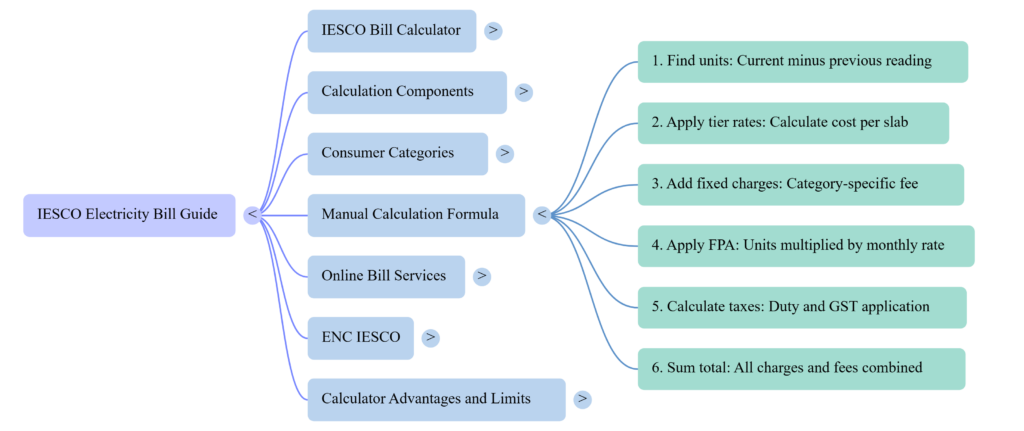
Consumers who want to check their electricity costs independently can follow a step-by-step IESCO bill calculation process. Start with the current and previous meter readings to determine the units consumed. Then identify the applicable consumer category, check the latest NEPRA-approved tariff rates, and include the relevant fixed charges, fuel price adjustments, electricity duty, GST, and other applicable bill components.
IESCO Unit Calculator: Step-by-Step Formula
Find your units consumed: Subtract your previous meter reading from your current reading. Example: Current reading 4,850 — Previous reading 4,550 = 300 units consumed
Apply slab rates to calculate unit charges: Under the unprotected slab structure, your units are charged in tiers. The first band of units is charged at the lowest rate, the next band at a higher rate, and so on until all consumed units are accounted for. Include the cost of each band together for your total unit charge.
Add fixed monthly charge: Add the fixed charges applicable to your consumer category (residential single phase or three phase).
Add FPA: Multiply your total units by the current month’s FPA per unit and add or subtract the result depending on whether FPA is positive or negative that month.
Calculate taxes: Apply electricity duty and GST to the applicable base amounts as specified in the current NEPRA tariff schedule.
Add TV fee and other minor charges: Add any fixed additional items shown on your bill category.
Total Bill = Unit charges + Fixed charges ± FPA + Electricity duty + GST + TV fee
IESCO Bill Estimate Example for Residential Consumers
Using a hypothetical 300-unit consumption month for an unprotected residential consumer as a structural example (with placeholder rate notation since NEPRA rates are updated periodically):
For a household consuming 300 units in one billing period, the total electricity cost depends on its applicable tariff category and the current slab rates. The calculation should account for the energy charges across the relevant consumption slabs, fixed charges, applicable fuel price adjustments, electricity duty, GST, and other charges shown on the bill. Consumers can compare this manual estimate with an online IESCO bill calculator to understand any differences.
For precise current-rate calculations, the iesco online bill calculator tools available through consumer-facing websites apply the current NEPRA rates automatically. This makes them the most accurate option for actual bill estimation.
How to Check Your IESCO Bill Online
Checking your iesco online bill takes under two minutes once you know the process. IESCO provides bill viewing through its official consumer portal, and the process works on any browser on desktop or mobile.
IESCO Online Bill Check by Reference Number
The reference number is the primary identifier for your electricity connection with IESCO. It appears on every previous bill and on your connection documents. Here is how to use it:
- Open your browser and navigate to the IESCO official website.
- Look for the “Online Bill” or “Bill Inquiry” section on the homepage.
- Enter your 14-digit reference number in the designated field.
- Click the search or submit button.
- Your current bill details appear — including billing period, units consumed, amount payable, and due date.
Electricity Bill Online Check IESCO — Step by Step
For consumers who cannot locate their reference number, some portals also allow search by consumer ID or meter number. The consumer ID typically appears on the meter itself or on previous bill documents.
Once your bill appears on screen through the electricity bill online check IESCO portal, you can view the full itemized breakdown — unit charges, fixed charges, taxes, and net payable — and download or print the bill directly. This downloaded version serves as a valid iesco duplicate bill for payment at any authorized collection point.
How to Get an IESCO Duplicate Bill
Losing a physical bill copy is common, and IESCO makes obtaining a iesco duplicate bill straightforward through the online portal. The process is identical to the online bill check — enter your reference number on the IESCO consumer portal, retrieve your current bill, and use the print or PDF download option to save the duplicate copy.
The iesco duplicate bill downloaded from the portal contains all the same information as the original paper bill, including the payment barcode or reference details needed for bank, mobile banking, or retail payment. IESCO does not charge a fee for accessing your bill online or downloading a duplicate copy.
For consumers who need a duplicate of a previous month’s bill rather than the current one, some IESCO service centers can provide historical bill copies upon request with your consumer ID and CNIC.
What Is ENC IESCO? Understanding Your Bill Code
ENC IESCO refers to an Electronic Notice Code — a digital notification system through which IESCO issues official communications to consumers regarding overdue amounts, disconnection warnings, or account status changes.
What Happened to ENC IESCO?
ENC was previously used as an online platform for electricity connection applications. However, IESCO has officially announced that it has shifted from ENC to e-OPS for its online new connection services.
Consumers who want to apply for a new electricity connection should use the Power Smart App, IESCO Smart App, or visit their nearest Customer Facilitation Center. The current application process and available services should be checked through IESCO’s official website.
For existing electricity connections, consumers can use IESCO’s online services to access bill information and other available consumer facilities.
If you receive an ENC IESCO notice, checking your iesco online bill and current account status immediately through the portal is the recommended first step. Most ENC situations are resolved by paying the outstanding balance before the action date specified in the notice.
IESCO Tariff Reference Table
The table below provides structural overview of how residential IESCO billing is organized by consumer category and key charge components. Exact per-unit rates should be verified against the current NEPRA tariff notification:
| Component | Protected Consumer (≤200 units) | Unprotected Consumer (>200 units) |
| Tariff structure | Flat subsidized rate | Progressive slab rates |
| Fixed monthly charge | Lower fixed rate | Standard fixed rate |
| GST rate | Reduced / zero-rated | Standard GST rate |
| FPA applicability | Applicable | Applicable |
| Electricity duty | Applicable | Applicable |
| Typical monthly bill range | Lower range | Higher, consumption-dependent |
Pros and Cons of Using an IESCO Bill Calculator
Where the IESCO Bill Calculator Delivers Real Value
Advance budgeting: Knowing your estimated bill before it arrives helps households allocate monthly expenses accurately rather than facing a surprise deduction when payment is due.
Bill verification: When an iesco bill seems unusually high, running the same unit count through an iesco electricity bill calculator using current slab rates quickly reveals whether the amount is consistent with legitimate tariff calculations or whether a meter reading error or billing issue may have occurred.
Appliance cost planning: Consumers considering a new air conditioner, geyser, or other high-consumption appliance can estimate the additional units it will add and translate that directly into rupees per month using the electricity unit cost calculator — a genuinely useful input for purchase decisions.
Online access convenience: The iesco online bill calculator and bill check portal eliminate the need to visit an IESCO office or customer service center for routine inquiries about bill amounts, due dates, or account status.
Limitations Worth Understanding
Tariff changes affect accuracy: NEPRA adjusts electricity tariffs periodically — sometimes quarterly — and FPA rates change monthly. A calculator using outdated rates will produce inaccurate estimates. Always verify the rate input against the most current NEPRA notification.
Estimates vs actuals may differ: The iesco bill estimate from a calculator is an approximation. Minor differences between estimate and actual bill are normal due to rounding, billing period length variations, or meter read timing. Significant differences warrant further investigation.
Calculator tools require correct unit input: The accuracy of any monthly electricity bill calculator is entirely dependent on the accuracy of the unit consumption figure entered. Entering an estimate rather than an actual meter reading produces an estimate, not a verified figure.
Which Method Is Best for Checking Your IESCO Bill?
For viewing your current bill and amount due: The iesco online bill check through the official IESCO portal using your reference number is the fastest and most reliable method. It shows the exact bill as issued, with all charges itemized, and allows immediate download of a duplicate.
For estimating next month’s bill before it arrives: An iesco bill calculator tool that applies current NEPRA slab rates to your estimated unit consumption gives you a usable advance figure for budgeting purposes.
For verifying a received bill: Manual iesco bill calculation using the formula — unit charges by slab, plus fixed charges, plus FPA, plus taxes — lets you independently verify whether the billed amount matches what your consumption justifies.
About resolving an ENC IESCO notice: The online portal is the first stop — view the current account status, confirm the outstanding balance, and pay through any authorized channel to resolve the notice before the action date.
Common Reasons Your IESCO Bill May Be Higher Than Expected
A higher bill does not always mean that the tariff rate has increased. Several factors can explain a difference between an estimate and the actual payable amount.
- Higher electricity consumption: Longer air-conditioner use, additional appliances, or changes in household activity can increase units. A power consumption calculator can help estimate how much electricity individual appliances use and identify which devices contribute most to your bill.
- Different billing period: A bill covering more days than usual may show higher total consumption.
- Tariff classification: An incorrect or changed category can affect the applicable charges.
- Tariff slab changes: Moving into a different consumption range can affect the energy charge.
- Adjustments and taxes: Applicable FPA, quarterly adjustments, and government charges can change the total.
- Meter reading concerns: An incorrect reading or an issue with the meter should be checked through the relevant IESCO customer-service channel.
If the bill appears incorrect, compare the current and previous readings, check the billing dates, and contact the relevant IESCO subdivision or complaint centre if the discrepancy remains unresolved.
Conclusion
An IESCO bill calculator transforms your electricity consumption data into a clear, understandable cost figure — giving you the ability to budget accurately, verify bills confidently, and make informed decisions about home appliance use. Whether you use an online calculator tool or apply the manual formula yourself, the core process is the same: units consumed, multiplied by the applicable slab rates, plus fixed charges and taxes, equals your bill.
The iesco online bill portal makes accessing, checking, and downloading your bill a two-minute process from any internet-connected device. The iesco duplicate bill download eliminates any need to visit an office for a bill reprint. And understanding what enc iesco means keeps you prepared to respond quickly if a notice arrives.
The IESCO online bill portal makes it easier for consumers to access their electricity bills and download duplicate copies when needed. For new electricity connections, IESCO has shifted from ENC to e-OPS and directs applicants to the Power Smart App, IESCO Smart App, or their nearest Customer Facilitation Center. Understanding these online services helps consumers manage routine electricity-related tasks more conveniently.
Frequently Asked Questions
How do I check my IESCO bill online?
Visit the IESCO official website and navigate to the Online Bill or Bill Inquiry section. Enter your 14-digit reference number and submit. Your current iesco online bill appears immediately with full charge details and a download option for a duplicate copy.
How is the IESCO electricity bill calculated?
The iesco bill calculation applies NEPRA-approved progressive slab rates to your monthly units consumed, adds a fixed monthly charge, applies the current fuel price adjustment (FPA) per unit, and then calculates electricity duty, GST, and any other applicable fees. The sum of all these components equals your total payable amount.
What is the difference between a protected and unprotected IESCO consumer?
Protected consumers use 200 units or fewer per month and qualify for a subsidized flat rate with reduced taxation. Unprotected consumers exceed 200 units monthly and are billed under progressive slab rates with standard taxes. The distinction significantly affects per-unit cost, which is why using an iesco tariff calculator that correctly identifies your consumer category is important for accurate estimates.
How do I get a duplicate IESCO bill?
Use the iesco online bill check portal to retrieve your current bill by reference number, then use the print or PDF download option on the bill display page. The downloaded file is a valid iesco duplicate bill accepted at all IESCO-authorized payment points. No fee applies for online duplicate bill access.
What does ENC IESCO mean?
ENC stands for Electronic Notice Code. An enc iesco notice is an official digital communication from IESCO regarding a specific account action — typically related to an overdue balance or disconnection warning. Check your account status through the online portal immediately upon receiving an ENC notice and clear any outstanding balance to prevent service interruption.
How accurate is an IESCO bill calculator?
An iesco bill calculator that uses current NEPRA tariff rates and the correct FPA for the billing month produces estimates that are typically within a few hundred rupees of the actual bill for most residential consumers. The main sources of variation are monthly FPA changes, billing period length differences, and rounding. For precise figures, always refer to the actual bill retrieved through the iesco online bill portal.