Massachusetts Paycheck Calculator — Your Exact Take-Home Pay
Knowing your gross salary is the easy part. Knowing what actually lands in your bank account after Massachusetts state income tax, federal withholding, Social Security, Medicare, and the state’s Paid Family and Medical Leave deduction — that’s where most employees go wrong. A reliable Massachusetts paycheck calculator solves this problem instantly, turning complex multi-layer payroll math into a clean, accurate take-home pay figure you can budget around with confidence. Whether you work in Boston, Worcester, Springfield, or anywhere across the Commonwealth, this guide walks you through every deduction on your Massachusetts paycheck — and shows you exactly how to use a Massachusetts paycheck calculator to verify your pay stub, compare job offers, and plan your finances with precision.
Table of contents
- What Is a Massachusetts Paycheck Calculator?
- How to Calculate Take-Home Pay in Massachusetts
- Massachusetts Payroll Tax Guide
- MA Paycheck Calculator — Hourly and Salary Modes
- Massachusetts Income Tax Calculator — Pay Period Breakdown
- Massachusetts Payroll Deductions Explained
- Overtime Pay Rules in Massachusetts
- Paycheck Calculator Massachusetts — Pros and Cons
- What Can Change Your Massachusetts Take-Home Pay?
- Common Mistakes When Estimating a Massachusetts Paycheck
- Which Massachusetts Paycheck Calculator Is Best for You?
- Conclusion
What Is a Massachusetts Paycheck Calculator?
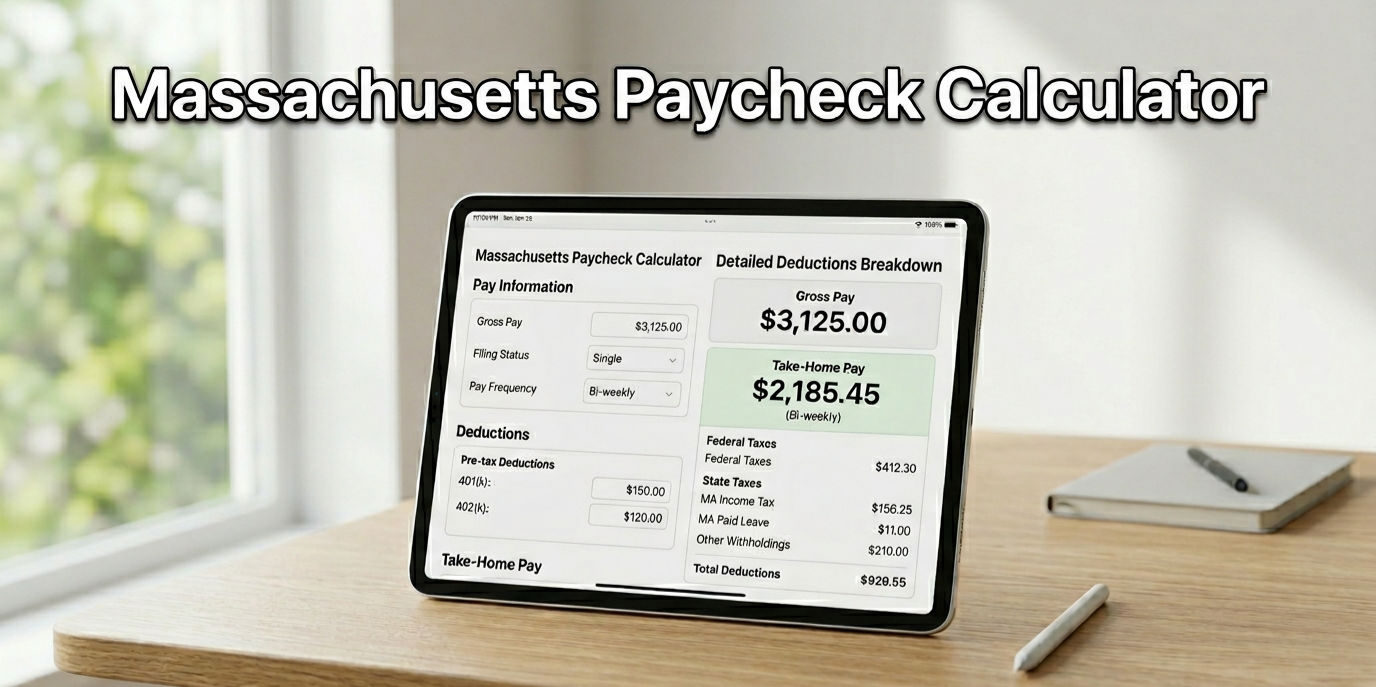
A Massachusetts paycheck calculator is a free online digital productivity tool that converts your gross pay into net take-home pay by applying all applicable state, federal, and FICA taxes — plus Massachusetts-specific deductions like the Paid Family and Medical Leave contribution. It accepts your gross salary or hourly rate, pay frequency, W-4 filing status, and any voluntary pre-tax deductions, then returns a fully itemized paycheck result that mirrors what your employer’s payroll department actually produces each cycle.
A purpose-built paycheck calculator trusted by Massachusetts workers delivers more accurate results than national calculators because it uses the state’s flat 5% income tax rate and incorporates the Massachusetts PFML contribution schedule, reflecting what actually reaches your bank account.
Explore more useful salary and payroll guides in our Digital Productivity category.
Gross Pay vs. Net Pay in Massachusetts
Every Massachusetts paycheck begins with gross pay and ends with net pay — and the distance between those two numbers is where your financial plan lives.
Gross pay is your total compensation before any deductions: your agreed annual salary divided by pay periods, or your hourly rate multiplied by hours worked. It’s the headline number in your job offer and the figure your employer reports to the IRS.
Net pay is what you receive after federal income tax, Massachusetts state income tax, Social Security, Medicare, and the PFML deduction have all been removed. For most Massachusetts employees, net pay is 70–78% of gross pay. The Massachusetts paycheck calculator converts that range into a precise, personalized figure for your specific income and filing situation.
Why Every Massachusetts Employee Needs This Tool?
Payroll errors are more common than most employees realize — incorrect W-4 settings, miscalculated PFML contributions, and outdated deduction configurations can silently drain paychecks for months. An independent Massachusetts paycheck calculator gives you a benchmark to verify every deposit and catch discrepancies before they compound.
Beyond verification, the tool is indispensable for comparing competing job offers in after-tax terms, modeling the financial impact of open enrollment benefit elections, and understanding how a raise actually affects your monthly cash flow after Massachusetts taxes take their share.
If you are comparing a Massachusetts job offer with one in Arizona, explore our Arizona Paycheck Calculator to estimate your state-specific take-home pay.
How to Calculate Take-Home Pay in Massachusetts
A complete Massachusetts paycheck calculator applies tax deductions in a specific sequence. Understanding that sequence helps you trust the results — and confidently audit your own pay stub.
Step-by-Step Massachusetts Paycheck Calculation
- Enter gross earnings — annual salary ÷ pay periods, or hourly rate × hours worked
- Select pay frequency — weekly, biweekly, semi-monthly, or monthly
- Choose W-4 filing status — single, married filing jointly, or head of household
- Input pre-tax deductions — 401(k), health/dental/vision insurance premiums, FSA or HSA contributions
- Apply PFML contribution — Massachusetts Paid Family and Medical Leave deduction
- Review full itemized output — federal tax, MA state tax, FICA, PFML, voluntary deductions, and net pay
Every field you complete improves accuracy. A Massachusetts paycheck calculator result that includes your state, pre-tax deductions, and PFML will match your actual pay stub far more closely than a basic gross-to-net estimate.
Massachusetts Income Tax Rates Explained
Massachusetts applies a flat income tax rate of 5% on all taxable income in 2024 for the vast majority of wage earners. Unlike states with graduated brackets, every Massachusetts employee — from an entry-level worker to a senior executive — pays the same 5% state rate on their taxable wages. This simplicity makes the Massachusetts income tax calculator result easy to verify: multiply your annual taxable income by 0.05 to confirm your state tax liability.
Massachusetts also levies a 4% surtax on income above $1 million (the “Millionaire’s Tax” passed in 2022). This applies to very high earners and is factored into accurate Massachusetts paycheck calculator tools for incomes at that threshold.
Massachusetts Payroll Tax Guide
A complete Massachusetts payroll calculator applies four distinct withholding layers. Here is every deduction that appears on a Massachusetts paycheck — what it is, where it goes, and how it’s calculated.
Federal Tax Withholding on Massachusetts Paychecks
Federal income tax is governed by 2024 IRS tax brackets ranging from 10% on the lowest income to 37% at the highest. Most Massachusetts workers earning $50,000–$100,000 annually fall into the 22% marginal federal tax bracket, while the IRS applies an effective average tax rate of about 12–16% after it applies the standard deduction.
Your W-4 filing status, dependent claims, and any additional withholding elections directly shape this number each pay period. Reviewing your W-4 annually — or after any major life change — is one of the highest-leverage financial adjustments any Massachusetts employee can make.
FICA — Social Security and Medicare Deductions
FICA withholding is mandatory on every Massachusetts paycheck without exception. The 2024 rates are:
- Social Security: 6.2% on gross wages up to the $168,600 annual wage base
- Medicare: 1.45% on all gross wages — no income cap applies
- Additional Medicare Tax: 0.9% on wages above $200,000 for single filers
Your employer matches Social Security and base Medicare in full — but that employer contribution is entirely separate and does not reduce your gross pay or appear on your pay stub as a deduction.
Massachusetts PFML Deduction Explained
Massachusetts operates a mandatory Paid Family and Medical Leave (PFML) program funded by employee and employer payroll contributions. In 2024, the total PFML contribution rate is 0.88% of gross wages up to the Social Security wage base.
For employees at companies with 25 or more workers, the employer covers at least 60% of the total contribution, and employees pay the remaining portion. At most Massachusetts companies, the employee-side PFML deduction is approximately 0.34% of gross wages for 2024. On a $3,000 biweekly paycheck, that’s approximately $10.20 per paycheck — a small but mandatory Massachusetts-specific deduction that many generic paycheck calculators miss entirely.
An accurate Massachusetts paycheck calculator includes the PFML deduction automatically, which is one of the reasons state-specific tools consistently outperform national ones for Massachusetts employees.
Does Massachusetts Have Different Tax Rates for Every Salary?
No. Massachusetts does not use a series of ordinary wage-income tax brackets in the same way as many progressive-tax states.
Most wage earners are subject to the standard 5% rate, subject to applicable exemptions, deductions and tax rules. The additional surtax affects taxable income above the annual threshold.
A paycheck estimate should also distinguish between tax withholding and final tax liability. The amount withheld by an employer during the year is an advance payment toward the employee’s eventual tax obligation.

MA Paycheck Calculator — Hourly and Salary Modes
The MA paycheck calculator delivers accurate results for both hourly and salaried employees. Each mode works from a different starting input but applies identical tax logic.
Hourly Workers in Massachusetts
Enter your hourly rate and hours worked for the pay period. If overtime hours apply — any hours worked beyond 40 in a single workweek under federal and Massachusetts law — enter those separately. Massachusetts follows the federal Fair Labor Standards Act and pays overtime at 1.5× the regular rate before calculating any taxes.
Example: A Massachusetts hourly worker earning $22/hour who clocks 46 hours in a week earns $880 in regular pay plus $198 in overtime pay, totaling $1,078 gross before deductions. The MA paycheck calculator applies federal withholding, MA’s 5% state tax, FICA, and PFML to that full gross amount.
You can also use our 23 Hourly to Salary Calculator to understand how an hourly wage translates into annual earnings.
Salaried Employees in Massachusetts
Enter your annual salary and select your pay frequency. The Massachusetts paycheck calculator divides your annual gross by the number of pay periods — 26 for biweekly, 24 for semi-monthly — and applies all tax rates proportionally to each period’s gross amount.
Pre-tax deductions reduce your taxable income by being subtracted before state and federal taxes are calculated. A $300 biweekly 401(k) contribution reduces your take-home by approximately $210–$230 after the combined federal and Massachusetts state tax savings it generates.
If you want to compare your annual salary with its hourly equivalent, use our Salary to Hourly Calculator.
Massachusetts Income Tax Calculator — Pay Period Breakdown
The Massachusetts income tax calculator is most actionable when you see your salary expressed across all pay frequencies — not just as an annual figure. Here is how a $72,000 gross annual Massachusetts salary distributes by period.
| Pay Period | Gross Amount |
|---|---|
| Annual | $72,000.00 |
| Monthly | $6,000.00 |
| Semi-Monthly (24×/year) | $3,000.00 |
| Biweekly (26×/year) | $2,769.23 |
| Weekly | $1,384.62 |
| Daily (8-hr day) | $276.92 |
Estimated biweekly net pay for a single Massachusetts filer at $72,000 annual gross — after federal tax, Massachusetts’s 5% flat rate, FICA, and PFML — is approximately $1,970–$2,060 depending on pre-tax deductions elected. Run your specific inputs through the Massachusetts paycheck calculator to get a figure calibrated to your exact situation.
Massachusetts Payroll Deductions Explained
The Massachusetts paycheck calculator result is most meaningful when you understand every deduction category your employer processes. Deductions fall into three clear groups — and knowing which group each deduction belongs to tells you what you control and what you don’t.
Pre-Tax Deductions That Increase Take-Home Pay
These are subtracted from gross pay before Massachusetts state and federal taxes are applied. Every dollar contributed here reduces your tax burden on both levels simultaneously — a compounding benefit that makes pre-tax elections far more valuable than they first appear:
- Traditional 401(k) or 403(b) retirement contributions
- Employer health, dental, and vision insurance premiums
- Flexible Spending Account (FSA) contributions — medical and dependent care
- Health Savings Account (HSA) contributions (requires a qualifying high-deductible plan)
Maximizing pre-tax deductions is the single most accessible legal strategy for increasing your Massachusetts take-home pay without negotiating a raise. Every dollar contributed to a traditional 401(k) reduces both your federal and Massachusetts state taxable income simultaneously.
Post-Tax Deductions and Their Effect
These are applied after all tax calculations. They reduce take-home pay directly but produce no immediate tax savings:
- Roth 401(k) contributions — taxed now, tax-free in retirement
- Supplemental life or disability insurance premiums beyond employer base coverage
- Charitable payroll giving or union dues
- Court-ordered wage garnishments where applicable
Understanding which deductions are pre-tax versus post-tax allows you to enter accurate data into the Massachusetts paycheck calculator and model the true net pay impact of every benefits election before you commit during open enrollment.
Overtime Pay Rules in Massachusetts
Massachusetts employees are protected by both federal FLSA and the Massachusetts Minimum Wage Act. Any employee who is non-exempt and works more than 40 hours in a single workweek is entitled to overtime compensation at 1.5× their regular rate of pay — no exceptions for Massachusetts employers.
Massachusetts taxes overtime wages at the same flat 5% rate and the federal government applies the same tax rates to overtime as it does to regular wages. However, because overtime inflates your per-period gross, it may temporarily push more of your income into a higher federal marginal bracket for that paycheck. The IRS taxes a $400 overtime premium on a paycheck at a 22% marginal federal rate instead of your lower effective tax rate.
The Massachusetts paycheck calculator accounts for this when regular and overtime hours are entered separately — applying the 1.5× rate to overtime gross before running all withholding calculations. This produces accurate results even on high-overtime pay periods, which a combined-hours input cannot achieve.

Paycheck Calculator Massachusetts — Pros and Cons
Pros
Massachusetts-specific accuracy. A dedicated Massachusetts paycheck calculator applies the state’s actual 5% flat income tax rate and includes the PFML deduction — two factors that generic national tools routinely miss. The result is a net pay estimate that matches your real paycheck, not a national approximation.
Instant after-tax job offer comparison. A $6,000 gross salary difference between two Massachusetts job offers might translate to only $4,000–$4,500 in additional annual take-home after state and federal taxes. The Massachusetts paycheck calculator shows you the real number before you negotiate.
Benefit election modeling. Before open enrollment closes, use the Massachusetts paycheck calculator to model how changing health plan tiers, increasing your 401(k) rate, or adding FSA contributions affects your biweekly net pay. Data-driven benefit decisions protect your monthly budget for the entire plan year.
Pay stub verification. Payroll errors happen. Having an independent MA paycheck calculator result gives you a benchmark to detect discrepancies before they compound across multiple pay periods.
W-4 optimization. Model different filing status and withholding settings before submitting a new W-4, eliminating the risk of a large year-end tax bill or excessive monthly over-withholding.
Cons
Estimates, not official payroll outputs. A Massachusetts paycheck calculator produces highly accurate estimates but is not a substitute for official payroll software. Mid-year rate changes or employer-specific deduction structures may cause minor discrepancies.
Input quality determines accuracy. Wrong gross salary, incorrect pay frequency, or outdated W-4 filing status entries produce unreliable results. The tool is only as accurate as the data you provide.
PFML rates change annually. Massachusetts PFML contribution rates are adjusted each year. A Massachusetts paycheck calculator using a prior year’s PFML rate may slightly understate or overstate that specific deduction.
Not built for self-employment. Massachusetts freelancers and sole proprietors face a 15.3% self-employment tax plus estimated state and federal income taxes paid quarterly. The standard Massachusetts paycheck calculator is optimized for W-2 employees and does not model this structure accurately.
What Can Change Your Massachusetts Take-Home Pay?
Two employees with identical annual salaries can receive different net pay. The following factors explain why.
Federal filing status: Your federal filing status affects the withholding calculation. Different W-4 information can produce different deductions.
State withholding information: Your Massachusetts Form M-4 provides information used by employers to calculate state income-tax withholding.
Retirement contributions: Traditional workplace retirement contributions may reduce federal taxable wages, depending on the plan and applicable rules. Roth contributions generally receive different tax treatment.
Health insurance: Employee-paid premiums can reduce the amount deposited into your bank account. Their tax treatment depends on the benefit arrangement.
Overtime and bonuses: Additional compensation increases gross earnings and may change withholding for that payroll period.
PFML contributions: The amount deducted can depend on employer size, eligible wages and whether the employer covers some or all of the employee share.
Additional withholding: Employees can request extra federal or state withholding, which reduces the current paycheck but may help manage their tax payments.
Common Mistakes When Estimating a Massachusetts Paycheck
A paycheck estimate is only useful when the information entered is accurate. Avoid these common mistakes:
- Using an outdated tax year: Older federal withholding tables, Social Security wage limits or Massachusetts PFML rates may produce incorrect estimates.
- Confusing gross pay with net pay: Annual salary is not the same as the amount deposited after deductions.
- Selecting the wrong pay schedule: Biweekly and semimonthly payments use different numbers of annual pay periods.
- Ignoring PFML: Eligible Massachusetts employees may have PFML contributions deducted from their wages.
- Using incorrect W-4 information: Federal withholding depends on the employee’s actual withholding instructions.
- Forgetting benefit deductions: Insurance premiums, retirement contributions and other benefits can change take-home pay.
- Treating withholding as final tax liability: Payroll withholding is not necessarily the same as the amount owed when filing an annual tax return.
Review your pay statement whenever your salary, filing information, benefits or withholding elections change.
Which Massachusetts Paycheck Calculator Is Best for You?
The best Massachusetts paycheck calculator is the one that matches your employment type, deduction complexity, and planning needs.
Hourly workers need a calculator with dedicated regular and overtime hour fields that applies the 1.5× rate to overtime gross before computing taxes — not a tool that bundles all hours at a single rate.
Salaried professionals benefit from a Massachusetts paycheck calculator that accepts annual gross input, allows pay frequency selection, and includes full pre-tax deduction fields for 401(k), health premiums, FSA, and HSA.
Job seekers comparing offers need a tool that converts two gross salary inputs into after-tax monthly figures side by side. The difference in net monthly income — not gross salary — is the number that should drive the negotiation and final decision.
Open enrollment planners need a Massachusetts income tax calculator with detailed pre-tax deduction fields that model different contribution levels before the election window closes.
HR professionals and small business owners need a tool that displays employer-side FICA contributions alongside employee-side deductions for accurate total labor cost modeling.
Non-negotiables in any best-in-class Massachusetts paycheck calculator: current 2024 Massachusetts 5% flat rate, accurate PFML deduction, full pre-tax and post-tax deduction fields, multiple pay frequency options, and fully itemized output showing every deduction as a separate line item.
Conclusion
Your Massachusetts paycheck is more complex than a standard national paycheck — and it deserves a tool built specifically for its unique deductions. A trusted Massachusetts paycheck calculator accounts for the state’s 5% flat income tax, the mandatory PFML contribution, federal withholding, and FICA — delivering an accurate, itemized net pay figure that generic national tools simply cannot match.
Whether you’re verifying your current pay stub, comparing competing job offers in real after-tax terms, modeling open enrollment decisions before the window closes, or planning your annual household budget around a predictable monthly income — the Massachusetts paycheck calculator is the most accurate free financial tool available to any Massachusetts employee.
FAQs
Q: What is Massachusetts’s state income tax rate in 2024?
Massachusetts applies a flat income tax rate of 5% on all individual taxable income in 2024. There are no graduated brackets for standard wage earners — every Massachusetts employee pays the same percentage. A 4% surtax applies to income above $1 million. The Massachusetts income tax calculator applies whichever rate matches your income level.
Q: What is the Massachusetts PFML deduction?
The Massachusetts Paid Family and Medical Leave (PFML) program requires a mandatory payroll contribution. In 2024, the total rate is 0.88% of gross wages up to the Social Security wage base. At companies with 25+ employees, the employee-side contribution is approximately 0.34% of gross wages. An accurate Massachusetts paycheck calculator includes this deduction automatically.
Q: Does Massachusetts have local income taxes?
No. Massachusetts does not impose local or city-level income taxes. Your Massachusetts paycheck calculator results reflect only federal income tax, Massachusetts’s 5% flat state tax, FICA, and PFML contributions — no additional local withholding applies anywhere in the state.
Q: How does overtime affect my Massachusetts paycheck?
Overtime wages are taxed at the same Massachusetts 5% flat rate as regular wages. However, overtime inflates your per-period gross, which may temporarily push more income into a higher federal marginal bracket for that paycheck cycle. The MA paycheck calculator accounts for this correctly when regular and overtime hours are entered separately.
Q: Can I use the Massachusetts paycheck calculator for self-employment income?
The standard Massachusetts paycheck calculator is designed for W-2 employees. Self-employed Massachusetts workers pay both the employee and employer sides of FICA (15.3% combined) plus estimated federal and Massachusetts state income taxes on a quarterly basis. A dedicated self-employment tax calculator is recommended for freelancers and sole proprietors.