Where to Find Electricity Meter Guide to Reading Electric Meter

Taking a meter reading, submitting accurate consumption data to your energy supplier, or simply verifying your bill starts with one essential first step — knowing where to find electricity meter in your property. For new tenants, first-time homeowners, or anyone moving into a property for the first time, locating the electricity meter is not always as straightforward as it sounds. Meters can be hidden inside cupboards, tucked into external meter boxes, located in shared communal areas, or mounted in positions that are easy to overlook. This complete guide covers every common and uncommon electricity meter location, what an electric meter looks like across different meter types, how to find your electric meter number, and what distinguishes a smart meter from a traditional one.
Table of contents
- What Is an Electricity Meter?
- Where to Find Electricity Meter — Common Locations in Houses
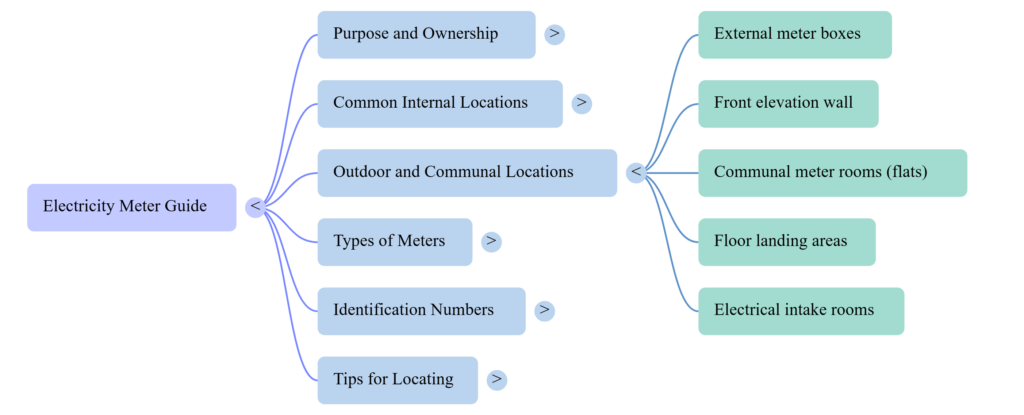
- Where to Find Electricity Meter — Outdoor Locations
- UK Electricity Meter — Different Types of Electric Meters UK
- What Does an Electricity Meter Look Like — Identifying Your Meter Type
- How to Find Your Electric Meter Number
- Electricity Meters in Flats and Apartments — Special Considerations
- Smart Meter vs Traditional Electricity Meter — Key Differences
- Electricity Meter Safety: What You Should and Should Not Do
- Conclusion
What Is an Electricity Meter?
An electricity meter is a measuring device installed at your property by your energy supplier or the network operator, responsible for recording the total electricity consumed at that address. Every unit of electricity that enters your home passes through this meter, which tallies the accumulated consumption in kilowatt-hours — the unit that appears on your bill.
Understanding where to find electricity meter matters for several practical reasons. Meter readings are required to generate accurate bills rather than estimated charges. You need the meter serial number when you switch energy suppliers, report faults, or request a meter replacement. Smart meter installations require access to the existing meter location. And in rental properties, the incoming tenant frequently needs to record an opening meter reading to establish their consumption baseline from the date they take occupancy.
Where to Find Electricity Meter — Common Locations in Houses
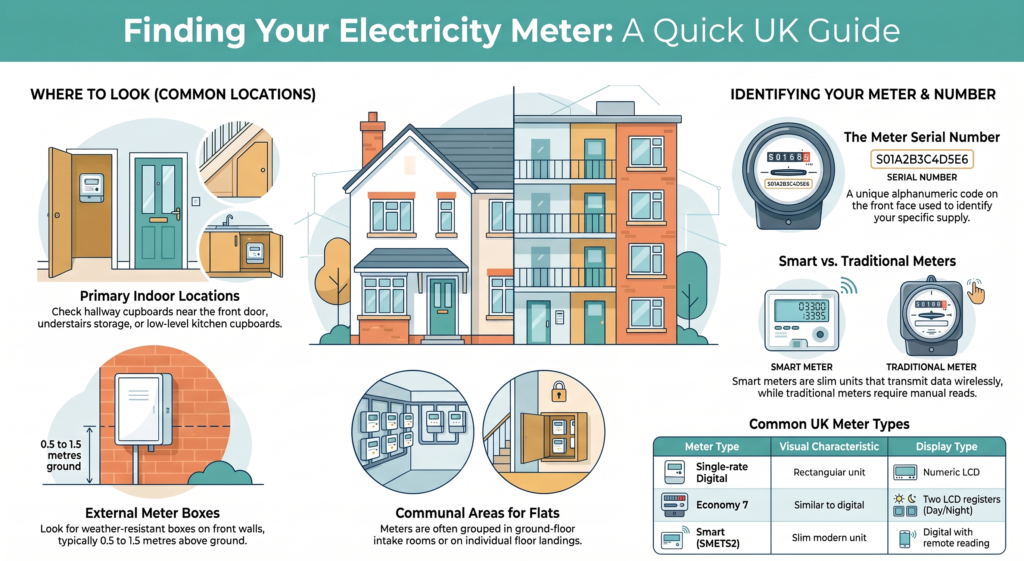
The most frequent answer to where to find electricity meter in typical house is the hallway, kitchen, or understairs cupboard. These are most common internal installation positions in UK residential properties built in the post-war period through to present day. For more information about household electricity, energy use, and electrical systems, explore our Smart Home guides.
Hallway cupboards near the front door are perhaps the single most common location. The service entry point for electricity supply cables typically runs from the street through the front wall or floor, making the hallway the natural first internal location. Meter boxes are frequently installed in cupboard spaces immediately adjacent to the front door on either side.
Understairs storage areas provide another frequently used location, particularly in terraced and semi-detached houses where the understairs space serves as a general utility area. Housing the consumer unit, fuse box, and associated infrastructure alongside the electricity meter.
Kitchen areas — particularly low cupboards near exterior wall — are used in properties where supply enters through rear of the property. If your kitchen backs onto the street side of the building, checking low-level cupboards along the rear external wall is a productive first step when searching for where to find electricity meter.
Utility rooms and garages attached to the main house serve as meter locations in properties where the architect positioned utility infrastructure away from the main living areas. In some detached properties, the garage wall facing the street contains both gas and electricity meters in adjacent external boxes.
Where to Find Electricity Meter — Outdoor Locations
Not every electricity meter is installed inside the property. A significant proportion of UK homes have their meters installed in external meter boxes mounted on the outside wall, accessible from outside without entering the building.
Property owners typically position external meter boxes on the front elevation of the property, close to ground level — usually between 0.5 and 1.5 metres above ground. They are weather-resistant enclosures, often dark brown or black in colour for older installations, or grey for more modern meter point installations. The box typically has hinged or removable door secured with standard meter box key that is available from hardware suppliers.
In terraced streets, homeowners commonly position meter boxes on the external front wall — sometimes slightly recessed into the brickwork — making a visual inspection of the front elevation the quickest way to confirm where to find the electricity meter for your property.
UK Electricity Meter — Different Types of Electric Meters UK
Knowing what does an electricity meter look like requires understanding that different types of electric meters UK installations use produce quite different visual appearances. Recognising which type of meter your property has also affects how you read and record consumption.
| Meter Type | Appearance | Display Type | Rate Structure |
| Single-rate analogue | Rotating dial mechanism, multiple dials | Spinning dials with numbers | One rate — all consumption |
| Single-rate digital | Rectangular display unit | LCD numeric display | One rate — all consumption |
| Economy 7 / multi-rate | Similar to single-rate but two displays | Two separate LCD registers | Day rate and night rate |
| Smart meter (SMETS1) | Modern rectangular unit | Digital display with buttons | Single or multi-rate |
| Smart meter (SMETS2) | Slim modern unit, often with in-home display | Digital display, remote reading | Single or multi-rate |
| Prepayment meter | Slot or keypad on front | Digital display | Pay-as-you-go |
What Does an Electricity Meter Look Like — Identifying Your Meter Type
What does an electric meter look like in practical terms depends on its age and type. Understanding the visual characteristics of each type helps you confirm you are looking at correct device and reading it correctly.
Traditional dial meters — increasingly rare in UK homes — present as a series of five or more circular dials arranged in a row, each showing a digit from 0 to 9 via a pointer. Reading a dial meter requires noting the number the pointer has most recently passed on each dial from left to right, which is less intuitive than digital reading. If you find this type when searching for where to find electricity meter, you likely have a particularly old installation that your supplier may offer to replace.
Digital single-rate meters show a straightforward numeric display — typically five digits before the decimal point — representing total accumulated kWh consumed since installation. This is what does an electricity meter look like for the majority of UK homes installed between the 1990s and the smart meter rollout period.
Economy 7 meters look similar to standard digital meters but display two separate consumption registers — one for daytime use and one for night-rate use, typically labelled “Day” and “Night” or “Normal” and “Low.” You must record both registers when you submit a meter reading to your supplier.
Smart meters are the most modern type and what does an electric meter look like in recent UK installations. They appear as a slim, compact digital unit with a small display and function buttons, often accompanied by a separate in-home display device that sits in your living area and shows real-time consumption data. Smart meters transmit readings automatically to your supplier, eliminating the need for manual meter reads in most circumstances.
How to Find Your Electric Meter Number
Every electricity meter carries a unique identification number — the meter serial number or MPAN meter serial number — that is distinct from your account number. It identifies that specific physical meter rather than your customer account.
Where to find electricity meter serial number: look on the front face of the meter itself. For digital meters, the serial number is typically printed on a label affixed to the front or side of the meter unit — it is usually a sequence of letters and numbers, often beginning with letters that identify the manufacturer. For older dial meters, the serial number appears on a metal plate attached to the meter face.
You need the electricity meter number when you switch energy suppliers. Your new supplier uses it to set up your supply correctly at the meter point. You also need it to report meter faults, arrange meter replacements, or resolve cases where someone reads the wrong meter.
Do not confuse the meter serial number with your MPAN — the Meter Point Administration Number, which is a 21-digit number identifying your specific electricity supply point nationally. Both numbers appear on your electricity bill and on meter itself, serving different identification purposes within the energy supply infrastructure.
Once you know how many electricity units you have used, enter your consumption and electricity rate into our Electricity Bill Calculator to estimate your bill.
Electricity Meters in Flats and Apartments — Special Considerations
In apartment buildings, individual electricity meters may be located in communal meter rooms, shared cupboards or designated service areas. Some properties also have meters installed within individual flats.
In converted Victorian and Edwardian properties divided into flats, owners often group meters in a ground floor or basement communal cupboard and label individual meters by flat number or letter. The labelling is not always reliable in older conversions — if you cannot identify which meter corresponds to your flat, your energy supplier can provide the MPAN for your address. The meter serial number matching that MPAN identifies your specific meter within the bank.
In purpose-built modern apartment blocks, dedicated electrical intake rooms on each floor or at ground level house the meter banks in organised, numbered arrangements. Building management companies typically keep keys for these rooms, and the building manager arranges meter access for readings.
Communal areas in purpose-built flats and apartment buildings concentrate multiple meters in a single location. A communal meter cupboard typically located at ground floor level near the building entrance, in a dedicated electrical intake room, or on each floor’s landing area in larger blocks. The meter or its corresponding space on the consumer unit board above displays or labels the flat number or unit designation to identify individual meters within these communal banks.
Smart Meter vs Traditional Electricity Meter — Key Differences
The shift toward smart meters across the UK has changed where to find electricity meter and how that meter functions. Smart meters communicate consumption data directly to suppliers through a wireless network, eliminating the need for customers to manually read and submit meter readings.
Smart meter installations place the meter in the same location where the traditional meter previously sat — so finding a smart meter follows the same location logic as finding a traditional meter. The in-home display that accompanies a SMETS2 smart meter works as a separate, battery-powered device that you can position anywhere within wireless range of the smart meter — typically in the kitchen or living room.
If you have a smart meter, you may never need to take a manual reading — but the meter remains physically accessible at its installation location. If you want to verify a reading, access the serial number, or check display information during a technical fault. For authoritative guidance on electricity meter standards, smart meter technology specifications, and your rights regarding meter access and accuracy in the UK, Ofgem’s consumer meter information pages provide verified regulatory guidance on all meter-related consumer rights.
For more details, read our electricity bill calculator guide to understand how meter readings help estimate your electricity costs.
Electricity Meter Safety: What You Should and Should Not Do
Electricity meters are connected to the property’s electrical supply. Although you can normally view the display, you should never attempt to dismantle, repair or move the equipment yourself.
Follow these basic precautions:
- Do not remove the meter cover or break protective seals.
- Never touch exposed wires or electrical terminals.
- Do not use wet hands around electrical equipment.
- Avoid forcing open locked meter cabinets.
- Keep the area clear for authorised utility workers.
- Report damaged equipment, burning smells, sparks or exposed wiring.
If you notice an immediate electrical hazard, keep away and contact the appropriate electricity network operator or emergency service.
The UK’s Health and Safety Executive provides additional information about electricity safety in its official electricity guidance.
For US households, the Electrical Safety Foundation International also explains common electrical equipment and household safety precautions.
Conclusion
Knowing where to find electricity meter in your property is foundational knowledge for every energy consumer — enabling accurate meter readings, bill verification, supplier switching, and smart meter installation. Whether your meter is in a hallway cupboard, an external wall box, a communal apartment bank, or a utility room, the location logic follows consistent patterns that this guide covers comprehensively. Understanding what an electric meter looks like across different types of UK properties helps you identify your meter type and locate your electric meter number. Recognising the difference between traditional and smart meter installations gives you confidence when managing your energy supply infrastructure.
Remember that meter locations differ between UK and US properties, so the arrangement in another home may not match yours. Once you find the meter, confirm its serial number against your electricity bill before recording a reading. If the meter is inaccessible, incorrectly labelled or damaged, contact your landlord, building manager or electricity supplier. Never remove covers or interfere with electrical equipment.
Frequently Asked Questions
Where to find electricity meter in a typical UK house?
The most common locations are the hallway cupboard near the front door, understairs storage, the kitchen, or an external meter box on the front wall of the property. Checking all four locations covers the vast majority of standard UK residential installations.
What does an electricity meter look like?
Modern digital meters appear as rectangular units with an LCD display showing a five-digit kWh reading. Smart meters are slimmer and more compact. Older properties may have dial meters with rotating pointer displays. Economy 7 meters show two separate consumption registers.
How do I find my electric meter number?
The meter serial number is printed on a label on the front face of the meter or on a metal plate attached to the meter unit. It is a sequence of letters and numbers distinct from your account number.
Where is the electricity meter in a flat?
In most UK flats, electricity meters are located in communal meter rooms or meter banks on the ground floor or each floor landing — not inside the individual flat. The specific meter for your flat should be labelled with your flat number.
What are the different types of electric meters in the UK?
UK electricity meters include single-rate analogue dial meters, single-rate digital meters, Economy 7 two-rate meters, prepayment meters, and smart meters of two generations — SMETS1 and the improved SMETS2.
How do I find my electricity meter if it is outside?
Check the front external wall of your property between ground level and 1.5 meters high for a weather-resistant meter box, typically dark brown or grey in colour. A standard meter box key opens most external boxes and is available from hardware stores.