Colorado Paycheck Calculator: Complete 2026 Take-Home Pay Guide
If you work in Colorado, running a colorado paycheck calculator tells you something immediately reassuring: the math here is simpler than most states. Colorado uses a flat income tax rate of 4.4% — no progressive brackets, no phase-outs, no tiered system. Every dollar of taxable income is taxed at the same rate regardless of whether you earn $40,000 or $200,000. But the colorado paycheck calculator also reveals deductions that catch many workers off guard: the Colorado FAMLI program, the Denver Occupational Privilege Tax, and how federal income tax interacts with the state’s flat structure. This complete 2026 guide covers every deduction, shows real take-home figures at multiple salary levels, compares Colorado to neighboring states, and tells you exactly how to use the colorado paycheck calculator to make smarter financial decisions.
Table of contents
What is Colorado Paycheck Calculator?
A Colorado Paycheck Calculator is a useful online tool designed to estimate your take-home pay after taxes and deductions. It helps employees, freelancers, and employers calculate accurate net income in Colorado. The calculator includes federal tax, Colorado state tax, Social Security, and Medicare deductions. Users can enter salary, hourly wages, overtime, bonuses, and pay frequency details.
It quickly shows gross pay, total deductions, and final paycheck amount. This tool is helpful for budgeting, payroll planning, and salary comparisons. Many workers use it to understand how much money they actually receive each payday. A Colorado Paycheck Calculator makes payroll calculations faster, easier, and more accurate.
How the Colorado Paycheck Calculator Works
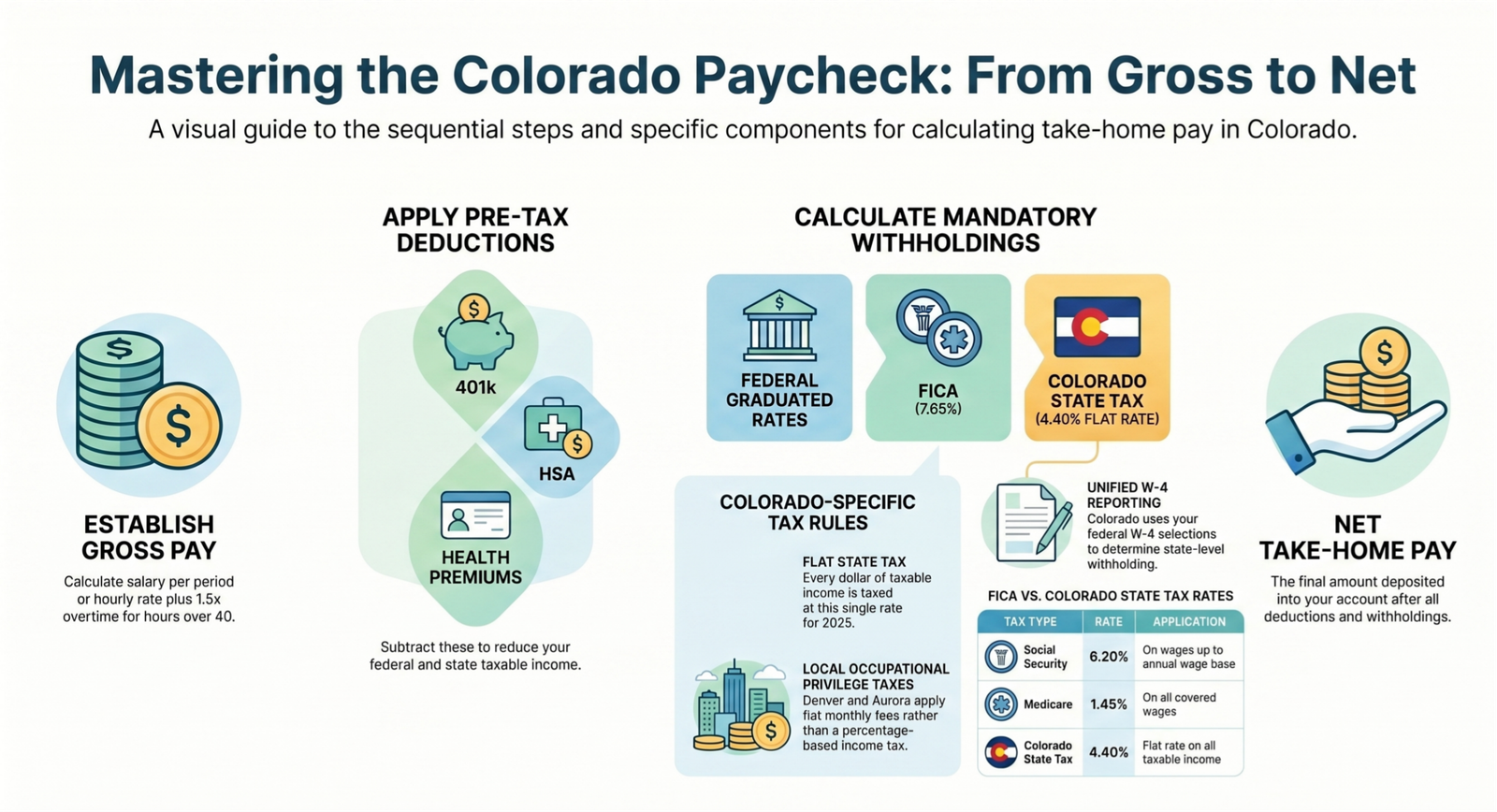
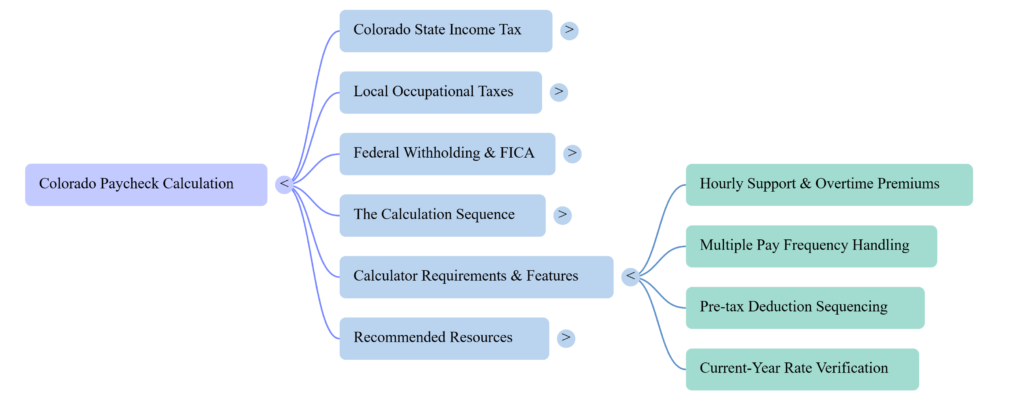
The colorado paycheck calculator applies five categories of deductions to your gross wages:
- Federal income tax — progressive 2026 brackets based on W-4 and filing status
- Social Security — 6.2% on wages up to $184,500 (2026 wage base)
- Medicare — 1.45% on all wages, no cap
- Colorado state income tax — flat 4.4% on taxable income
- Colorado FAMLI — approximately 0.45% employee share on wages
Workers in Denver also face a sixth deduction: the Denver Occupational Privilege Tax (OPT) of $5.75/month for employees earning more than $500 in a calendar month within Denver city limits. The paycheck calculator colorado hourly tool should account for this if you work in Denver.
Unlike states with progressive brackets, the colorado paycheck calculator requires no complex bracket calculation for state tax. Once federal taxable income is determined, 4.4% is applied flat. This simplicity is one of Colorado’s genuine advantages for workers trying to estimate their net pay.
Before calculating your Colorado paycheck, use our Salary to Hourly Calculator to convert hourly wages into annual income estimates.
Colorado’s TABOR Refund: A Unique Benefit
Colorado is the only state in the US with a constitutional Taxpayer’s Bill of Rights (TABOR). When state revenue exceeds the TABOR cap, Colorado is required to refund the excess directly to taxpayers. Recent TABOR refunds have ranged from $400 to $800 per person depending on filing status.
While TABOR refunds do not appear in the colorado paycheck calculator (they come as a lump sum at tax filing, not as paycheck adjustments), they represent a genuine annual benefit unique to Colorado workers. A TABOR refund effectively reduces your real annual state tax burden below what the 4.4% rate suggests — making Colorado an even more attractive state from a total tax perspective.
Feature Breakdown
How the Colorado Paycheck Calculator Works: Step by Step
The colorado paycheck tax calculator processes your paycheck in this exact sequence:
Step 1 — Determine gross wages For salaried workers: annual salary ÷ pay periods. For hourly workers: hours worked × hourly rate. The paycheck calculator colorado hourly applies overtime at 1.5× for hours beyond 40/week per Colorado COMPS Order requirements.
Step 2 — Subtract pre-tax deductions 401(k) contributions (up to $23,500 in 2026), health insurance premiums, HSA contributions, and FSA contributions reduce federal and Colorado taxable income simultaneously. For a Colorado worker in the 22% federal bracket and 4.4% Colorado bracket, each pre-tax dollar saves $0.264 in combined income tax — plus avoids FICA on employer-plan contributions.
Step 3 — Apply federal income tax withholding Federal brackets for 2026 (single filer, $14,600 standard deduction):
| Federal Taxable Income | Rate |
|---|---|
| $0 – $11,600 | 10% |
| $11,601 – $47,150 | 12% |
| $47,151 – $100,525 | 22% |
| $100,526 – $191,950 | 24% |
| Over $191,950 | 32%–37% |
Step 4 — Subtract FICA Social Security: 6.2% up to $184,500. Medicare: 1.45% on all wages.
Step 5 — Apply Colorado flat state tax (4.4%) Colorado uses federal taxable income as the starting point, then applies the flat 4.4% rate. No separate Colorado standard deduction is needed — the federal standard deduction ($14,600 single) reduces both federal and Colorado taxable income simultaneously.
Step 6 — Subtract Colorado FAMLI Employee FAMLI contribution: approximately 0.45% of gross wages up to the Social Security wage base ($184,500 in 2026).
Step 7 — Subtract Denver OPT (if applicable) $5.75/month for workers performing services within Denver city limits earning over $500/month.
Colorado Payroll Taxes Explained
Colorado State Income Tax: The Flat 4.4% Rate
Colorado’s flat 4.4% rate is the cornerstone of every colorado paycheck calculator. Its simplicity has two major implications for workers:
Predictability: A Colorado worker earning $50,000 pays the same percentage of state income tax as one earning $150,000. There are no sudden jumps into higher brackets as income rises — which makes raise calculations and income planning straightforward.
Middle-income advantage: In progressive-tax states like Oregon or California, middle-income earners often face marginal state rates of 7%–9.9%. In Colorado, every earner pays 4.4%. A worker earning $80,000 in Colorado pays approximately $2,860 in Colorado state income tax — compared to approximately $5,800–$6,700 in Oregon at the same income.
Colorado FAMLI: Family and Medical Leave Insurance
Colorado’s FAMLI program provides paid family and medical leave benefits for qualifying workers. The 2026 employee contribution rate is approximately 0.45% of gross wages up to the Social Security wage base of $184,500.
On common Colorado salary levels, FAMLI costs:
| Annual Salary | FAMLI Annual Cost | Per Biweekly Paycheck |
|---|---|---|
| $50,000 | $225 | $8.65 |
| $75,000 | $338 | $13.00 |
| $100,000 | $450 | $17.31 |
| $150,000 | $675 | $25.96 |
What workers receive in return: FAMLI pays up to 90% of wages for lower-income workers and up to $1,100/week for higher earners (approximately) for qualifying leave events — childbirth, serious illness, or family caregiving. Like Washington’s PFML, the benefit value substantially exceeds the annual cost for workers who qualify for leave.
Every accurate colorado paycheck calculator — particularly the take home pay calculator colorado — must include FAMLI to produce a realistic net pay estimate.
Browse our Digital Productivity guides for more salary calculators, income planning tools, and workplace resources.
Denver Occupational Privilege Tax (OPT)
Workers who perform services within Denver city limits and earn more than $500 in a calendar month are subject to the Denver OPT: $5.75/month, withheld by the employer. This amounts to $69/year — modest, but a deduction the colorado paycheck tax calculator should include for Denver workers.
Workers in other Colorado cities (Aurora, Colorado Springs, Boulder, Fort Collins) are not subject to the Denver OPT. The paycheck calculator colorado hourly for non-Denver workers does not include this charge.
Calculate Colorado Take-Home Pay: Real Numbers by Salary
Here is what the colorado paycheck calculator produces at four salary levels (single filer, standard deduction, no additional pre-tax deductions, non-Denver worker):
| Annual Salary | Biweekly Gross | Federal Tax | FICA | CO State (4.4%) | FAMLI (0.45%) | Net Biweekly |
|---|---|---|---|---|---|---|
| $50,000 | $1,923 | ~$215 | ~$147 | ~$64 | ~$9 | ~$1,488 |
| $75,000 | $2,885 | ~$380 | ~$221 | ~$104 | ~$13 | ~$2,167 |
| $100,000 | $3,846 | ~$535 | ~$294 | ~$142 | ~$17 | ~$2,858 |
| $130,000 | $5,000 | ~$800 | ~$383 | ~$189 | ~$23 | ~$3,605 |
The take home pay calculator colorado shows effective total deduction rates of approximately 22–28% at these income levels — comfortably below Oregon (26–31%) and California (28–36%) at equivalent salaries.
Gross Pay vs Net Pay in Colorado
The colorado paycheck calculator reveals a favorable gross-to-net spread compared to most western US states. At $100,000 annual salary, a Colorado worker takes home approximately $74,300–$75,000 per year — compared to approximately $69,300 in Oregon and $65,000–$67,000 in California.
The flat 4.4% rate is the primary driver. Unlike progressive-tax states where additional earnings push workers into higher brackets, every extra dollar earned in Colorado is taxed at the same 4.4% state rate. This makes the colorado paycheck calculator particularly useful for evaluating raises, overtime, or side income — because the state-level math never changes regardless of income level.
If you’re evaluating entry-level income scenarios, see our guide on How Much Is $25 an Hour Annually.
Paycheck Calculator Colorado Hourly: Calculating Hourly Take-Home Pay
The paycheck calculator colorado hourly applies the same tax structure to hourly workers. The formula:
Hourly Rate × Hours Per Week × 52 = Annual Gross Annual Gross ÷ 26 = Biweekly Gross Apply federal brackets + FICA + CO 4.4% + FAMLI 0.45% = Net Biweekly
Example — $25/hour, 40 hours/week, Denver worker:
- Annual gross: $25 × 40 × 52 = $52,000
- Biweekly gross: $2,000
- Federal tax: ~$232
- FICA: ~$153
- Colorado state tax (4.4%): ~$69
- FAMLI (0.45%): ~$9
- Denver OPT: ~$2.65
- Net biweekly: ~$1,534
Example — $40/hour, 40 hours/week, non-Denver worker:
- Annual gross: $83,200
- Biweekly gross: $3,200
- Federal tax: ~$452
- FICA: ~$245
- Colorado state tax: ~$118
- FAMLI: ~$14
- Net biweekly: ~$2,371
The paycheck calculator colorado hourly confirms that Colorado’s flat rate is especially favorable for hourly workers who see overtime or irregular hours — because extra hours never push them into a higher state bracket.
Colorado Tax Deductions Explained
Colorado workers have several powerful strategies to reduce both federal and Colorado taxable income simultaneously:
401(k) contributions: Up to $23,500 pre-tax in 2026. Each $1,000 contributed saves $44 in Colorado state tax (4.4%) plus federal tax savings — maximizing the value of every retirement dollar.
HSA contributions: $4,300 individual / $8,550 family in 2026. HSA contributions through payroll also avoid FICA — making them the most tax-efficient savings vehicle available in the colorado paycheck calculator framework.
Dependent Care FSA: Up to $5,000/year pre-tax for qualifying childcare costs. Reduces both Colorado and federal taxable income.
Colorado-specific retirement subtraction: Colorado allows a subtraction of up to $24,000 of pension or annuity income for taxpayers age 65 and older — a meaningful benefit for older workers or those planning early retirement in Colorado.
You can also compare earnings with our How Much Is 36 Dollars an Hour Annually? Complete Salary Breakdown guide.
Pros & Cons of Colorado’s Tax System
Pros of the Colorado Paycheck System
Pro 1: Flat 4.4% rate eliminates bracket anxiety The colorado paycheck calculator never produces a surprise jump in state tax as income rises. Every additional dollar of earnings is taxed at exactly 4.4% — making salary negotiations, bonus planning, and freelance income estimations perfectly predictable. Workers in Oregon or California face 8.75%–13.3% on incremental income; Colorado workers face 4.4% always.
Pro 2: TABOR refunds reduce real annual state tax burden No other state has a constitutionally mandated revenue refund mechanism. TABOR refunds of $400–$800/person have been issued in recent years, effectively reducing the real annual Colorado state tax burden below the 4.4% rate. A worker paying $3,300 in Colorado state tax who receives a $700 TABOR refund has an effective rate closer to 3.3% — competitive with Kentucky’s flat 3.5%.
Pro 3: FAMLI provides genuine leave benefits at low cost The 0.45% FAMLI deduction appearing in the colorado paycheck tax calculator costs approximately $225–$450/year at middle incomes. The benefit pays up to 90% of wages for lower earners and meaningful weekly amounts for higher earners during qualifying leave. The cost-to-benefit ratio is strongly favorable for parents, caregivers, and workers with health risks.
Pro 4: No complex bracket system simplifies financial planning Because Colorado’s state tax is flat, every financial calculation — retirement planning, income goal-setting, tax optimization — is more straightforward than in progressive states. The take home pay calculator colorado produces the same result regardless of which side of an income threshold a worker sits on.
Pro 5: Colorado offers strong retirement income subtractions Workers approaching retirement benefit from Colorado’s up-to-$24,000 pension and annuity income subtraction for taxpayers 65+. This makes Colorado particularly attractive for workers who plan to stay in the state after retirement — a long-term financial planning advantage that extends beyond paycheck calculations.
Higher earners may want to review our $45 an Hour Salary Guide to compare annual income and take-home pay.
Cons of Colorado’s Paycheck System
Con 1: 4.4% flat rate is higher than some neighboring states Wyoming and Texas have no state income tax. Nevada has no income tax. Compared to these zero-tax neighbors, the colorado paycheck calculator produces $2,200–$4,400 less in annual take-home on a $50K–$100K salary — purely from state income tax. Workers with location flexibility should weigh this difference seriously.
Con 2: FAMLI is a required deduction even for workers who may not benefit Young, healthy, single workers with no caregiving responsibilities pay the FAMLI 0.45% deduction but may be statistically unlikely to use the benefit for years or decades. Unlike a traditional insurance product with individual risk pricing, FAMLI is a mandatory social insurance program where contributions are pooled.
Con 3: Denver OPT adds a layer for workers in the city The Denver $5.75/month Occupational Privilege Tax is minor in dollar terms ($69/year) but adds a deduction that paycheck calculator colorado hourly tools frequently omit. Workers in Denver should confirm their calculator includes OPT for accurate net pay estimates.
Con 4: Colorado state tax starts with federal taxable income — no state standard deduction Colorado uses federal adjusted gross income (AGI) as its starting point, minus the federal standard deduction. Workers who itemize federal deductions may face different Colorado taxable income than expected. The colorado paycheck calculator for itemizers requires careful input to produce accurate results.
Con 5: High cost of living — especially in Denver and Boulder — can absorb take-home advantages Denver and Boulder rank among the most expensive US metros for housing. A worker whose colorado paycheck tax calculator shows strong take-home vs California may find that housing costs in Denver approach California levels, partially neutralizing the income tax advantage.
Which Is Best? Colorado vs Neighboring States
Workers in the Mountain West frequently compare Colorado’s take-home pay against neighboring zero-tax states and progressive-tax neighbors. Here is what the colorado paycheck calculator shows at an $80,000 salary compared to six regional alternatives:
| State | State Tax Rate | FAMLI/Similar | Annual Net on $80K | vs Colorado |
|---|---|---|---|---|
| Wyoming | 0% | None | ~$63,800 | +$2,940 |
| Nevada | 0% | None | ~$63,800 | +$2,940 |
| Texas | 0% | None | ~$63,800 | +$2,940 |
| Colorado | 4.4% flat | 0.45% FAMLI | ~$60,860 | — |
| Utah | 4.55% flat | None | ~$60,600 | −$260 |
| New Mexico | 1.7%–5.9% progressive | None | ~$61,200 | +$340 |
| Oregon | 4.75%–9.9% progressive | 0.2% transit | ~$57,400 | −$3,460 |
Colorado wins decisively against Oregon — the take home pay calculator colorado shows approximately $3,460 more in annual net income on $80,000. Colorado also competes closely with Utah and New Mexico, where the tax differences are under $400/year.
The Colorado trails Wyoming, Nevada, and Texas by approximately $2,940/year on $80,000 — but Colorado offers FAMLI benefits, a TABOR refund mechanism, and a more developed public services infrastructure that zero-tax states do not provide.
Best fit for Colorado’s paycheck system:
- Workers who value predictable flat-rate calculations and benefit from FAMLI leave coverage
- Residents in smaller Colorado cities (Colorado Springs, Fort Collins, Pueblo) where cost of living is manageable and the no-bracket advantage is fully realized
- Workers relocating from Oregon, California, or New York, where Colorado delivers $3,000–$7,000 more in annual take-home
- Parents and caregivers who anticipate using FAMLI benefits within their career timeline
For another state-specific example, explore our CT Income Tax Calculator guide to estimate after-tax income.
Conclusion
The colorado paycheck calculator is one of the most straightforward state paycheck tools available — because Colorado’s flat 4.4% income tax removes the complexity of progressive bracket calculations entirely. Whether you are a salaried professional in Denver or an hourly worker in Fort Collins, the state tax math is identical: 4.4% on taxable income, applied without variation.
The take home pay calculator colorado also shows that Colorado competes strongly against high-tax neighbors like Oregon and California, delivering $3,000–$7,000 more in annual net income at most salary levels. The 0.45% FAMLI deduction reduces take-home slightly below zero-tax states like Wyoming and Texas — but Colorado workers receive meaningful paid leave benefits in exchange, plus TABOR refunds that partially offset their state tax burden.
For hourly workers, the paycheck calculator colorado hourly confirms a powerful advantage: Colorado’s flat rate means overtime and raises are never taxed at a higher state rate. Every extra hour worked produces take-home income at the same predictable rate.
FAQs
Q: What is Colorado’s state income tax rate in 2026?
Colorado has a flat income tax rate of 4.4% for 2026. This applies to all taxable income regardless of income level — no brackets, no phase-outs. The colorado paycheck calculator applies this flat rate after subtracting the federal standard deduction from gross income.
Q: What is Colorado FAMLI and how does it affect my paycheck?
Colorado FAMLI (Family and Medical Leave Insurance) is a state program providing paid leave for childbirth, serious illness, or family caregiving. The 2026 employee contribution rate is approximately 0.45% of gross wages. On a $75,000 salary, FAMLI costs approximately $338/year ($13/biweekly paycheck). The take home pay calculator colorado must include FAMLI for accurate net pay estimates.
Q: Does the Colorado paycheck tax calculator include the Denver OPT?
The Denver Occupational Privilege Tax ($5.75/month) applies only to workers performing services within Denver city limits who earn more than $500/month. Workers in Aurora, Colorado Springs, Fort Collins, Boulder, and other Colorado cities are not subject to the OPT. The paycheck calculator colorado hourly should include OPT only for Denver-based workers.
Q: How does the Colorado paycheck calculator compare to Oregon or California?
The colorado paycheck calculator consistently produces higher net pay than Oregon or California at the same salary. On $80,000/year, Colorado workers take home approximately $3,460 more than Oregon workers and $7,000+ more than California workers — primarily because Colorado’s flat 4.4% rate is far below Oregon’s top rate of 9.9% and California’s top rate of 13.3%.
Q: Does Colorado have a standard deduction separate from the federal deduction?
No. Colorado uses federal adjusted gross income (after the federal standard deduction of $14,600 for single filers in 2026) as the starting point for calculating Colorado state tax. There is no separate Colorado standard deduction. This means the federal standard deduction effectively reduces both federal and Colorado taxable income simultaneously.
Q: What is a TABOR refund and how does it affect my Colorado taxes?
TABOR (Taxpayer’s Bill of Rights) is Colorado’s constitutional revenue limit. When state revenue exceeds the cap, Colorado must refund the excess to taxpayers. Recent refunds have ranged from $400 to $800 per person. TABOR refunds are received as a credit when filing Colorado taxes — not as a paycheck adjustment. They effectively reduce a Colorado worker’s real annual state tax burden below the 4.4% nominal rate.