Connected Load : Formula, Calculation & Electrical Sizing Guide
Connected load is the starting point for every electrical system design decision made in a building — from sizing the main service panel and selecting the right transformer to planning a generator installation or calculating battery backup capacity. Yet despite its central importance, connected load is one of the most misunderstood and incorrectly applied concepts in electrical engineering, often confused with demand load, maximum demand, or peak load in ways that lead to systems that are either dangerously undersized or unnecessarily expensive to install.
This guide gives you a complete, accurate understanding of connected load and what it means in electrical systems. It explains the connected load formula, how it differs from demand load and maximum demand, and how calculations work for residential and commercial buildings. It also shows how to use connected load correctly when sizing battery backup systems, generators, and utility service connections. Whether you are an electrical engineer, a facilities manager, or a technically curious homeowner, the concepts here directly affect the safety and reliability of every electrical system you work with.
What Is Connected Load?
Connected load is the total electrical power that would be consumed if every piece of electrical equipment installed in a building, circuit, or system were operating simultaneously at its full rated capacity. It is calculated by simply adding up the nameplate wattage (or VA rating) of every individual device, appliance, motor, lighting fixture, heating element, and piece of equipment that is permanently or semi-permanently connected to the electrical supply — without applying any reduction factor for the statistical reality that not everything runs at once.
This worst-case characteristic is precisely what makes connected load the most conservative and most trustworthy starting figure for electrical planning. It tells you the absolute ceiling of what the electrical system needs to be prepared to deliver. It is used as the foundation for transformer sizing, generator capacity planning, and battery backup system design. All situations where the backup or supply system must be ready for anything.
What Is Connected Load Formula? How to Calculate It
The Connected Load Formula
The connected load formula is straightforward:
Connected Load (W or kW) = Σ (Nameplate Watts of All Connected Equipment)
In kilowatts: Connected Load (kW) = Total Connected Watts ÷ 1,000
If device ratings are given in volt-amperes (VA) rather than watts — common for UPS systems, transformers, and electronic equipment — convert to watts using the power factor: Watts = VA × Power Factor. For most general electronic and computer equipment, assume PF = 0.80. For purely resistive loads (incandescent lighting, electric heaters, water heaters), PF = 1.0.
There are no demand factors, diversity factors, or usage multipliers in a connected load calculation. It is the pure arithmetic sum of nameplate ratings — nothing added, nothing subtracted, nothing estimated. This is what distinguishes connected load from demand load.
Before sizing an electrical circuit, calculate the total connected load with our Home Appliance Energy Calculator.
Connected Load Calculation in kW: Worked Example
Consider a small office space with the following equipment:
- Lighting: 20 × 40W LED fixtures = 800 W
- Computers and monitors: 10 workstations × 200 W each = 2,000 W
- Air conditioning unit: 3,500 W nameplate
- Printer/copier: 800 W
- Coffee machine: 1,500 W
- Refrigerator: 150 W
Total Connected Load = 800 + 2,000 + 3,500 + 800 + 1,500 + 150 = 8,750 W = 8.75 kW
This 8.75 kW is the connected load for this space. It sizes the panel feeding this office, the UPS or battery backup system protecting the critical equipment, and the circuit breakers feeding each subcircuit. It tells us that the electrical infrastructure for this space must be capable of supplying 8.75 kW continuously if every device runs simultaneously.
Connected Load Using Voltage and Current
When you express individual device ratings as voltage and current rather than watts, calculate each device’s connected load contribution using:
Device Load (W) = Voltage (V) × Current (A) [for resistive / DC loads]
Device Load (W) = Voltage (V) × Current (A) × PF [for AC loads with power factor]
Sum all individual device loads to produce the total connected load. For three-phase equipment: Device Load (W) = √3 × Line Voltage × Line Current × PF
After calculating your connected load, estimate your monthly energy expenses with our Electricity Bill Calculator.
Connected Load vs Demand Load: Understanding the Critical Difference
The distinction between connected load and demand load is one of the most important concepts in electrical engineering. Using the wrong figure for the wrong application produces systems that either fail dangerously under real loads or waste significant capital on unnecessary capacity:
| Parameter | Connected Load | Demand Load | Maximum Demand |
| Definition | Sum of all nameplate ratings of every installed device | Load actually used over a defined time interval | Highest demand recorded in any interval (usually 15 or 30 min) |
| Demand Factor Applied? | No — raw sum only | Yes — NEC demand factors reduce total | Yes — derived from measured peak usage |
| Value vs. Connected | Highest possible value (worst case) | Lower than connected load (10–40% typical reduction) | Usually lower than connected; higher than average demand |
| Used For | Transformer sizing, initial load estimation | Service entrance sizing, feeder design (NEC Art. 220) | Utility billing, tariff demand charge calculation |
| Measurement Required? | No — calculated from nameplates | No — calculated using NEC tables | Yes — measured by utility meter over billing period |
| Battery Backup Sizing | Use connected load (no reduction) | Do not use — unsafe for backup sizing | Use if measured; otherwise use connected load |
| Formula | CL = Σ (Individual Device Watts) | DL = CL × Demand Factor | MD = Peak kW in measurement interval |
| NEC Reference | NEC 220.12, 220.14 | NEC 220.40–220.44, Table 220.42 | NEC 220.87 (existing installations) |
Connected Load vs Demand Load: When Each Figure Is Used
The connected load is the theoretical maximum — every device on, every circuit loaded. The demand load is the realistic operating load — the power the system actually draws when accounting for the statistical likelihood that not every device operates simultaneously or at full capacity.
The NEC permits demand factors to be applied to connected load when sizing service entrances and feeders for dwelling units and commercial occupancies. NEC 220.42 allows the first 3,000 VA of combined lighting and small appliance connected load to be taken at 100% and everything above 3,000 VA at only 35% — reducing the calculated demand load significantly below the connected load. NEC Table 220.55 provides similar demand reduction for electric ranges and cooking equipment.
The practical implication: for a 200-amp residential service, a licensed electrician might calculate a connected load of 45,000 VA but a demand load of only 28,000 VA — both figures are correct, but they serve different purposes. The demand load (28,000 VA ÷ 240 V = 116.7 A) confirms that a 150-amp service may be adequate.
Connected Load for Residential Buildings
In a typical residential setting, the total connected load includes every electrically powered device in the home. This includes all lighting fixtures at full rated wattage and all major appliances such as ovens, dryers, water heaters, and HVAC systems at nameplate ratings. It also covers small appliances, electronics, EV chargers, pool pumps, and any other permanently or regularly connected equipment.
Typical Residential Connected Load Components
- General lighting: number of fixtures × fixture wattage
- HVAC: nameplate tonnage converted to watts (approximately 1,200 W per ton for central AC)
- Electric range and oven: typically 8,000–12,500 W nameplate
- Electric water heater: typically 4,500 W
- Clothes dryer: typically 5,000–6,000 W
- EV charger (Level 2): typically 6,400–11,520 W
- Refrigerator, dishwasher, microwave, washer, and other appliances
A fully equipped 2,500 sq ft home with an EV charger and electric appliances throughout commonly has a connected load of 35,000–55,000 watts (35–55 kW). The demand load after NEC Article 220 calculations is typically 20,000–30,000 watts — which is why 200-amp services (200 A × 240 V = 48,000 VA) are the standard for modern homes with significant electrical loads.
Learn how watts are calculated by reading our How to Find Watts guide.
Connected Load for Commercial Buildings
Commercial connected load calculations follow NEC 220.14 for branch circuits, which specifies minimum connected load per square foot based on occupancy type. Office spaces use 3.5 VA/sq ft; retail uses 3 VA/sq ft; industrial areas may use higher values depending on specific equipment. These per-square-foot values are minimum connected load figures — actual equipment loads are added on top for specific equipment such as HVAC, motors, specialized machinery, and process equipment.
A 10,000 sq ft commercial office building at 3.5 VA/sq ft produces a minimum lighting and general power connected load of 35,000 VA before adding any specific equipment. Adding HVAC, elevator, server room, and kitchen equipment might bring the total connected load to 120,000–200,000 VA (120–200 kVA), requiring transformer and service equipment sized accordingly.
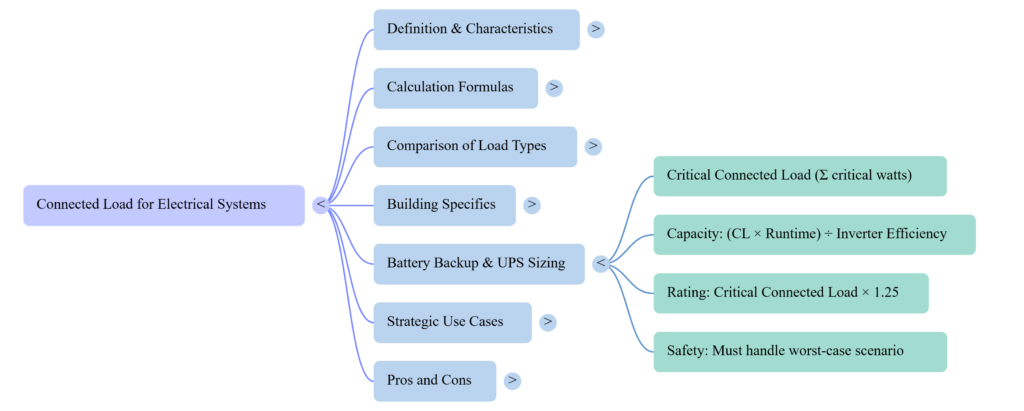
Connected Load and Battery Backup System Sizing
For battery backup and UPS system sizing, connected load — not demand load — is always the correct figure to use. A battery backup system does not know in advance which loads will be active during a power outage, and the entire purpose of the system is to handle the worst-case scenario: maximum simultaneous load at the moment the utility fails.
The battery backup sizing formula starting from connected load is:
Critical Connected Load (W) = Σ critical equipment nameplate watts (all items that must stay powered)
Battery Capacity (Wh) = Critical Connected Load × Required Runtime (hours) ÷ Inverter Efficiency
Inverter / UPS Rating (VA or W) = Critical Connected Load × 1.25 (safety margin)
For the office example above with a critical connected load of 2,800 W (computers, networking, security systems — excluding air conditioning and coffee machine), requiring 2 hours of backup at 85% inverter efficiency:
Battery Capacity = 2,800 × 2 ÷ 0.85 = 6,588 Wh ≈ 6.6 kWh of battery capacity
UPS or Inverter Rating = 2,800 × 1.25 = 3,500 W minimum inverter capacity
Pros and Cons of Using Connected Load for Electrical Planning
Why Connected Load Is the Most Reliable Planning Figure
- Represents the absolute worst-case electrical demand — systems sized to connected load will never be undersized for any realistic operating scenario
- Requires no assumptions about usage patterns, occupancy schedules, or diversity factors — pure arithmetic from verified nameplate data
- Engineers use it for battery backup and generator sizing where they cannot apply demand factors without risking system failure during the outage they are protecting against.
- Provides a clear, auditable figure that can be verified by anyone reviewing electrical design — nameplate ratings are fixed and documented
- Recalculating the connected load after adding equipment automatically captures future load additions and maintains a living record of the system’s true capacity requirement.
Limitations That Make Demand Load Necessary for Service Sizing
- Connected load is deliberately conservative — sizing utility service entrances to connected load would produce oversized, expensive services for most residential and commercial buildings
- NEC demand factors exist specifically because practical operating experience proves that connected load is rarely if ever achieved simultaneously — designing to connected load for service sizing wastes electrical infrastructure investment
- For large commercial facilities with diverse loads across many zones, sizing the entire service to connected load without demand factors would require transformer and switchgear capacity far in excess of any real operating need
For AC systems, understanding the Power Factor Formula improves connected load calculations.
When to Use Connected Load vs. Demand Load: The Right Tool for Each Job
Always Use Connected Load For
Battery backup and UPS sizing (no demand factor reduction), generator capacity planning, individual circuit breaker and conductor sizing (before applying continuous load multipliers), transformer sizing for dedicated equipment rooms where all loads may operate simultaneously, and any application where the consequence of undersizing is equipment failure or safety risk during an actual emergency.
Use Demand Load (with NEC Factors) For
Residential service entrance sizing under NEC Article 220, feeder sizing for general commercial and industrial buildings, transformer sizing for large mixed-use facilities with diverse and staggered load profiles, and utility service agreement negotiations where actual demand billing is based on measured peak demand rather than theoretical connected load.
Use Both Together For
Complete electrical system design that must satisfy both code-minimum service sizing (demand load calculation) and worst-case protective capacity verification (connected load calculation). The connected load confirms that every circuit, breaker, and conductor has adequate fault current withstand rating; the demand load confirms that the service entrance and feeder sizes are code-compliant and appropriately sized for realistic operating conditions.
Conclusion
Connected load is the bedrock figure that every other electrical calculation either derives from or references back to. It is the honest, uncompromised statement of what an electrical system must be able to supply — the sum total of every device’s nameplate rating added without adjustment, reduction, or optimism.
Understanding the distinction between connected load, demand load, and maximum demand is what separates electrical system designs that perform reliably under all conditions from those that work most of the time but fail when the stakes are highest. For battery backup planning, generator sizing, and any power continuity application, connected load is not just the starting point — it is the only figure that can be trusted to represent what the system genuinely needs to deliver.
Calculate connected load first. Apply demand factors where the NEC explicitly permits. Size backup systems, generators, and emergency power equipment to the connected load without reduction. Document every nameplate value used in the calculation. These four practices ensure that every electrical system you design, specify, or manage will perform exactly as intended — not just under average conditions, but when conditions are at their worst.
Explore our Smart Home guides for electrical calculations, appliance energy usage, and home efficiency tips.
Frequently Asked Questions
1. What is the connected load in electrical engineering?
Connected load is the total electrical power that would be consumed if every piece of equipment wired into an electrical system operated simultaneously at its full nameplate-rated capacity. It is the calculated by summing the nameplate wattage of every device, appliance, motor, and lighting fixture connected to the supply — with no demand factor reductions applied. Connected load represents the absolute maximum the electrical system must be capable of supplying, making it the most conservative and reliable figure for capacity planning.
2. What is the connected load formula?
The connected load formula is: Connected Load (W) = Σ (Nameplate Watts of All Connected Equipment). In kilowatts: CL (kW) = Total Connected Watts ÷ 1,000. For equipment rated in volt-amperes: Watts = VA × Power Factor (use PF = 0.80 for most electronic equipment; PF = 1.0 for purely resistive loads like heaters and incandescent lighting). For three-phase equipment: Watts = √3 × Line Voltage × Line Current × PF.
3. What is the difference between connected load and demand load?
Connected load is the theoretical maximum — the sum of all nameplate ratings assuming every device runs simultaneously at full capacity. Demand load applies NEC demand factors to produce a realistic operating figure that accounts for the statistical reality that not all loads operate at full capacity simultaneously. Connected loads is always higher than demand load. For service entrance sizing, the NEC permits using demand load (lower figure) to avoid oversized services. For battery backup and generator sizing, always use connected load (higher figure) to ensure adequate capacity during worst-case scenarios.
4. Why is connected load important for battery backup sizing?
Battery backup systems must be ready to power all critical equipment simultaneously at the moment a power outage occurs — there is no way to predict in advance which devices will be active. Using demand load (which applies demand factor reductions) for battery backup sizing creates a system that may be unable to power all critical loads simultaneously during an actual outage. Connected load gives you the true worst-case demand figure and ensures the inverter, UPS, and battery bank can handle everything that might be running when the power fails.
5. How does connected load affect electrical panel sizing?
Connected load determines the minimum fault current withstand capacity and branch circuit breaker ratings for every circuit in the panel. Each circuit breaker must be rated to carry the connected load of its circuit (with a 125% multiplier for continuous loads per NEC 210.20). The panel’s total capacity (bus rating in amps × service voltage) must be sufficient to interrupt the maximum available fault current, which is also related to the connected loads.
6. Can connected load exceed the service entrance amperage?
Yes — and in many residential and commercial buildings, amps does exceed the service entrance rating. This is intentional and code-compliant because demand factors ensure that the actual operating load (demand load) remains within the service capacity under realistic conditions. The NEC specifically allows this diversity through demand factor calculations.