HP to kW Conversion: Guide with Formula, Chart and Examples
If you’ve ever looked at a motor nameplate, a generator spec sheet, or an old engine manual and wondered how horsepower relates to kilowatts, you’re far from alone. HP to kW conversion is one of those small but constant calculations that shows up across electrical work, mechanical engineering, automotive specs, and home backup power planning. It looks simple on the surface — multiply by a number — but the details around motor efficiency, mechanical vs. electrical horsepower, and real-world power draw can trip people up.
This guide walks through the exact formula, a ready-to-use conversion chart, motor-specific calculations including three-phase setups, and how all of this ties into sizing a battery backup system correctly. By the end, you’ll be able to convert any HP value to kW confidently, and understand why the number matters, not just what it is.
Table of contents
What Is HP to kW Conversion?
Horsepower (HP) and kilowatts (kW) are both units of power — meaning they describe the rate at which energy is delivered or work is done, not the total amount of energy itself. The distinction matters: power is about speed of energy transfer, while energy itself (measured in kWh, joules, etc.) is about total quantity over time.
Horsepower has a colorful history. It was originally defined in the late 1700s to compare the output of early steam engines to the pulling power of a horse, so manufacturers could market their machines in terms people already understood. That historical origin is why horsepower isn’t a clean, round metric number — it’s based on a practical (if slightly arbitrary) 18th-century benchmark.
Kilowatts, by contrast, are part of the International System of Units (SI), the standardized metric system used in science, engineering, and most of the world outside the United States. Because electrical systems, generators, batteries, and most modern engineering specs are built around SI units, hp to kw conversion becomes necessary almost anywhere horsepower-rated equipment meets a kilowatt-rated system — which is constantly, given how globalized manufacturing and supply chains are today.
In practice, you’ll run into this conversion when:
- Comparing an imported motor’s HP rating to a local kW-rated electrical panel
- Sizing a generator or battery backup system for HP-rated equipment
- Reading older engine specs (often in HP) against newer kW-labeled appliances
- Working with industrial three-phase motors that list both ratings
After converting horsepower into kilowatts, use our Home Appliance Energy Calculator to estimate energy consumption.
The HP to kW Conversion Formula
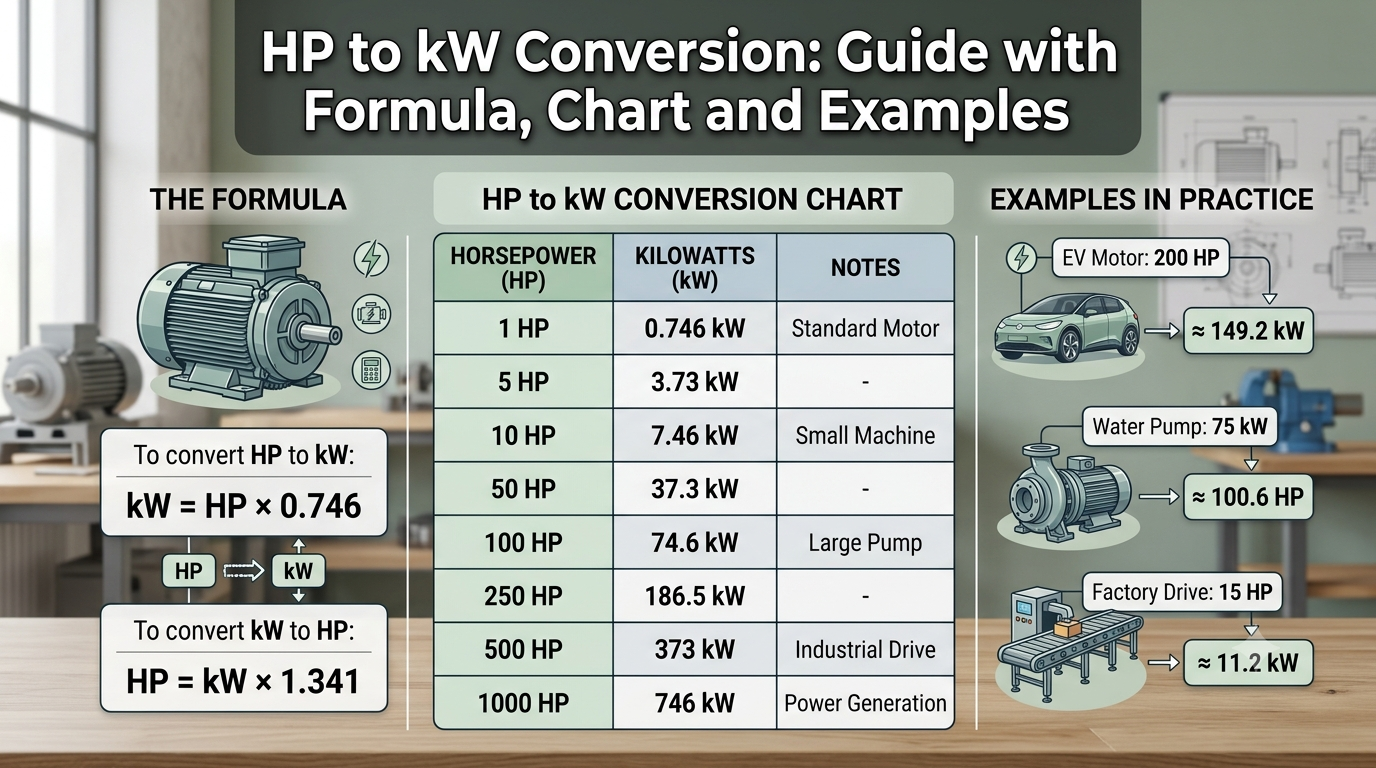
The core hp to kw conversion formula is simple multiplication:
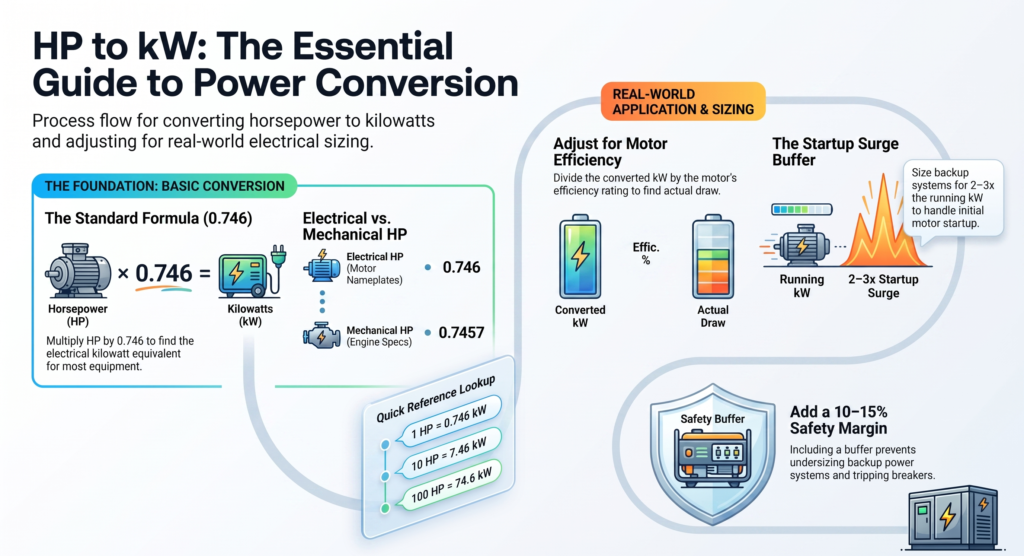
kW = HP × 0.7457 (mechanical horsepower — the traditional engineering definition)
For most everyday and electrical contexts, a slightly rounded version of the same constant is also widely used:
kW = HP × 0.746 (electrical horsepower — common on motor nameplates in North America)
The difference between these two constants is less than 0.02%, so for nearly every practical purpose — sizing equipment, comparing specs, doing rough estimates — either constant will give you an answer accurate enough to work with. The distinction only really matters in precision engineering contexts, like lab calibration or regulatory compliance documentation.
To reverse the calculation and convert kW back to HP, simply divide instead of multiply:
HP = kW ÷ 0.746
This is useful if you’re starting from an electrical spec (say, a battery backup system rated in kW) and need to know how many HP-rated devices it could realistically support.
Mechanical HP vs. Electrical HP
There are actually several historical definitions of horsepower depending on the country and era — metric horsepower, boiler horsepower, hydraulic horsepower — but for almost all modern purposes, two definitions matter:
- Mechanical horsepower (0.7457 kW): The classic engineering definition, still used for combustion engines, mechanical drivetrains, and general physics calculations.
- Electrical horsepower (0.746 kW): A standardized, slightly rounded value used on electric motor nameplates, particularly following NEMA (National Electrical Manufacturers Association) conventions in North America.
If you’re converting a car engine’s horsepower, the mechanical constant is technically more correct. If you’re converting an electric motor’s nameplate rating, the electrical constant is what the manufacturer almost certainly used to begin with. In day-to-day use, though, this level of precision rarely changes your practical outcome — both will land you in the same ballpark.
Once you know the kilowatt rating of your equipment, use our Electricity Bill Calculator to estimate monthly operating costs.
HP to kW Conversion Chart
For quick reference, here’s a conversion chart covering the most commonly searched horsepower to kw values, including the specific numbers people look up most — 1hp to kw, 2 hp to kw, 10 hp to kw, and 15 hp to kw:
| Horsepower (HP) | Kilowatts (kW) |
| 1 HP | 0.746 kW |
| 2 HP | 1.492 kW |
| 5 HP | 3.73 kW |
| 10 HP | 7.46 kW |
| 15 HP | 11.19 kW |
| 20 HP | 14.92 kW |
| 25 HP | 18.65 kW |
| 50 HP | 37.3 kW |
| 75 HP | 55.95 kW |
| 100 HP | 74.6 kW |
This table is designed to save you the manual math for the values people need most often. If your exact HP figure isn’t listed, just apply the formula above — multiply by 0.746 and you’ll get an accurate kW equivalent every time.
It’s worth noting that this chart uses the electrical horsepower constant (0.746), since most searches for “hp to kw calculator” or “hp to kw converter” come from people working with electric motors, generators, or backup power equipment rather than mechanical engine specs.
Motor HP to kW (Including Three-Phase Motors)
When it comes to motor hp to kw conversion specifically, the basic formula is your starting point — but real motors don’t operate at perfect theoretical efficiency, so the actual electrical power they draw from the supply is usually a bit higher than the simple converted number suggests.
A motor’s nameplate HP rating describes its mechanical output power — the useful work it can do at the shaft. But the electrical input power it draws from the wall or panel is always somewhat higher, because some energy is lost to heat, friction, and other inefficiencies during conversion. This is where motor efficiency comes into the picture.
The more complete formula for estimating actual electrical draw looks like this:
Input kW = (HP × 0.746) ÷ Motor Efficiency
For example, 10 HP motor with 90% efficiency doesn’t draw exactly 7.46 kW — it actually draws closer to 8.3 kW, because the motor needs extra input power to compensate for the roughly 10% lost as heat and friction. That difference might seem small, but across multiple motors or large industrial loads, it adds up quickly.
If you need to convert motor power into current, read our HP to Amps conversion guide.
Why 3-Phase Motors Need Extra Care
For HP to kW three-phase motor calculations, you must also consider the power factor because three-phase power systems use it to measure how effectively electrical current performs useful work, independent of motor efficiency. Many industrial and commercial three-phase motors operate with power factors between 0.8 and 0.95, meaning a portion of the apparent power drawn isn’t doing useful mechanical work.
For most everyday conversion purposes, you don’t need to dive into power factor calculations unless you’re doing detailed electrical system design or working with an electrician on panel sizing. But it’s useful context: if your three-phase motor’s actual measured electrical draw seems a bit higher than the simple HP-to-kW formula predicts, efficiency and power factor are almost always the reason.
A simplified takeaway for anyone working with motors: when converting horsepower to kw for sizing purposes (rather than academic calculation), it’s wise to add a 10–15% buffer above the basic converted number to account for real-world inefficiencies. This single habit prevents a surprising number of undersized electrical and backup power systems.
Why HP to kW Conversion Matters for Battery Backup Sizing
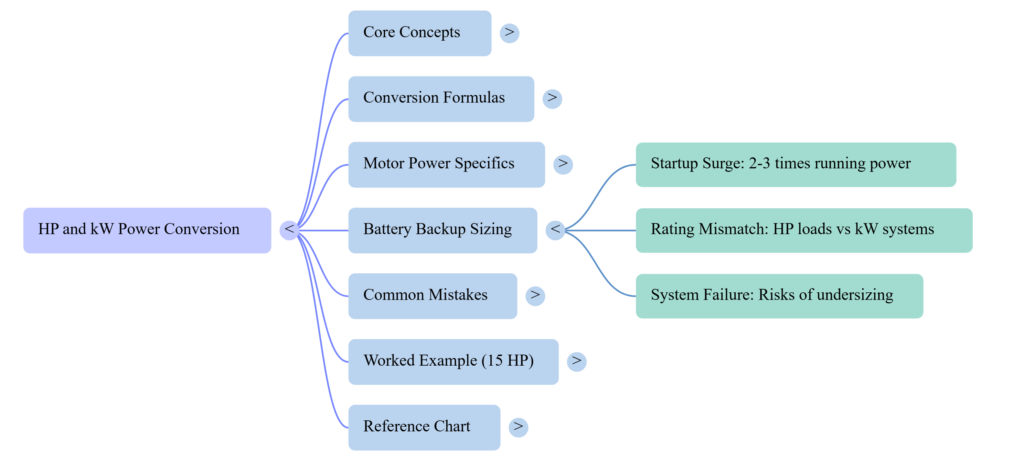
This is where the conversion stops being academic and becomes genuinely practical. If you’re using a battery backup calculator to plan backup power for motors, water pumps, HVAC compressors, or workshop equipment, the very first step — before you even open the calculator — is converting every piece of equipment’s HP rating into kW.
Here’s why this matters so much: battery backup systems, inverters, and generators are almost universally rated in kW or kVA, while a huge amount of motor-driven equipment (pumps, compressors, fans, older appliances) is still labeled in HP. If you skip the conversion step or do it incorrectly, you’ll either oversize your backup system unnecessarily (wasting money) or — far more commonly — undersize it, leading to a system that trips, overheats, or simply fails to start your equipment.
There are three things worth keeping in mind when feeding HP-rated equipment into a battery backup calculation:
- Convert using the electrical horsepower constant (0.746) since you’re dealing with electrical loads, not mechanical engine output.
- Account for motor efficiency if you know it, especially for larger motors (1 HP and above), since nameplate HP understates actual electrical draw.
- Add a startup surge buffer. Motors typically draw 2–3 times their running power for a brief moment during startup. A battery backup or inverter sized only for “running kW” can fail the moment the motor tries to start, even if it would handle the running load just fine afterward.
Putting this together: if you have a 5 HP pump motor, the running load converts to roughly 3.73 kW. But your battery backup or inverter should realistically be sized to handle a brief startup surge of 7–10 kW or more, even though the sustained draw afterward drops back down to that ~3.73 kW figure.
Common Mistakes When Converting HP to Kilowatts
A handful of mistakes show up again and again when people calculate hp to kw conversion manually or plan power systems around it:
- Mixing up mechanical and electrical HP constants. The error is tiny (under 0.02%) but inconsistent use across a project can create confusing discrepancies in documentation.
- Ignoring motor efficiency entirely. Treating nameplate HP as a direct stand-in for electrical kW draw understates real power consumption, sometimes significantly for older or lower-efficiency motors.
- Forgetting startup surge when sizing backup power. This is probably the single most common and costly mistake — a backup system that handles running load fine but can’t handle the brief startup spike.
- Rounding too early in multi-step calculations. If you’re converting HP to kW and then factoring in efficiency and power factor, rounding the first number too aggressively compounds errors through the rest of the calculation.
- Assuming all “HP” labels mean the same thing. Mechanical, electrical, metric, and even marketing-inflated horsepower ratings aren’t always directly comparable, especially on older or imported equipment.
You can also use our Amps to kW Calculator guide for additional electrical conversion formulas.
Avoiding these five mistakes covers the vast majority of real-world conversion errors people run into.
A Quick Worked Example
To tie everything together, here’s a complete worked example using a 15 HP three-phase motor — a common size for workshop or light industrial equipment.
Step 1: Basic conversion. 15 HP × 0.746 = 11.19 kW (theoretical electrical equivalent)
Step 2: Adjust for motor efficiency. If the motor is rated at 88% efficiency: 11.19 ÷ 0.88 ≈ 12.7 kW actual electrical draw under running conditions.
Step 3: Account for startup surge. At a conservative 2.5× surge multiplier: 12.7 × 2.5 ≈ 31.75 kW momentary surge requirement.
Step 4: Size your backup power accordingly. A battery backup or inverter for this motor would need to comfortably handle a brief 30+ kW surge, even though its continuous running draw is closer to 12–13 kW.
This example illustrates why a simple one-line hp to kw calculator answer (11.19 kW) is a useful starting point, but real-world equipment sizing requires layering in efficiency and surge considerations on top of it.
Conclusion
Understanding hp to kw conversion doesn’t require an engineering background — just the right formula, a bit of context about mechanical versus electrical horsepower, and an awareness of how motor efficiency and startup surge affect real-world power draw. Whether you’re converting a single value out of curiosity, comparing equipment specs, or planning a battery backup system around HP-rated motors, the chart and formulas in this guide will get you an accurate kW figure every time.
The single most valuable habit to take away from this guide: don’t stop at the basic converted number when you’re sizing actual electrical or backup power equipment. Factor in efficiency, add a buffer for startup surge, and round up rather than down. That small extra step is the difference between a backup power system that works reliably when you need it and one that fails at the worst possible moment.
Explore our Smart Home guides for electrical calculations, appliance energy usage, and home efficiency tips.
Frequently Asked Questions
How many kW is 1 HP?
1 HP equals approximately 0.746 kW using the electrical horsepower standard, or 0.7457 kW using the mechanical horsepower standard. The difference is negligible for almost all practical purposes.
What is the formula to convert HP to kW?
Multiply the horsepower value by 0.746 (electrical) or 0.7457 (mechanical) to get the equivalent in kilowatts. To go the other direction, divide the kW value by the same constant.
Is hp to kw conversion the same for every type of motor?
The base mathematical conversion is identical across all motors, but the actual electrical power drawn varies based on motor efficiency and, for three-phase motors, power factor. Two motors with the same HP rating can draw slightly different amounts of electrical power depending on these factors.
How do I convert motor HP to kW for a three-phase motor?
Start with the standard conversion (HP × 0.746), then divide by the motor’s efficiency rating to estimate actual electrical input power. For detailed electrical system design, a qualified electrician may also factor in power factor.
Why do generators and battery backups use kW instead of HP?
Kilowatts are the standard SI unit for electrical power output, making it straightforward to match generator, inverter, or battery backup capacity directly against the electrical loads they need to support — most of which are also measured in kW or kVA.
Can I use an online hp to kw calculator instead of doing the math myself?
Yes — an hp to kw calculator applies the same formula instantly and is especially convenient when you need to convert several different values quickly, such as when comparing multiple pieces of equipment for a backup power project.