PF Penalty in Electricity Bill: How It’s Calculated and How to Eliminate It

The pf penalty in electricity bill is one of the most significant and least understood charges that industrial and commercial consumers encounter on their utility invoices. While energy consumption charges based on kilowatt-hours (kWh) are familiar to everyone, the PF penalty in electricity bill appears as a separate surcharge that can add 10–30% to the total bill. Most businesses that pay it do not fully understand why utilities apply it or how they can eliminate it.
This guide explains everything: what power factor is and why it matters to utility companies, what PF penalty in electricity bill means and how utilities calculate it. It also covers the power factor penalty formula with a complete worked example and the most common causes of low power factor in industrial and commercial facilities. Finally, it explains effective methods for power factor correction, including capacitor banks and APFC panels, that can eliminate the penalty entirely and often generate a rebate instead.
Table of contents
- What Is Power Factor?
- What Is PF Penalty in Electricity Bill?
- Power Factor Penalty Reference: PF Range and Billing Impact
- How Is the PF Penalty Calculated? The Power Factor Penalty Formula
- Common Causes of Low Power Factor in Industrial and Commercial Facilities
- How to Reduce PF Penalty in Electricity Bill: Power Factor Correction Methods
- Pros and Cons of Power Factor Correction for Eliminating PF Penalty
- Which Power Factor Correction Method Is Best for Eliminating PF Penalty?
- Conclusion
What Is Power Factor?
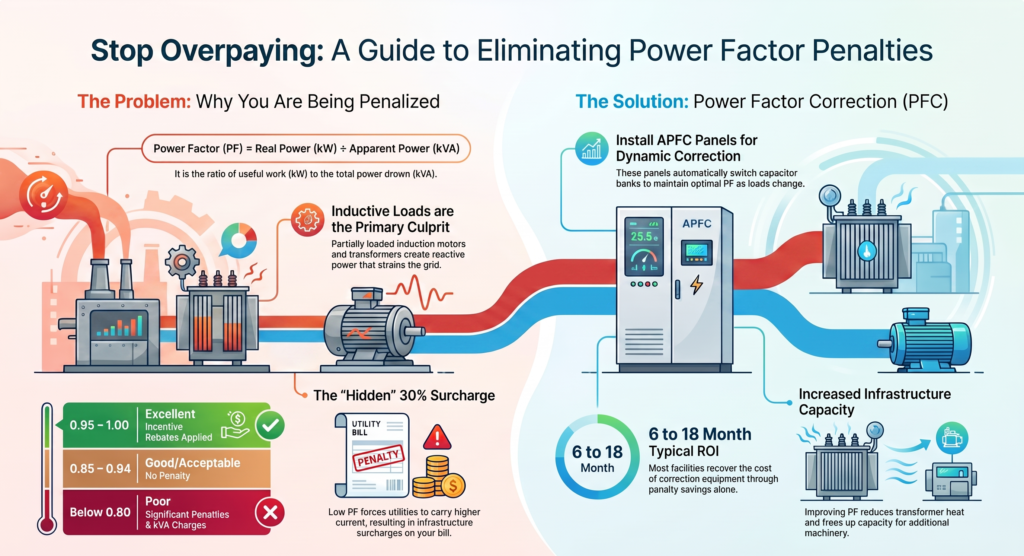
Power factor (PF) is a measure of how efficiently electrical power is being used in a circuit or building. It is defined as the ratio of real power (kW) — the power that actually does useful work such as running motors, heating, or lighting — to apparent power (kVA) — the total power drawn from the utility supply, including both useful and reactive components.
Power Factor = Real Power (kW) ÷ Apparent Power (kVA)
A power factor of 1.0 (or 100%) is perfect — every volt-ampere drawn from the grid is being converted into useful work. A power factor of 0.80 means that only 80% of the power drawn from the utility is being used productively; the remaining 20% is reactive power (kVAR) that oscillates back and forth between the source and inductive loads without doing any useful work.
The ideal power factor for industrial users is 0.95 or above. Most utility tariffs in India, Southeast Asia, and increasingly worldwide set a minimum acceptable power factor—commonly 0.85 or 0.90—and apply a power factor penalty to the monthly electricity bill when the power factor falls below this level. This is the pf penalty in electricity bill that causes so many industrial facilities to overpay for electricity they could keep with a relatively straightforward technical correction.
What Is PF Penalty in Electricity Bill?
The pf penalty in electricity bill is a surcharge that utility companies apply when a customer’s average power factor falls below the minimum threshold specified in their electricity tariff. It is charged in addition to the standard energy consumption charges (per kWh) and demand charges (per kVA or kW), specifically to compensate the utility for the additional burden that low power factor places on the grid’s generation, transmission, and distribution infrastructure.
If you want to understand how regular electricity charges are calculated, read our guide to calculating your electricity bill.
When a consumer draws reactive power from the grid, the utility’s generators, transformers, transmission lines, and distribution cables must carry higher current than the useful load alone would require. This extra current causes increased losses, reduces the capacity available for other customers, and requires the utility to invest in larger infrastructure. The pf penalty in electricity bill is the mechanism utilities use to pass this cost back to the consumers who create it.
Reactive Power Explained
Reactive power (kVAR) is the component of apparent power that does no useful work but is required by inductive loads — electric motors, transformers, induction furnaces, arc welders, and fluorescent lighting with magnetic ballasts — to maintain the magnetic fields they need to operate. Unlike real power (kW), reactive power oscillates between the source and the load rather than being consumed. The problem is that this oscillation still flows through conductors, creating I²R losses and consuming transmission capacity.
The pf penalty in electricity bill exists because low power factor means high reactive power demand, which strains the grid and reduces its effective capacity. A facility drawing 100 kW at 0.75 power factor forces the utility to supply 133 kVA of apparent power through its cables and transformers. The same 100 kW at 0.95 power factor requires only 105 kVA — the difference in infrastructure loading is significant, and the utility charges accordingly.
Power Factor Penalty Reference: PF Range and Billing Impact
Utility tariff structures vary by state and country, but the following ranges reflect typical power factor penalty thresholds and rebate structures found across commercial and industrial electricity tariffs:
| Power Factor (PF) Range | Classification | Utility Billing Impact | Recommended Action |
| 0.95 – 1.00 | Excellent | Incentive rebate in many tariffs; no penalty applied | Maintain — no action required |
| 0.90 – 0.94 | Good | Typically no penalty; may qualify for small rebate | Monitor and maintain |
| 0.85 – 0.89 | Acceptable | No penalty in most tariffs; marginal zone in some states | Consider light correction |
| 0.80 – 0.84 | Below target | PF penalty begins in many industrial / commercial tariffs | Capacitor bank installation recommended |
| 0.75 – 0.79 | Poor | Significant pf penalty in electricity bill; higher kVA charges | Urgent power factor correction required |
| Below 0.75 | Very poor | Maximum penalty tier; possible disconnection warning from utility | APFC panel and full correction audit needed |
| Above 1.00 | Leading PF | Leading PF from over-correction can also attract penalty | Reduce capacitor bank kVAR — overcompensation |
How Is the PF Penalty Calculated? The Power Factor Penalty Formula
Utilities calculate PF penalties in electricity bills differently depending on the tariff structure, but they most commonly use either the kVA-based billing method or the percentage surcharge method.
Method 1: kVA-Based Billing (Most Common for Industrial Tariffs)
Under kVA-based billing, the utility charges for apparent power (kVA) rather than real power (kW). A facility with low power factor draws more kVA for the same kW consumption — and pays more as a direct result.
Example: A factory consumes 500 kW at a power factor of 0.75:
kVA billed = kW ÷ PF = 500 ÷ 0.75 = 666.67 kVA
If the same factory improves its power factor to 0.95:
kVA billed = 500 ÷ 0.95 = 526.3 kVA
Difference = 666.67 − 526.3 = 140.4 kVA less billed demand. At a typical kVA demand rate of ₹400 per kVA per month, the saving is 140.4 × 400 = ₹56,160 per month — simply from power factor improvement. This is the pf penalty in electricity bill in its most direct form: paying for kVA you would not have to pay for if your power factor were higher.
Method 2: Percentage Surcharge on Energy Charges
Some tariff structures apply the pf penalty in electricity bill as a percentage surcharge on the total energy consumption charge. The formula is:
PF Penalty Surcharge = Total Energy Charge × PF Penalty Rate × (Target PF − Actual PF) ÷ Target PF
The tariff defines the PF penalty rate, commonly at 1–2% per 0.01 unit below the target PF. Under this method, a consumer with a target PF of 0.90 operating at an actual PF of 0.75 faces a 15-unit deficit, resulting in a surcharge of 15 × 1% = 15% added to the energy consumption bill — in addition to the higher kVA demand charges described above.
Power Factor Calculation with Example
The power factor formula using measurable electrical quantities is:
PF = Real Power (kW) ÷ Apparent Power (kVA) = cos θ
Or from measured values: PF = kW ÷ √(kW² + kVAR²)
Example: A factory’s energy meter readings for the month show:
- kWh consumed: 75,000 kWh
- kVAh consumed: 94,340 kVAh
Average PF = kWh ÷ kVAh = 75,000 ÷ 94,340 = 0.795
This PF of 0.795 would attract a significant pf penalty in electricity bill under virtually any industrial tariff with a minimum PF threshold of 0.85 or 0.90. The reactive energy consumed = √(kVAh² − kWh²) = √(94,340² − 75,000²) = 57,060 kVARh. This reactive demand is what must be supplied locally through capacitor banks to eliminate the pf penalty in electricity bill.
To estimate the cost of your regular electricity consumption separately, try our Electricity Bill Calculator.
Common Causes of Low Power Factor in Industrial and Commercial Facilities
Inductive Equipment — The Primary Source of Low Power Factor
The most common causes of low power factor — and therefore the primary drivers of pf penalty in electricity bill — are all inductive loads. Induction motors are the largest single contributor: a motor running at partial load operates at a significantly lower power factor than at full load. A 100 HP motor running at 30% load may have a power factor as low as 0.5–0.6, compared to 0.85–0.90 at full load.
- Induction motors operating at partial load — the most common cause across industrial facilities
- Transformers energized without load (no-load magnetizing current is purely reactive)
- Induction furnaces and arc furnaces — inherently low power factor equipment
- Arc welders and resistance welders during their reactive welding cycle
- Fluorescent lighting with magnetic (inductive) ballasts in older commercial buildings
- Drives, UPS systems, and variable speed drives that draw non-sinusoidal current (harmonic distortion reduces effective power factor)
How to Reduce PF Penalty in Electricity Bill: Power Factor Correction Methods
Method 1: Capacitor Banks for Static Power Factor Correction
Installing capacitor banks is the most direct and widely used method for eliminating the pf penalty in electricity bill. Capacitors supply reactive power (kVAR) locally — at the point of use or at the main panel — rather than drawing it from the utility grid. The reactive power the capacitors supply offsets the reactive demand of inductive loads, increasing the net power factor seen at the utility meter.
The required capacitor kVAR to correct from an existing power factor to a target power factor is:
Required kVAR = P (kW) × (tan θ1 − tan θ2)
Where θ1 = cos⁻¹(existing PF) and θ2 = cos⁻¹(target PF). For the factory example with 500 kW at 0.75 PF targeting 0.95 PF:
Required kVAR = 500 × (tan(cos⁻¹0.75) − tan(cos⁻¹0.95)) = 500 × (0.8819 − 0.3287) = 500 × 0.5532 = 276.6 kVAR
Installing a 280 kVAR capacitor bank eliminates virtually all of the pf penalty in electricity bill for this facility while bringing the power factor above the target threshold for rebate eligibility.
Method 2: APFC Panel (Automatic Power Factor Correction)
Automatic Power Factor Correction (APFC) panel is a dynamic power factor correction system that automatically switches capacitor banks in and out in response to changing load conditions throughout the day. Because industrial loads vary continuously — motors start and stop, production shifts change, heavy equipment cycles on and off — a static capacitor bank sized for peak reactive demand would overcompensate during light load periods, pushing the power factor above 1.0 (leading) and potentially attracting a leading power factor penalty from the utility.
An APFC panel uses a power factor controller (relay) that measures the real-time power factor at the incoming supply and automatically steps the available capacitor kVAR in the correct increments to maintain the target power factor — typically 0.96 to 0.99 — regardless of how the load profile changes throughout the day. This is the most effective technology for consistently eliminating the pf penalty in electricity bill in facilities with variable loads.
Method 3: Load Management and Motor Sizing
Oversized motors running at partial load cause the most common hidden PF penalty in electricity bills in manufacturing facilities.
A motor running at 30–40% of rated load operates at a power factor of 0.50–0.65. Replacing oversized motors with correctly sized units — or installing variable frequency drives (VFDs) that match motor speed to actual load — dramatically improves power factor without any capacitor correction at all. This approach also reduces energy consumption and mechanical wear simultaneously.
Pros and Cons of Power Factor Correction for Eliminating PF Penalty
Why Power Factor Correction Always Makes Financial Sense
- Eliminates the pf penalty in electricity bill immediately — most facilities recover the cost of capacitor bank installation within 6–18 months from penalty savings alone
- Many tariffs offer a power factor rebate (incentive credit) for facilities maintaining PF above 0.95–0.98 — correction converts a penalty into a financial benefit
- Reduces kVA demand charges independently of kWh consumption — a significant additional saving on top of penalty elimination
- Reduces current in distribution conductors and transformers — lowering I²R losses, reducing cable heating, and extending equipment life
- Increases the effective capacity of existing electrical infrastructure — for example, a transformer that was operating at 90% load at 0.75 PF may operate at only about 70% load after correction to 0.95 PF.
Practical Considerations Before Installing Correction Equipment
- Harmonic distortion from VFDs, UPS systems, and non-linear loads damages capacitors, so engineers should perform harmonic analysis before installing capacitors in facilities with significant drive loads.
- Over-correction (leading PF above 1.0) can also attract a pf penalty in electricity bill — always target 0.95–0.98 rather than unity to avoid leading PF issues
- Static capacitor banks require periodic inspection and replacement of capacitor elements that degrade over time — APFC panels simplify this through staged bank switching
- The initial capital cost of an APFC panel is higher than a static bank — but the superior performance and protection against over-correction typically justify the additional investment for loads above 50 kVAR correction
Explore more energy-saving guides and practical resources in our Smart Home category.

Which Power Factor Correction Method Is Best for Eliminating PF Penalty?
Best for Small Commercial Facilities (Under 50 kVAR Required)
A static capacitor bank — either at the main panel or distributed near the largest inductive loads — is the most cost-effective solution for small commercial facilities where the load profile is relatively consistent. A single-stage bank sized to the calculated kVAR requirement will maintain adequate power factor for most of the operating day without the complexity or cost of automatic switching.
Best for Large Industrial Facilities With Variable Loads
An APFC panel with 6–12 stages of capacitor switching is the standard solution for any industrial facility where load varies significantly throughout the day. The automatic controller eliminates manual intervention, prevents over-correction, and maintains power factor within the optimal range (0.96–0.99) continuously. For facilities that have been paying a significant pf penalty in electricity bill for years, APFC installation with a properly sized capacitor bank routinely delivers payback in under 12 months.
Best for Facilities With High Harmonic Distortion
Facilities with significant VFD, UPS, or power electronics loads require detuned capacitor banks fitted with series reactors (typically tuned to prevent resonance at the 5th harmonic). Standard capacitors in high-harmonic environments suffer accelerated failure and can cause harmonic amplification that damages other equipment. Qualified engineers should perform a power quality audit before specifying any power factor correction equipment in these environments.
Conclusion
The pf penalty in electricity bill is a fully avoidable charge that many industrial and commercial facilities pay month after month simply because the underlying power factor problem has never been addressed. Every rupee, dollar, or unit of currency paid as a pf penalty is money that could be retained by installing a capacitor bank, an APFC panel, or by correctly sizing and loading inductive equipment.
The power factor penalty represents a utility’s legitimate cost recovery for the reactive power burden low-power-factor loads place on the grid. But from the consumer’s perspective, it is an entirely solvable problem. The technology is well-established, the investment pays for itself quickly, and the benefits extend beyond just eliminating the pf penalty in electricity bill — improved power factor also reduces kVA demand charges, lowers cable and transformer losses, and increases the effective capacity of existing electrical infrastructure.
Start with a power factor audit: measure your current PF from utility meter readings or a power quality analyzer, calculate the kVAR correction required, and obtain a quotation for either a static bank or APFC panel appropriate for your facility’s load profile. In most cases, eliminating the pf penalty in electricity bill is one of the fastest-payback electrical investments any industrial or commercial facility can make.
Frequently Asked Questions
1. What is PF penalty in electricity bill?
The pf penalty in electricity bill is a surcharge applied by the utility when a consumer’s average power factor falls below the minimum threshold specified in their electricity tariff — commonly 0.85 or 0.90. It is charged because low power factor means high reactive power demand, which increases the current flowing through the utility’s infrastructure without delivering additional useful energy, creating higher losses and reducing available capacity for other consumers. The pf penalty in electricity bill is the utility’s mechanism for recovering these extra infrastructure costs from the consumers who cause them.
2. What is a power factor penalty and how is it different from a PF penalty?
Power factor penalty and pf penalty in electricity bill refer to the same charge — both describe the surcharge or additional billing cost that utilities impose when a consumer’s power factor falls below the contractual minimum. The terminology varies by region and tariff document. In India, utilities most commonly use the term “PF penalty in electricity bill,” while other markets use terms such as “power factor penalty surcharge” or “reactive energy charge” for the same underlying cost on invoices.
3. What is the best way to eliminate the pf penalty in electricity bill?
The most effective method is installing an APFC (Automatic Power Factor Correction) panel with appropriately sized capacitor banks that automatically maintain the power factor at or above 0.95–0.98 throughout all load conditions. For facilities with variable loads — which includes most manufacturing, processing, and commercial operations — APFC panels outperform static capacitor banks because they prevent over-correction (leading PF) while responding dynamically to load changes. Most APFC installations recover their cost from pf penalty savings within 6–18 months.
4. Can over-correction of power factor also cause a penalty?
Yes — leading power factor (PF above 1.0 caused by excess capacitive kVAR) can also attract a pf penalty in electricity bill under some tariff structures, particularly in industrial tariffs that specify an acceptable PF range (such as 0.90 to unity) rather than a minimum floor. Over-correction typically occurs with static capacitor banks during light load periods when the full capacitor bank remains energized while the reactive load drops. APFC panels prevent this by automatically switching out capacitor stages when the power factor approaches unity.
5. What equipment typically causes low power factor and pf penalty?
The most common causes of low power factor — and therefore the primary sources of pf penalty in electricity bill — are induction motors running at partial load (by far the largest contributor in industrial facilities), transformers on light load, induction furnaces, arc furnaces, arc welders, older fluorescent lighting systems with magnetic ballasts, and non-linear electronic loads including variable frequency drives (VFDs), UPS systems, and rectifier-based power supplies that draw non-sinusoidal current and reduce the displacement and total power factor simultaneously.