AES, RSA, and ECC: Why Encryption Key Sizes Aren’t Directly Comparable
Ask a developer whether a 256-bit key is stronger than a 2048-bit key, and you’ll often get a confident wrong answer. The numbers look like they belong on the same ruler, but they measure very different things. Understanding why AES, RSA, and ECC key sizes aren’t directly comparable is the difference between picking encryption that holds up for decades and picking encryption that only looks impressive on a spec sheet.
Bit length alone tells you almost nothing. What matters is how much work an attacker has to do, and that depends entirely on the math underneath each algorithm.
The Underlying Mathematics of Symmetric and Asymmetric Algorithms
Every encryption algorithm rests on a problem that is easy to compute in one direction and painfully hard to reverse. The size of the key matters only in relation to the best known way of attacking that specific problem. Symmetric and asymmetric algorithms rely on completely different hard problems, which is why their key sizes drift so far apart.
Symmetric Security: The Brute Force Barrier of AES
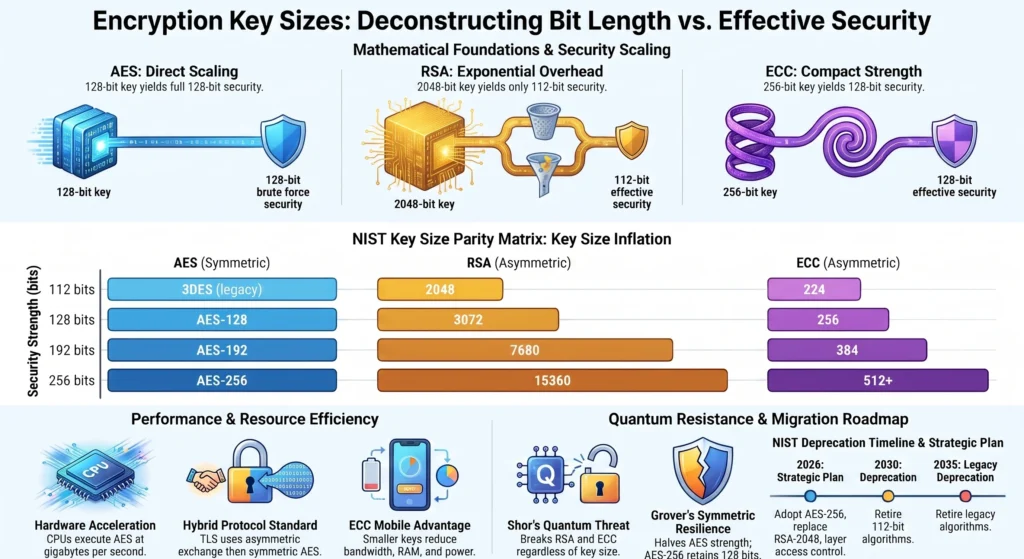
AES uses a single shared secret key, and decades of public analysis have produced no practical shortcut around it. The best realistic attack is still brute force: trying every possible key until one works. A 128-bit AES key therefore offers roughly 2128 possibilities, and each added bit doubles the attacker’s workload.
That clean relationship makes AES easy to reason about. AES-128 gives about 128 bits of security, and AES-256 gives about 256. No meaningful gap exists between the key length and the actual strength, which is the exception rather than the rule in cryptography.
Asymmetric Complexity: Factoring RSA and Discrete Logs in ECC
RSA’s security depends on how hard it is to factor a huge number into its two prime components. Attackers don’t need to guess every possible value. Algorithms like the General Number Field Sieve cut through the search space dramatically, so a 2048-bit RSA key delivers only about 112 bits of real security.
ECC relies on the elliptic curve discrete logarithm problem, which has resisted shortcuts far better than factoring. The best known attacks only reduce the effective strength to about half the key length. A 256-bit ECC key yields roughly 128 bits of security: much closer to AES than RSA ever gets.
Encryption Key Sizes at a Glance: AES vs. RSA vs. ECC
Before looking at exact equivalences, it helps to see how the three algorithms differ in what they protect, where they are used, and which encryption key sizes are common today:
| Feature | AES | RSA | ECC |
|---|---|---|---|
| Algorithm type | Symmetric (one shared key) | Asymmetric (public/private key pair) | Asymmetric (public/private key pair) |
| Hard problem behind it | No known shortcut; brute force only | Factoring large prime products | Elliptic curve discrete logarithm |
| Typical key size today | 128 or 256 bits | 2048 to 4096 bits | 256 or 384 bits |
| Main job | Bulk encryption of files, disks and traffic | Key exchange, digital signatures, certificates | Key exchange, digital signatures, certificates |
| Speed | Very fast, often hardware-accelerated | Slow, gets much slower as keys grow | Fast, with small keys and signatures |
| Common examples | Wi-Fi (WPA2/WPA3), BitLocker, VPN tunnels | Older TLS certificates, code signing | Modern TLS (ECDHE), mobile apps, cryptocurrency wallets |
Security Strength vs. Bit Length: The NIST Encryption Key Sizes Scale
NIST publishes equivalency guidance in SP 800-57 so organizations can match algorithms by actual strength rather than raw size. Here’s how the comparable levels line up:
| Security Strength | AES (Symmetric) | RSA | ECC |
|---|---|---|---|
| 112 bits | 3DES (legacy) | 2048 | 224 |
| 128 bits | AES-128 | 3072 | 256 |
| 192 bits | AES-192 | 7680 | 384 |
| 256 bits | AES-256 | 15360 | 512+ |
The pattern is striking. To match AES-128, RSA needs a key 24 times longer, while ECC needs only double. Pushing RSA to 256-bit equivalence demands a 15,360-bit key, which is so unwieldy that almost nobody deploys it.
This table also exposes a common audit trap. A system using RSA-2048 might pass a compliance checklist, yet it sits at the lowest acceptable tier and is the first in line for deprecation. Checking a box for an auditor is not the same as having encryption with a long shelf life.
The Efficiency Gap: Performance Implications of Key Size
Larger keys cost real resources. RSA key generation, signing, and decryption all slow down sharply as keys grow, because the underlying arithmetic scales worse than linearly. Moving from RSA-2048 to RSA-3072 can multiply private-key operation time several times over on the same hardware.
AES sits in a different category altogether. Most modern processors include dedicated AES instructions, so bulk encryption runs at gigabytes per second with negligible overhead. That’s why real-world protocols like TLS use asymmetric cryptography only to exchange a session key, then hand the heavy lifting to AES. The same pattern protects everyday video calls, which is why encryption is one of the key points in any Google Meet vs Zoom comparison.
This hybrid design is the practical answer to the efficiency gap. Each algorithm does the job it handles best.
Why ECC Outperforms RSA in Mobile and IoT Environments
Smaller keys pay off most where resources are scarce. ECC’s compact keys translate into tangible advantages:
- Faster handshakes: ECDHE key exchange and ECDSA signing finish quicker than RSA equivalents at the same strength.
- Lower bandwidth: Certificates and signatures are far smaller, which matters on constrained networks.
- Reduced power draw: Fewer CPU cycles mean longer battery life for phones, sensors, and wearables.
- Smaller memory footprint: Microcontrollers with limited RAM can handle ECC where RSA-3072 would strain them.
There is a usability tradeoff. ECC implementations are more prone to subtle bugs, such as weak randomness in signature nonces, which has leaked private keys in real products. Choosing well-audited libraries matters as much as choosing the algorithm.
Future-Proofing Encryption Against Quantum and Classical Threats
Quantum computing reshuffles the comparison again. Shor’s algorithm, run on a sufficiently large quantum computer, would break both RSA and ECC regardless of key size. Making those keys bigger buys almost nothing. Grover’s algorithm, by contrast, only halves symmetric strength, so AES-256 would still retain about 128 bits of effective security.
How Quantum Computing Affects Each Encryption Key Size
| Algorithm and key size | Security today (classical) | After a large quantum computer | Recommended action |
|---|---|---|---|
| AES-128 | 128 bits | About 64 bits (Grover) | Move to AES-256 for long-term data |
| AES-256 | 256 bits | About 128 bits (Grover) | Safe; keep using it |
| RSA-2048 | 112 bits | Broken (Shor) | Plan migration now |
| RSA-3072 / 4096 | 128+ bits | Broken (Shor) | Bigger keys do not help; migrate |
| ECC P-256 | 128 bits | Broken (Shor) | Move to hybrid or post-quantum key exchange |
| ML-KEM-768 (post-quantum) | About 192 bits | Designed to resist known quantum attacks | Adopt, often in hybrid with ECC |
In short, quantum computing changes which encryption key sizes are safe far more for RSA and ECC than for AES. As a result, simply adding bits to a public key will not solve the problem.
NIST finalized its first post-quantum standards in 2024: ML-KEM for key exchange, plus ML-DSA and SLH-DSA for signatures. Its transition guidance proposes deprecating 112-bit RSA and ECC around 2030 and disallowing quantum-vulnerable public-key algorithms by 2035. The “harvest now, decrypt later” threat means data encrypted today with RSA could be exposed years from now.
A Practical Encryption Plan for 2026
A sensible plan in 2026 looks like this:
- Standardize on AES-256 for data at rest and in transit.
- Retire RSA-2048 in favor of ECC or hybrid post-quantum key exchange.
- Inventory where asymmetric keys live so migration isn’t a scramble.
- Layer protections: encryption alone won’t stop an authorized user from forwarding a decrypted file.
That last point deserves emphasis. Defense-in-depth means pairing strong encryption with access controls, device binding, dynamic watermarking, and the ability to revoke access remotely. Even perfect AES-256 can’t stop someone from sharing a document they’ve already opened, and every added control introduces some friction, so the goal is protection that users won’t try to work around.
In addition, for businesses, defense-in-depth also means someone watching for misuse in real time. Our guide to SOC monitoring, managed IT and penetration testing explains how that layer fits alongside encryption.
Conclusion: Measure Encryption Key Sizes by Strength, Not Bit Length
Key sizes only make sense in context: AES maps bits to strength directly, RSA needs enormous keys to keep pace, and ECC delivers more security per bit. The smartest move is to measure algorithms by real security strength and combine encryption with controls that follow your content wherever it goes.