What Is 37 an Hour Annually Complete Annual Salary Guide

Knowing exactly what an hourly wage translates to over a full year — and what it means for monthly budgeting, tax planning, and lifestyle affordability — is foundational financial knowledge for anyone evaluating a job offer or tracking their income. What is 37 an hour annually is a question with a precise mathematical answer and a more nuanced financial picture beyond the gross number. This complete guide covers the exact annual salary for $37 per hour, how that income breaks down across every pay period, what the realistic after-tax take-home looks like in different states, and how $37 per hour compares to related wage rates including $33 per hour and the $60k annual salary mark.
Table of contents
- What Is $37 an Hour Annually?
- $37 an Hour Salary Breakdown — Weekly, Monthly and Annual Pay
- $37 Per Hour Annual Salary Before Taxes — Understanding Gross Income
- $37 an Hour After Taxes — Estimated Take-Home Pay by State
- What If You Work Part-Time at $37 an Hour?
- How Unpaid Time Off Changes Your Annual Salary
- How to Convert $37 Hourly Pay to Annual Salary
- PaycheckCity Payroll and 60k Hourly — Calculating Net Pay Accurately
- $16 an Hour 40 Hours a Week After Taxes vs $37 an Hour — The Wage Journey
- Is $37 an Hour a Good Salary? — Financial Reality Check
- Conclusion
What Is $37 an Hour Annually?
The standard calculation for what is 37 an hour annually uses full-time employment at 40 hours per week across all 52 weeks of the year — 2,080 total working hours.
$37 × 2,080 hours = $76,960 per year
This is the gross annual salary for $37 per hour under standard full-time conditions — the figure before any taxes, retirement contributions, or benefit deductions reduce it to actual take-home. What is 37 an hour annually in gross terms is $76,960, and this number is the anchor for every financial calculation that follows.
At $76,960 annually, what is 37 an hour annually positions this wage comfortably above the US median household income — meaning $37 per hour represents genuinely strong compensation by national standards for an individual earner. This is the wage territory of experienced professionals, skilled tradespeople, mid-level managers, and specialised technical workers whose earning power reflects real market value and accumulated expertise.
$37 an Hour Salary Breakdown — Weekly, Monthly and Annual Pay
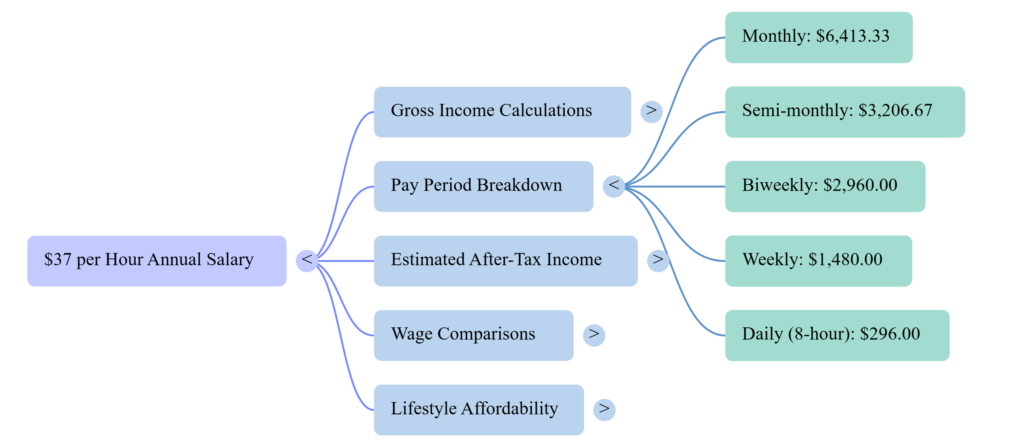
Converting what is 37 an hour annually into every pay period format creates the practical figures needed for household budgeting and paycheck planning.
| Pay Period | Gross Amount |
| Annual | $76,960 |
| Monthly | $6,413.33 |
| Semi-monthly | $3,206.67 |
| Biweekly | $2,960 |
| Weekly | $1,480 |
| Daily (8-hour day) | $296 |
| Hourly | $37.00 |
The biweekly gross of $2,960 is the figure that appears on most paychecks for workers paid every two weeks — it is the starting point before withholding reduces it to the deposited net amount. The monthly gross of $6,413 is the anchor for monthly expense planning and the figure most relevant for evaluating housing affordability, savings capacity, and debt repayment at this income level.
$37 Per Hour Annual Salary Before Taxes — Understanding Gross Income
What is 37 an hour annually before taxes is $76,960 — but understanding what “before taxes” actually means clarifies why the gross figure differs substantially from take-home pay.
Gross income is the total compensation earned before any deductions. It includes every dollar your employer pays you at $37 per hour across your full working hours. From this gross amount, several mandatory withholding items are subtracted before you receive the remainder.
The gross annual salary of $76,960 is what appears on job offer letters, employment contracts, and annual income statements such as your W-2. It is also the figure used for loan applications, rental applications, and income verification — because these assessments use pre-tax income as the standard measure of earning capacity rather than take-home pay.
For 37 per hour annual salary calculations involving overtime, the FLSA-required rate of $55.50 per hour (1.5× $37) for hours above 40 per week significantly increases gross annual income. A worker averaging 5 overtime hours per week produces approximately $76,960 (regular) plus $14,430 (overtime) = $91,390 annually — almost $14,500 more than the standard what is 37 an hour annually calculation without overtime.
Explore more useful salary calculators and online tools in our Digital Productivity category.
$37 an Hour After Taxes — Estimated Take-Home Pay by State
The gap between what is 37 an hour annually in gross terms ($76,960) and the actual take-home amount depends on several withholding components that vary by filing status and state.
Federal income tax for a single filer in 2025 with the standard deduction on $76,960 gross: after applying the $14,600 standard deduction, taxable income is approximately $62,360. Federal income tax on this amount falls across the 10%, 12%, and 22% brackets, producing an estimated federal tax liability of approximately $9,200 to $10,000 annually.
FICA taxes — Social Security at 6.2% and Medicare at 1.45% — apply to gross wages. Combined FICA on $76,960: approximately $5,887 annually.
State income tax varies significantly. Zero-tax states like Texas, Florida, and Nevada add nothing to the withholding stack. Moderate-tax states around 4% to 5% add approximately $3,078 to $3,848. High-tax states add substantially more.
Estimated annual take-home for what is 37 an hour annually:
- No state income tax: approximately $60,873 to $61,673 — roughly $29.27 to $29.65 per hour after taxes
- Moderate-tax state: approximately $57,025 to $57,795 — roughly $27.42 to $27.79 per hour after taxes
- High-tax state (California ~9%): approximately $53,000 to $55,000 — roughly $25.48 to $26.44 per hour after taxes
The same $37 per hour gross produces meaningfully different real financial outcomes depending purely on geographic location — making state selection a significant financial variable for workers with location flexibility.
Does Your State Affect Your Take-Home Pay?
Yes. State and local tax rules can affect how much of your earnings you keep.
Some states do not impose an individual state income tax, while others apply their own tax rates and rules. Local taxes may also apply in certain areas. This means a worker earning $76,960 in one state may have a different net paycheck from someone earning the same amount elsewhere.
Your employer’s benefits and payroll deductions can also affect your final pay. For a more accurate estimate, use current tax information for your location rather than applying one nationwide take-home percentage.
What If You Work Part-Time at $37 an Hour?
You do not need to work 40 hours a week to earn $37 an hour. Your annual income will simply depend on the number of hours you work and the weeks you are paid.
Here are examples using 52 paid weeks:
| Weekly hours | Weekly pay | Annual gross pay |
| 15 | $555 | $28,860 |
| 20 | $740 | $38,480 |
| 25 | $925 | $48,100 |
| 30 | $1,110 | $57,720 |
| 35 | $1,295 | $67,340 |
| 40 | $1,480 | $76,960 |
A part-time worker earning $37 an hour for 20 hours a week would make $38,480 annually if they worked all 52 weeks.
This is useful when comparing flexible jobs. A higher hourly wage does not always mean a higher annual income if the position offers substantially fewer working hours.

How Unpaid Time Off Changes Your Annual Salary
The standard $76,960 estimate assumes 52 weeks of paid work. If you take unpaid leave, your annual earnings decrease.
For example, if you take two unpaid weeks off, you would work 50 weeks:
$37 x 40 x 50 = $74,000
Your gross annual income would be $74,000 instead of $76,960.
Here are a few examples:
| Unpaid weeks off | Paid working weeks | Annual gross pay |
| 0 | 52 | $76,960 |
| 1 | 51 | $75,480 |
| 2 | 50 | $74,000 |
| 3 | 49 | $72,520 |
| 4 | 48 | $71,040 |
Paid holidays and paid vacation generally do not reduce your annual salary when you continue receiving your normal pay. The table assumes the time away is unpaid.
How to Convert $37 Hourly Pay to Annual Salary
The conversion formula behind what is 37 an hour annually is straightforward and applicable to any hourly rate:
Annual salary = Hourly rate × Weekly hours × Weeks per year
$37 × 40 × 52 = $76,960
If you are comparing a salaried job offer with a $37 hourly position, use our Salary to Hourly Calculator to convert the annual offer into an hourly rate.
This formula assumes a standard full-time schedule. Variations from this baseline produce different annual totals — working 35 hours per week produces $67,340 annually at $37 per hour. Working 45 hours per week with overtime at $55.50 for the extra 5 hours produces $83,512.
The formula also works in reverse — dividing an annual salary by 2,080 converts it to an equivalent hourly rate. This reverse calculation is the basis for the “62000 salary to hourly” search: $62,000 ÷ 2,080 = $29.81 per hour. Someone earning $62,000 annually would need a raise to $37 per hour to reach the $76,960 annual income that what is 37 an hour annually produces.
Annual Earnings Comparison: $33 Hourly Pay vs $37 Hourly Pay
Comparing what is 37 an hour annually against the closely related “how much is 33 dollars an hour annually” question illustrates the financial impact of a $4 per hour wage difference.
$33 per hour × 2,080 hours = $68,640 annually. $37 per hour = $76,960 annually. The difference is $8,320 more per year at $37 per hour.
After taxes in a moderate-tax state, this $8,320 gross difference translates to approximately $6,000 to $6,500 more in annual take-home — roughly $500 to $542 more per month in actual spending and saving capacity. Over five years at identical hours, the cumulative gross income difference between $33 and $37 per hour exceeds $41,600.
For workers negotiating between a firm offer at $33 per hour and a counter at $37 per hour, this concrete dollar gap makes the case for pursuing the higher rate clear and quantifiable rather than abstract.
PaycheckCity Payroll and 60k Hourly — Calculating Net Pay Accurately
When workers search for “paycheckcity payroll” and “60k hourly” alongside what is 37 an hour annually, they are typically trying to calculate precise after-tax take-home using online payroll tools.
PaycheckCity and similar payroll calculators produce state-specific net pay estimates by applying the current federal withholding tables, applicable state income tax rates, and FICA calculations simultaneously. For workers in states with local income taxes, these tools also incorporate municipal-level withholding that general estimates like those above cannot capture accurately.
“60k hourly” searches reflect the confusion some users have between annual salary and hourly rate — $60,000 per year is $28.85 per hour, not $60 per hour. At what is 37 an hour annually ($76,960), the wage sits significantly above $60,000 annually, producing approximately $16,960 more in gross annual income than a $60,000 salary at standard hours.
$16 an Hour 40 Hours a Week After Taxes vs $37 an Hour — The Wage Journey
The comparison between $16 an hour 40 hours a week after taxes and what is 37 an hour annually illustrates the transformative financial difference that wage progression produces across a career.
$16 per hour × 2,080 hours = $33,280 annually gross. After taxes in a moderate-tax state, take-home is approximately $27,000 to $29,000 per year — roughly $2,250 to $2,417 per month.
At what is 37 an hour annually ($76,960 gross), after-tax monthly take-home is approximately $4,752 to $5,139 in a moderate-tax state — nearly double the $16 per hour monthly take-home. This comparison contextualises the financial significance of wage growth: moving from $16 to $37 per hour over a career is not merely a raise but a fundamental transformation in financial capacity — the difference between struggling with basic expenses and building genuine wealth.
Is $37 an Hour a Good Salary? — Financial Reality Check
What is $37 an hour annually at $76,960 is unambiguously a good income by US national standards. It exceeds the US median household income and places an individual earner in the upper-middle tier of compensation nationally.
In practical terms, what is 37 an hour annually enables comfortable living across the vast majority of US markets. Monthly gross of $6,413 and take-home of approximately $4,750 to $5,100 in a moderate-tax state supports housing well within the recommended 30% ratio in most cities, genuine retirement savings at 10% to 15% of gross income, emergency fund building, and meaningful discretionary spending.
In high cost-of-living cities — San Francisco, Manhattan, Seattle — $37 per hour provides a comfortable but not extravagant single-person lifestyle. The same income in mid-sized markets like Columbus, Nashville, or Phoenix enables considerably more financial security and savings capacity.
For career planning purposes, $37 per hour represents a meaningful milestone — above the wage level where financial stress is constant for most Americans, and a foundation from which wealth-building becomes genuinely achievable through consistent saving and investment habits. For official federal withholding guidance and accurate net pay calculation on what is 37 an hour annually, the IRS Tax Withholding Estimator provides the official federal tool for calculating precise withholding based on individual filing circumstances.
If you are comparing different hourly rates, you can also see how much $25 an hour is annually to understand the difference in yearly earnings.
Conclusion
What is 37 an hour annually resolves to $76,960 gross — $6,413 monthly, $2,960 biweekly, and $1,480 weekly before taxes. After federal income tax, FICA, and state income tax, realistic take-home ranges from approximately $53,000 to $61,500 annually depending on your state — representing $27 to $30 effective per hour in real spending power. Compared to $33 per hour, the $37 per hour rate produces $8,320 more annually — a meaningful difference that compounds significantly over a career.
Whether you are evaluating a job offer at this rate, negotiating upward from $33 per hour, or simply understanding what your current compensation means in annual and monthly terms, this complete guide to what is 37 an hour annually gives you every figure needed for confident, informed financial decision-making.
Frequently Asked Questions
What is 37 an hour annually in gross terms?
$37 × 2,080 hours = $76,960 per year gross before taxes at a standard 40-hour week, 52-week year.
How much is $37 an hour per month?
$76,960 ÷ 12 = $6,413.33 gross per month before taxes. After taxes in a moderate-tax state, approximately $4,750 to $5,100 monthly take-home.
How much is $37 an hour biweekly?
$37 × 80 hours = $2,960 gross per biweekly paycheck before taxes.
What is $37 an hour after taxes in a no-tax state?
In zero-income-tax states like Texas or Florida, estimated annual take-home is approximately $60,873 to $61,673 — roughly $29.27 to $29.65 effective per hour after taxes.
How does $37 an hour compare to $33 an hour annually?
$33/hr = $68,640/yr. $37/hr = $76,960/yr. The $4 per hour difference produces $8,320 more per year gross — approximately $500 to $542 more per month after taxes in a moderate-tax state.
Is $37 an hour considered a good wage?
Yes — what is 37 an hour annually at $76,960 exceeds US median household income and represents upper-middle individual compensation nationally. It supports comfortable living in most US markets and genuine wealth-building capacity with disciplined saving habits.