Nevada Paycheck Calculator: Estimate Your Take-Home Pay

Knowing how much of your paycheck you will actually receive makes it easier to plan your budget, compare job offers, and manage everyday expenses. A Nevada paycheck calculator helps estimate your take-home pay after federal income tax, Social Security, Medicare, and applicable payroll deductions.
Nevada has no state individual income tax on wages and salaries, which means employees generally do not have Nevada state income tax withheld from their paychecks. However, federal income tax and payroll taxes can still reduce your earnings. Your final paycheck also depends on your salary, filing status, pay frequency, benefit contributions, and withholding elections.
This guide explains how to estimate your Nevada paycheck, understand common deductions, compare pay periods, and account for overtime and other earnings. The examples are illustrative rather than personalized tax calculations, so use your actual payroll details for a more reliable estimate.
Table of contents
- How to Use a Nevada Paycheck Calculator ?
- Does Nevada Have State Income Tax?
- Nevada Paycheck Tax Breakdown
- Gross Pay vs. Net Pay in Nevada
- Hourly vs. Salary Paycheck Calculations
- Weekly, Biweekly, Semimonthly, and Monthly Paychecks
- Overtime Pay in Nevada
- Factors That Affect Your Nevada Take-Home Pay
- How to Make Your Paycheck Estimate More Accurate
- Conclusion
How to Use a Nevada Paycheck Calculator?
A paycheck calculator typically asks for several details about your employment and tax situation. The more accurate your inputs are, the more useful the estimate will be.
Start with these details:
- Gross pay: Enter your hourly wage or annual salary before deductions.
- Pay frequency: Select weekly, biweekly, semimonthly, or monthly, depending on how your employer pays you.
- Federal filing status: Use the status that applies to your federal tax situation.
- W-4 information: Include relevant withholding details, such as dependents or additional withholding.
- Pre-tax deductions: Enter eligible retirement contributions, health insurance premiums, or other applicable deductions.
- Additional earnings: Include overtime, bonuses, commissions, or other compensation when relevant.
The calculator uses these inputs to estimate gross earnings, applicable taxes, and deductions. The result is an estimated net paycheck, not a guarantee of the exact amount your employer will deposit.
For example, an employee earning $60,000 annually has gross pay of $5,000 per month before deductions. Their actual monthly take-home pay will be lower after applicable federal taxes, FICA, and any employee-paid benefits or other deductions.
Does Nevada Have State Income Tax?
No. Nevada does not impose an individual state income tax on wages and salaries. According to the Nevada Department of Taxation, individuals do not pay Nevada state income tax on compensation such as salaries and wages.
Nevada residents may still pay federal income tax, Social Security tax, Medicare tax, and other applicable taxes. They may also pay sales tax, property tax, or other taxes unrelated to the income tax withheld from a regular paycheck.
Nevada Paycheck Tax Breakdown
Understanding each deduction helps you interpret your paycheck and identify why your net pay differs from your gross earnings.
Federal Income Tax
Federal income tax is generally withheld from employee wages throughout the year. The amount depends on factors including taxable wages, filing status, applicable deductions, and the information provided on Form W-4. An nv paycheck calculator can help estimate how much federal income tax may be withheld from each paycheck based on these details.
The United States uses a progressive federal income tax system. Different portions of taxable income can fall into different tax brackets; reaching a higher bracket does not mean all your income is taxed at that higher rate.
For tax year 2026, federal tax brackets and standard deduction amounts are updated under federal law. The IRS lists the 2026 standard deduction as $16,100 for single filers and married individuals filing separately, $24,150 for heads of household, and $32,200 for married couples filing jointly, subject to the applicable rules. A nevada pay calculator uses these federal figures as part of estimating take-home pay for Nevada employees.
If you want to compare state-specific paycheck rules, read our Colorado Paycheck Calculator guide to learn how taxes may affect take-home pay in another state.
These amounts are relevant to federal income tax calculations, but a paycheck calculator does not simply subtract a standard deduction from each paycheck. Payroll withholding follows IRS methods and uses information such as pay-period wages and Form W-4 elections.
If you live in Nevada but work for an employer in another state, or if you work remotely across state lines, your circumstances may require additional review. State tax treatment can depend on residency, where the work is performed, and the rules of the other state. Do not assume every cross-border employment arrangement follows the same rules.
Your employer’s withholding is also not necessarily identical to your final annual tax liability. When you file your federal tax return, the amount you owe or receive as a refund depends on your full-year income, deductions, credits, and payments.
Social Security Tax
Social Security tax is part of FICA, the Federal Insurance Contributions Act payroll tax. For 2026, the employee Social Security tax rate is generally 6.2% of covered wages up to the annual Social Security wage base of $184,500.
For example, if an employee earns $1,000 in wages subject to Social Security tax and has not reached the annual wage limit, the employee share would generally be $62. This is an illustration of the rate, not a complete paycheck calculation.
Once covered wages exceed the annual wage base, Social Security tax generally no longer applies to additional wages for that calendar year. The wage base is updated periodically, so use the current IRS figure when estimating a particular year’s paycheck.
Medicare Tax
Medicare tax is also part of FICA. The standard employee rate is generally 1.45% of Medicare wages, with no annual wage cap for this basic tax. An employee earning $1,000 in Medicare wages would generally have $14.50 withheld for the employee share of Medicare tax.
Some higher earners are subject to Additional Medicare Tax. Employers generally begin withholding this additional 0.9% when an employee’s Medicare wages exceed $200,000 during the calendar year. The threshold used to determine an individual’s final liability depends on filing status, so employer withholding and final tax liability may not match exactly.
Social Security and Medicare rules are federal rules. Nevada’s lack of an individual income tax does not remove these payroll tax obligations.
Other Payroll Deductions
Your employer may deduct amounts for benefits or other authorized purposes. Common examples include:
- Traditional 401(k) retirement contributions
- Employee health, dental, or vision insurance premiums
- Health savings account contributions, when eligible
- Certain flexible spending account contributions
- Other authorized deductions permitted by applicable law
The tax treatment varies by deduction. Some eligible contributions reduce wages used for federal income tax withholding, while others may have different treatment for Social Security or Medicare taxes. A Roth 401(k) contribution, for example, is generally made after federal income tax withholding calculations rather than reducing federal taxable wages in the same way as a traditional 401(k) contribution.
Review your employer’s benefits information and pay statement rather than assuming every deduction receives identical tax treatment.
Gross Pay vs. Net Pay in Nevada
Gross pay is the amount you earn before taxes and deductions. Net pay, often called take-home pay, is the amount remaining after applicable withholding and deductions. Explore our Digital Productivity category for more useful guides and calculators that help simplify everyday work and financial tasks.
The basic relationship is:
Net pay = Gross pay − taxes withheld − other deductions
This is a simplified formula. Actual payroll systems may apply tax rules and deduction ordering in more detailed ways.
Consider an employee with a $60,000 annual salary paid monthly. Their gross monthly pay is $5,000 before deductions. Their take-home pay will be lower after federal income tax withholding, Social Security, Medicare, and any applicable benefit contributions or other deductions.
Two employees earning the same salary in Nevada may receive different net pay. One may have additional federal withholding, higher health insurance premiums, or larger retirement contributions. Another may have different W-4 elections or a different pay schedule. For that reason, gross salary alone cannot determine an exact paycheck amount.
Hourly vs. Salary Paycheck Calculations
A Nevada paycheck calculator can help hourly and salaried employees estimate earnings, but they should enter their pay information differently.
Hourly Employees
Hourly workers generally calculate gross pay by multiplying their hourly rate by the number of hours worked during the pay period. For example, an employee earning $20 per hour who works 40 hours has $800 in regular gross pay for that week, before deductions and any additional earnings.
If the employee works different hours each week, their paycheck may change from one pay period to another. Overtime eligibility and pay should also be considered when applicable.
Salaried Employees
A salaried employee is a person who receives a fixed amount of pay on a monthly or yearly basis, regardless of how many hours they work. Their overtime is not counted, and they receive paid leave and benefits.
Salaried employees generally receive a stated annual salary. To estimate gross pay per period, divide annual salary by the number of pay periods in the year. You can also use a Nevada salary calculator to quickly estimate your gross pay, take-home salary, and deductions based on your annual salary and pay schedule.
To convert an annual salary into an estimated hourly rate, use our Salary to Hourly Calculator.
For a $60,000 annual salary:
| Pay schedule | Gross pay before deductions |
| Weekly, 52 pay periods | $1,153.85 |
| Biweekly, 26 pay periods | $2,307.69 |
| Semimonthly, 24 pay periods | $2,500.00 |
| Monthly, 12 pay periods | $5,000.00 |
| Annual | $60,000.00 |
These figures show gross pay only. They do not represent estimated take-home pay after taxes.
Weekly, Biweekly, Semimonthly, and Monthly Paychecks
Your pay schedule affects the size and frequency of each paycheck, but it does not by itself determine your annual salary or total annual tax liability.
- Weekly: Employees receive 52 regular weekly paychecks in a typical year.
- Biweekly: Employees are usually paid every two weeks, often resulting in 26 paychecks.
- Semimonthly: Employees are generally paid twice a month, resulting in 24 paychecks.
- Monthly: Employees receive 12 paychecks per year.
Biweekly and semimonthly pay are not the same. A biweekly schedule follows a two-week cycle, while semimonthly pay typically occurs on two set dates each month.
When comparing paycheck estimates, use the same annual salary and withholding assumptions. A monthly paycheck will normally be larger than a biweekly paycheck for the same salary, but that does not mean the employee earns more over the year.
For another example of how hourly wages translate into annual earnings, read our guide on how much $25 an hour is annually.
Overtime Pay in Nevada
Overtime can increase gross earnings, but the rules are more detailed than simply multiplying every hour over 40 by 1.5.
Nevada has state overtime provisions that may require eligible employees to receive overtime pay for working more than eight hours in a 24-hour period or more than 40 hours in a workweek, depending on the employee’s wage rate and applicable exemptions. Certain employees and work arrangements are exempt, and special rules may apply.
Nevada has state overtime provisions that may require eligible employees to receive overtime pay for working more than eight hours in a 24-hour period or more than 40 hours in a workweek, depending on the employee’s wage rate and applicable exemptions. Certain employees and work arrangements are exempt, and special rules may apply.
Federal overtime rules under the Fair Labor Standards Act can also be relevant. Whether an employee qualifies depends on the nature of the work, pay arrangements, and applicable legal requirements—not just whether the employee is paid hourly or receives a salary.
For an eligible employee whose regular rate is $20 per hour, an overtime rate of 1.5 times that rate would be $30 per hour. If the employee qualifies for five overtime hours at that rate, those hours would represent $150 in gross overtime pay before applicable withholding. To estimate how overtime, regular wages, and deductions affect your total paycheck, you can use a salary calculator Nevada before reviewing your final pay details.
Do not assume that every salaried employee is exempt from overtime or that every worker automatically qualifies for daily overtime. Check current Nevada Labor Commissioner guidance and applicable federal rules for your circumstances.
Factors That Affect Your Nevada Take-Home Pay
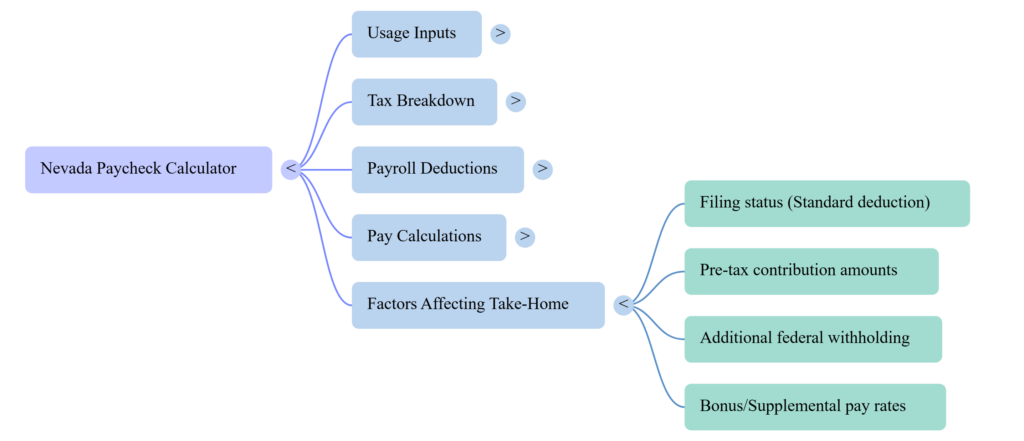
Several factors can cause your paycheck to differ from someone else’s, even when both employees have the same gross salary.
1. Federal filing status: Your filing status affects federal income tax calculations and the standard deduction applicable to your annual return.
2. Form W-4 elections: Your withholding instructions, including additional withholding, can change how much federal income tax your employer deducts.
3. Retirement contributions: Eligible retirement contributions can reduce the amount available in your paycheck. Their tax treatment depends on the type of plan and contribution.
4. Health insurance and benefits: Employee-paid premiums and other benefit deductions can reduce net pay.
5. Overtime, bonuses, and commissions: Additional compensation can change gross pay and withholding for a particular pay period. Supplemental wage withholding methods may differ from regular wage withholding.
6. Social Security wage base: Once your covered wages reach the annual Social Security limit, the Social Security portion of withholding generally changes for the remainder of that calendar year.
7. Employment and residency circumstances: Working across state lines or having more than one job can introduce additional tax considerations.
A useful estimate requires accurate inputs and an understanding of which deductions apply to your specific circumstances.
How to Make Your Paycheck Estimate More Accurate
For a more useful estimate, start with your latest pay stub or employer payroll information. Confirm your gross wages, pay frequency, year-to-date earnings, benefit deductions, and federal withholding elections.
Use the correct tax year when entering tax information. Tax brackets, standard deductions, and Social Security wage limits can change, so an older calculator may produce outdated results.
If you have multiple jobs, irregular hours, commissions, bonuses, or substantial pre-tax benefits, make sure the calculator can represent those details. If it cannot, treat its output as a starting estimate rather than a precise forecast.
Compare the calculator’s result with an actual pay statement. If there is a significant difference, review the inputs and ask your payroll department about unfamiliar deductions. For questions about your final federal tax liability, consult current IRS guidance or a qualified tax professional.
A paycheck calculator is most useful when it helps you understand the relationship between earnings and deductions. It should not replace professional tax advice for complex circumstances.
Conclusion
A Nevada paycheck calculator can help you estimate take-home pay by accounting for gross earnings, federal income tax withholding, Social Security, Medicare, and applicable payroll deductions. Nevada’s lack of an individual state income tax simplifies one part of the calculation, but it does not eliminate federal taxes or employee benefit deductions.
Whether you earn an hourly wage or an annual salary, use the correct pay schedule, current tax-year information, and realistic withholding assumptions. Review your actual pay stub when available and verify unusual deductions with your employer. The result is a more informed estimate for budgeting, evaluating job offers, and planning your finances—without confusing gross earnings with the money you actually receive.
Frequently Asked Questions
Does Nevada have state income tax on wages?
No. Nevada does not impose an individual state income tax on wages and salaries. Employees may still owe federal income tax and applicable payroll taxes.
What taxes are taken out of a Nevada paycheck?
Common required federal deductions include federal income tax withholding, Social Security tax, and Medicare tax. Other deductions may include benefit premiums, retirement contributions, or other authorized items.
How much tax will I pay on a $60,000 salary in Nevada?
The exact amount depends on filing status, federal withholding elections, eligible deductions, credits, benefit contributions, and other circumstances. A $60,000 salary equals $5,000 per month in gross pay when divided across 12 monthly pay periods, but that is not the take-home amount.
Is biweekly pay the same as semimonthly pay?
No. Biweekly pay generally occurs every two weeks, resulting in 26 paychecks in a typical year. Semimonthly pay usually occurs twice a month, resulting in 24 paychecks.
Does Nevada require overtime pay?
Nevada overtime rules may require eligible employees to receive overtime for qualifying daily or weekly hours, depending on wage rate and applicable exemptions. Check current state and federal rules before determining eligibility.
Can a paycheck calculator give an exact take-home amount?
A calculator provides an estimate based on the information entered and the rules it applies. Actual pay can differ because of payroll settings, withholding elections, benefits, additional compensation, and other circumstances.
Does a 401(k) contribution reduce take-home pay?
Yes. A contribution reduces the cash included in your paycheck. Traditional and Roth contributions can receive different tax treatment, so the effect on taxable wages depends on the contribution type and applicable rules.
Why is my paycheck different from my coworker’s?
Differences can result from filing status, W-4 elections, insurance premiums, retirement contributions, pay frequency, overtime, bonuses, or other deductions—even when gross salaries are similar.